



Wrongly accused of making you gain weight, cheese is above all a living product with multiple health benefits. Which one beats all the records in terms of fat?
Cheese is often accused of being too fatty and making you gain weight. But reducing cheese to its simple lipid content would be a mistake, as its high-quality fats and its richness in proteins and probiotics hide real benefits for our health. “In a country which has more than 1,200 varieties, it would be a real shame to deprive ourselves of such a jewel of our heritage.“, deplores nutritionist Nina Voit. Interviewed by the Journal des Femmes, this food expert reveals to us the right way to enjoy it and how to make informed choices at the cheesemonger.
To know if one cheese weighs more than another in terms of calories, you have to look at its composition. The calculation is purely mathematical: “One gram of carbohydrates is 4 calories, one gram of protein is 4 calories, but one gram of fat is 9 calories.Nina Voit reminds us. Logically, a high-calorie cheese is a fatty cheese. You also need to look at its humidity level. “Imagine a sponge: the more it dries, the more it shrinks, but its material remains there, ultra-concentrated“. This is the case for hard cheeses or blue-veined cheeses. By losing their water during ripening, they concentrate their nutrients… and their fats.
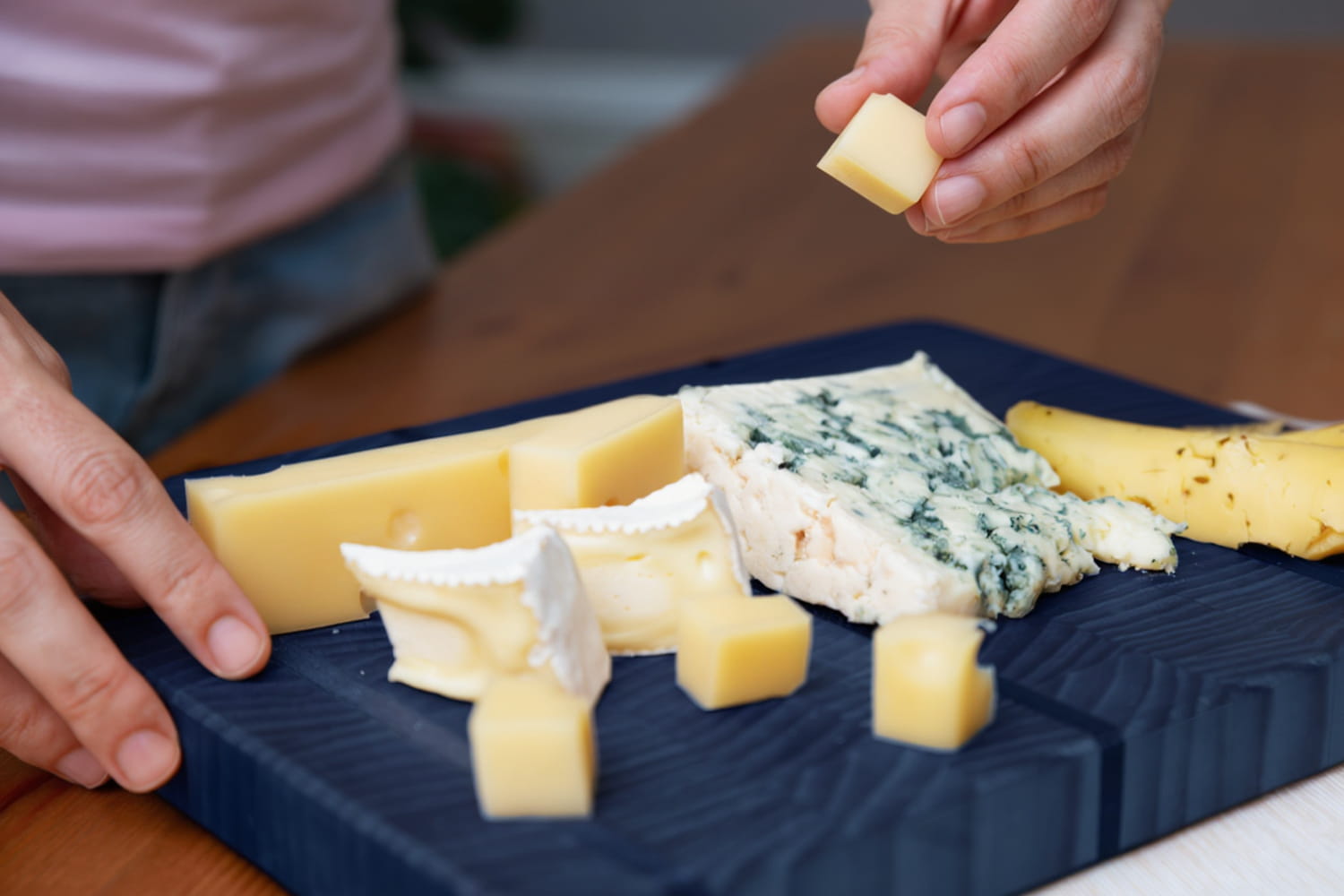
By applying this rule, the absolute champion of fat on our platters is none other than Roquefort, the famous blue-veined cheese from Aveyron. Unlike cow’s cheeses, it is made exclusively from sheep’s milk, a milk naturally much richer in lipids. Combine this ultra-generous raw material with maturing in natural cellars which eliminates a large part of the water, and you obtain a record: Roquefort displays around 35 g of pure fat per 100 g (or around 52% fat on dry extract). Just behind, we find its cousins the Bleus (like the Bleu d’Auvergne) and the very old hard cheeses (Comté “Vieux” or “Grand Cru”, Cantal Vieux or Mimolette Extra-Vieille).
However, the fact that cheese is a rich food should not hold you back: it’s all a question of strategy. Rather than banishing it from your diet, you just need to learn to trick your biological clock to enjoy it without storing it. To benefit from these good lipids, everything is a question of timing. “The ideal time to consume your daily portion (around 30 grams) is in the morning or midday, as its richness provides lasting energy for the day“, continues the nutritionist. On the other hand, it is better to avoid it in the evening. So after 7 p.m., we don’t touch it anymore!
The fat in cheese puts a lot of work on the gallbladder and requires 3 to 4 hours of digestion, which disrupts sleep. Even worse for your figure: at night, the fat from the cheese travels into the lymph. As we do not move, this lymph stagnates. “In the morning, we will wake up and we will have water retention. We step on the scale and say to ourselves “My God, I gained 800 grams!”. But we didn’t gain 800 grams of fat, we retained 800 grams of water“, reveals Nina Voit. It is therefore not only the fat or the calories that make you gain weight, but the moment when you consume them.
Thanks to Nina Voit, holistic therapist, food coach, author and creator of “Common Sense on My Plate®”. Exclusive interview.