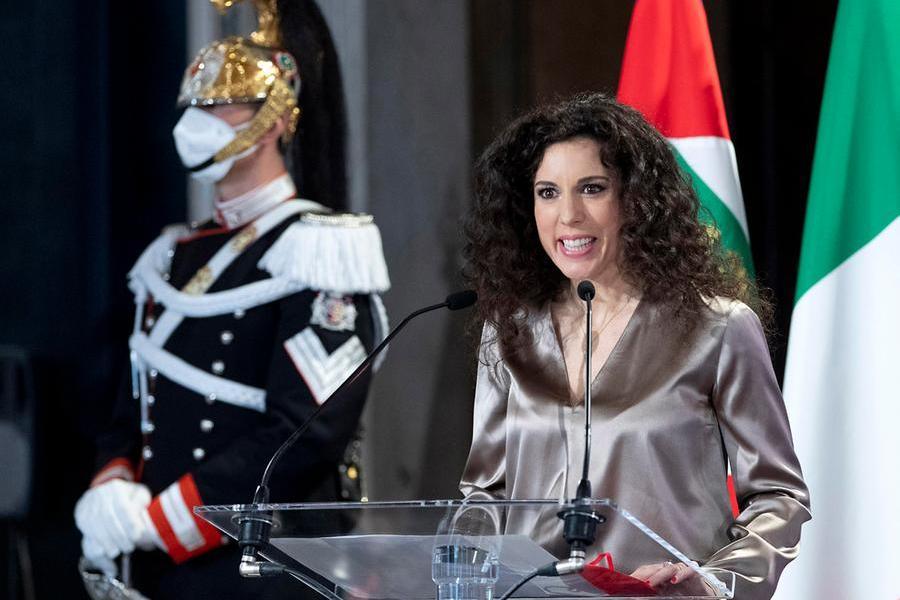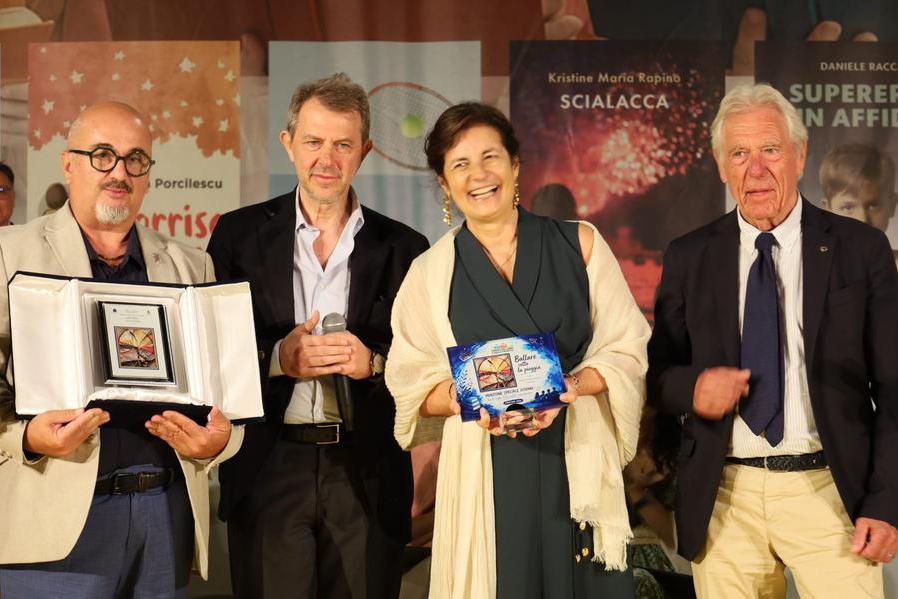
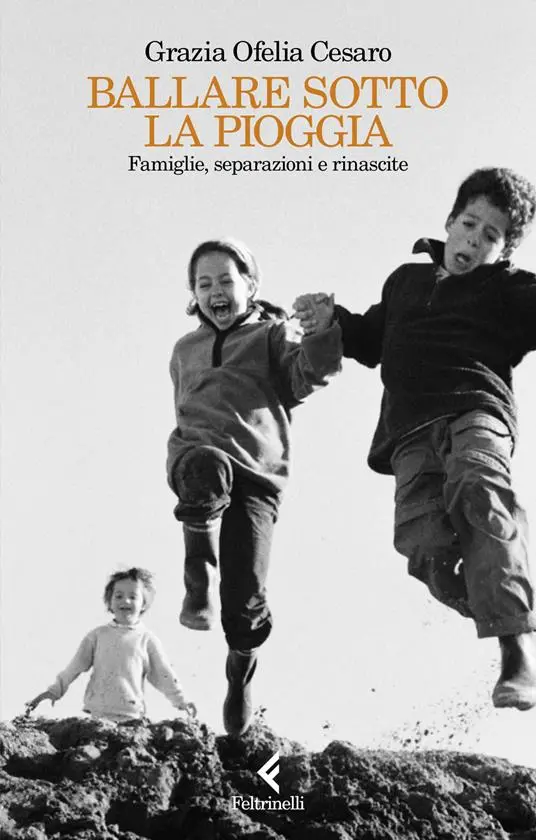
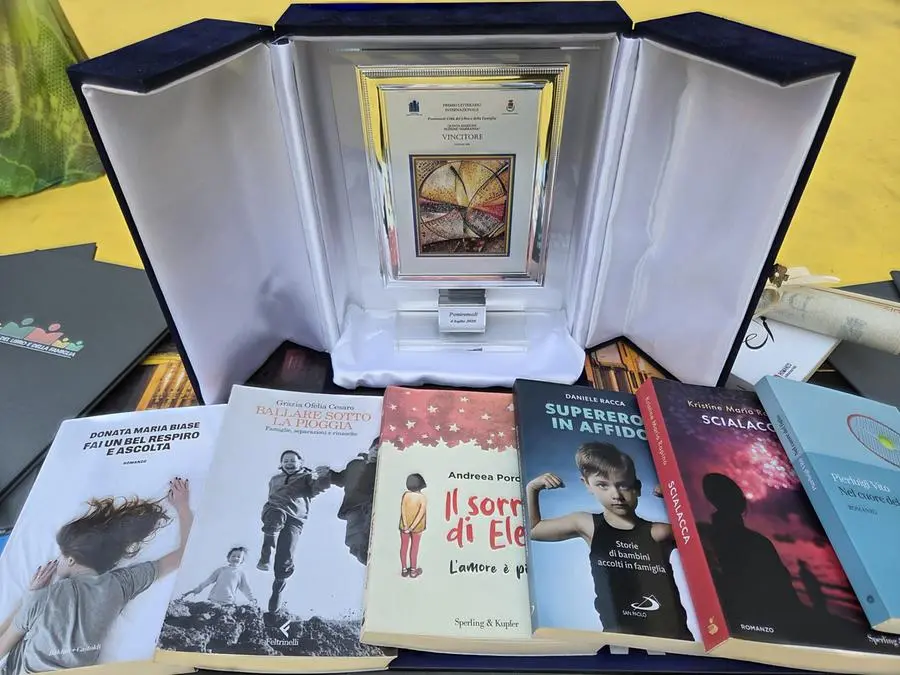
When we reach her by phone she has just returned from two days at the Higher School of the Judiciary where she held a lesson on international family law. «I was struck by seeing two magistrates finally approach me with my book in hand to ask me for an autograph, I thought, two distant worlds coming together». Why Grazia Ofelia Cesaro, last Saturday 4 July, he won the fifth edition of the Pontremoli Città del Libro e della Famiglia Award with his autobiographical novel – and partly essay – Dancing in the rain, published by Feltrinelli. A poignant and enlightening book on “families, separations and rebirths” as the subtitle states where he narrates the particular story of his family, making it, however, a universal tale, a heritage of humanity. But Cesaro is first and foremost a lawyer with over 30 years of experience in family and juvenile law, national and international. Former president of the National Union of Juvenile Chambers, he participated in the working tables of the Ministry of Justice for the recent reforms on the juvenile family trial.

She learned early to dance in the rain…
«It was a phrase that our mother always said to me and my two brothers. “Life isn’t about waiting for the storm to pass, it’s about learning to dance in the rain.” She was joking about this sentence. We discovered as adults that our life followed her in an almost unconscious way. In the book I tell the story of my parents’ separation in the Seventies. In fact, at a certain point when our mother passed away, we found ourselves alone and we tried, under the storm, to learn to move dance steps that would go towards the future and not leave us bogged down in the situation we were in.”
Demonstrating that parents’ sentences often build our future, for better or for worse.
«Connecting the story to this title allowed me to reconnect with the profound meaning of what my mother wanted to tell me. This is why the phrases we say to our children are so important. Phrases that remain and that I thought about one night while I was looking for the right title.”
A phrase that I knew and appreciated with dad Cecchettin.
«Gino Cecchettin, Giulia’s father, teaches us every day to dance in the rain. It is a virtuous example of how he managed to transform an unspeakable loss into an educational message, a message that will tend to change the values of society.”
She experiences a separation in the seventies when separation did not yet exist.
«It was a new event for those years. I always remember that the divorce law dates back to 1970 and then there was, almost immediately, the failed attempt at a repeal referendum. Society was clearly divided on whether the family could somehow dissolve and rebuild itself according to other models. I was the only separated child in my school, there was no separation education for parents. We acted, period. My mother had decided to leave and so for us children, who were still young, limited financial support from my father was not foreseen, because the separation was his choice. A situation in which today the court would intervene immediately so that the children maintain the same standard of living, but not then and we found ourselves living in great hardship.”
A lot of things have changed in 50 years.
«Parents’ communications with their children regarding separation, communication between parents, the protection that the parent who has custody of the children must have with respect to the figure of the other parent. A thought that is scientific, but also legislative and has led to the creation of intervention and protection tools. At the time there was action, that was a wound from which blood should only flow. There was no thought of mending. Today we know that parents can jointly address the issue of separation, how to communicate it to their children and find the best agreements. Today family mediation exists and in cases of heated conflict lawyers can be appointed who are special guardians to protect the interests of the minors involved. We have experts in evolutionary psychology who accompany the children on these paths, there are speaking groups for the children of separated people, for separated parents. In short, we’ve come a long way.”

On this wound he has built a professional career of the highest level.
«I admit that there was a phase in which I even thought about changing completely because, at the time of my degree with honors in Law, I received a telegram from Rai to take part in the competition and join the legal office, I wasn’t interested in that role. However, I attempted the competition for journalist in Rai, but I didn’t pass. Another thing that intrigued me a lot was access to the specialty of Medicine in clinical criminology which, at the time, was also allowed to one or two jurists. Three years of specialization in Clinical Criminology made me passionate about the psychological study, more criminal-oriented, but also with civil expertise, on the effects of major “family pathologies” on the raising of children. So, when I also specialized in clinical criminology, I immediately began to defend minors, because in the meantime a law had established that to defend minors who had committed crimes, you also had to have specific training that was no longer just legal and which I magically had.”
And then there was her experience as a child of separated parents.
«I have always considered it an indispensable background, but I have always preferred scientific in-depth analysis, so much so that I immediately began to train colleagues too. Now that I have written the book, many colleagues who have heard me speak at many conferences on family law and psychology have said to me “but how is it possible that you have never talked about your story?”. Because I didn’t want to talk about “my” story, I didn’t want to personalize it. When my brothers and I saw that it was starting to look like a book, we understood that the real strength was not our story, but the story of those three boys. I saw the fathers, mothers and children that I have met for years through work.”
The book was born from a scientific need and perhaps that is also why it is so moving and, at the same time, useful. Were your family members happy with the result?
“We are all reserved by nature, we were certainly worried about oversharing, but now I would say the fear is over, we are happy, even the grandchildren who didn’t know so much about our history.”

Separations after 50 years have become daily… Why is family mediation so important?
«In situations of heated conflict, the indication is to help separating parents with mediation or family and/or individual therapy, depending on the case. We lawyers also always try to find agreements. Today there are mediation information desks even in our courts where we, by ethical obligation, must send the parties even before starting legal disputes. This is a space in which parents learn the alphabet of “talking to each other”, so after the big fire they find a place not to continue adding fuel to the fire, but to cool their hearts and begin to think, putting the good of their children at the center.”
A revolutionary aspect of the book is the reversal of the point of view on his father from which we understand how decisive the work of the court and the operators is to restore the right role to parents.
«This is a decisive aspect of the book: entering into the suffering of a specific family to understand dynamics that are universal. Presenting it around Italy I found separated mothers who told me “I identified with the father”. It means it was worth publishing. This is one of the great objectives of family mediation: teaching spouses to put themselves in the other’s shoes.”
And then there are those details of real life that take on an extraordinary strength and speak to the experience of each of us. That phone that rings – your dad’s calls, after your mum passed away – that you will never answer, but which make you feel good.
«Back in the day when there was still a telephone placed there with the rotary knob on the bedside table in the living room or hanging on the wall. Today there are cell phones that kids constantly look at waiting for that call even if they never answer. It is that attempt that children always expect from their parents, regardless of whether they want to accept it or not.”
Children who are the true strength of the family today and then.
«The family lives on a dizzying roller coaster, but today as then it is saved by the boys. And that is the objective of the book: to show how the kids ultimately save the family system even before the final reconciliation, because they create a family of their own and they do it with principles that are based on listening, community, the ability to ask for help. Of great naivety, but also of great genuineness. There are many situations in which children are seen as victims, while it is very difficult to see them as a great resource and also as someone who can teach you things.”
He said “ask for help”: this is the other great message of the book.
«Psychologists often recall an African proverb: it takes a village to raise a child. In the book, an entire world emerges that helped those three boys. From the juvenile court, to social services, to lawyers, to the school, to neighbors, to parents of friends. Even today, the tools for the protection of minors, let us call them institutional, are decisive and it is important to enhance their role, but let’s not forget that there is also the role of the community. When we take care of a child or young person who is not ours, even with small gestures, as in the book, we remember that child protection is a responsibility that belongs to everyone.
What did it mean for you to receive an award for your family as the first prize? «It was a source of great pride and happiness. Doubly so because it was also successful among the youth jury. When we three brothers decided to publish the book we thought that it would also be useful to other teenagers and children in difficult family situations. That the first prize comes to me precisely with this focus on families and that the kids, in addition to the technical jury, recognize the relevance to the theme and feel truly represented in their creative power in these situations, for me, beyond anything that may come, responds precisely to what was our initial idea. Beautiful, I can’t help but be happy.”
THE MOTIVATION OF THE AWARDS
The sixth motivation:
The cracks of affection become the space in which to rediscover the value of responsibility, listening and mutual care. With intense and measured writing, Dancing in the Rain accompanies the reader into the complexity of family relationships, showing how every fracture can hold the seed of a rebirth.
The motivation of young people:
For having told with truth and sensitivity the pain of family separations through the eyes of those who experience them most closely, without ever losing faith in the possibility of starting over. A novel that accompanies young people in their fragility, showing that even in the rain you can learn to dance, transforming wounds into strength and suffering into hope.