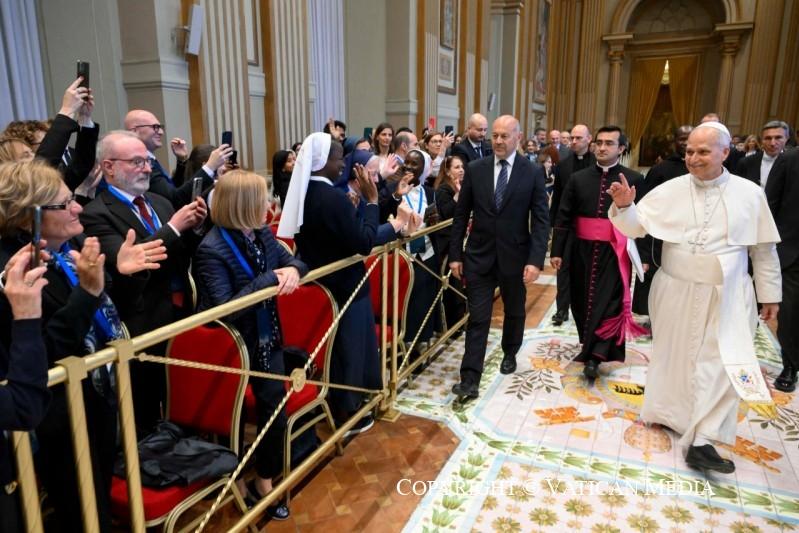





«Yours is a delicate commitment» began Leone, addressing CEI employees this morning, «the importance of which is underlined in the Preamble of the CEI Statute: “The Italian Episcopal Conference – we read – (…) it is an authentic and authoritative sign of communion of the particular Churches in Italy; constitutes a legitimate and qualified representation of the people of God living in the country; promotes the concerted action of the Italian Episcopate, in special harmony with the Successor of Peter, Bishop of Rome and Primate of Italy” (Statute of the Italian Episcopal Conference, Preamble, 3)”.
A special thank you therefore, «for what you do, at all levels, from the best known to the most hidden and everyday ones. And here I would like to remind you how important it is, for every institution, each person’s loyalty to their taskto the most ordinary commitments: a practice followed carefully, a well-prepared meeting, the patience of a moment of prolonged listening, the dedication in responding to a request, the order and care of the rooms themselves. They are simple things, but useful for the good of all and great before God. In the life of the Church nothing is small if done with faith, with love and with a spirit of communion.”
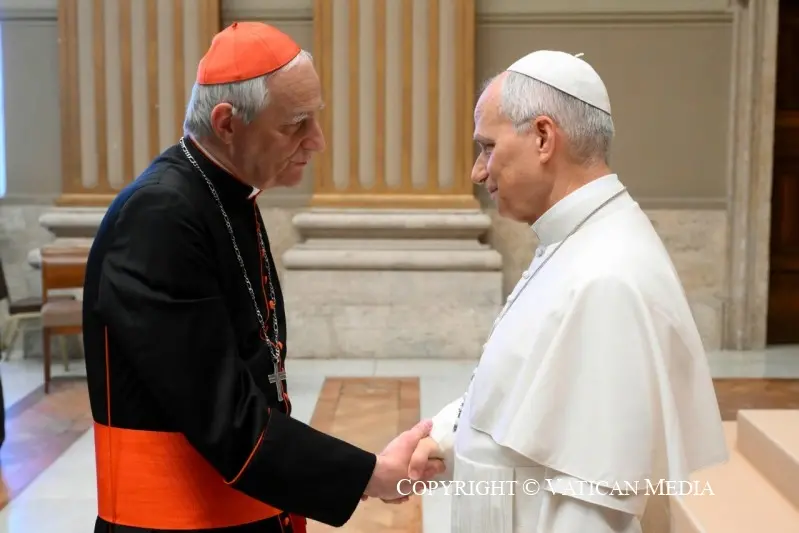
Leone with Cardinal Matteo Zuppi, president of the CEI
(Vatican Media)
In light of all this, he chose to focus on some aspects of their commitment that he considers particularly important: «First of all, its nature of service. The various offices in which you operate are not structures in themselves, but instruments with which you help the Bishops and Churches in Italy, so that the threads of communion are firmly established and the fabric of the ecclesial fabric is compact, rich in the Gospel and fruitful with gestures of proximity. It is a task of great responsibility: yours, in fact, is a “service to service”, a work that supports other work, a commitment that makes the contribution of many possible, a collaboration that helps local Churches to announce the Good News, to walk together and to be a living presence of the Lord, in this country and in the world. What you do – even the most technical, administrative or organizational activities – it is part of the mission of the whole great family of God. In the Church, in fact, serving is not simply carrying out a function, but actively participating, as members, in the life of a body whose head is the Lord. The centre, therefore, is never us, our offices, our programmes, but it is Him, and every activity finds meaning when it helps, even in a humble and hidden way, to meet and unite with Him”.
And again, «Belonging. The Bride of Christ, in fact, cannot be served by spectators, but only with the love of those who know they belong to her, in a bond of faith and communion which is first of all a gift of grace, a gift of God. I therefore invite you to live your daily occupations immersed in a mystery, in a history and in a project that precedes and surpasses you (see Francis, Apostolic Exhortation Evangelii gaudium, 111). The places in which you carry out your daily tasks are the first space in which you are called to let the Gospel take shape, promoting unity and peace, with patience and humility, in mutual care and custody. And this awareness must shape your way of perceiving yourself, of speaking, of listening, of correcting, of supporting, permeating the work environments and determining true evangelical lifestyles.”
Finally, a final reflection: «because service and belonging are inseparable from a third fundamental dimension of the life of the people of God: mission. The Church exists to proclaim Christ, building bridges, establishing bonds, offering welcome and help to anyone who needs support, listening, love, and you participate in this mandate.”
And he concluded: «We live in an era of profound changes, in the family, in school, in work, in communication, in social participation, in the transmission of faith, even in Italy. In this context, the Lord asks us not to close ourselves in and not to be afraid, but rather to spend ourselves generously so that the Gospel can reach and enlighten every woman and every man today too, with their efforts, questions and hopes (see Second Vatican Council, Past. Constitution Gaudium et spes, 1), so that all “may be saved and come to the knowledge of the truth” (1 Tim 2:4).