
Former notary turned heritage mediator, Caroline Maurel knows better than anyone the unsaid things that undermine French families around money and inheritance.
In this interview, she explains why the family financial taboo actually hides a much deeper fear, how to help women regain their place in property decisions, and what golden rules can be used to approach transmission without triggering conflict. His conviction? Silence never protects family harmony, it only postpones it. Interview.
In France, money remains a deeply taboo subject in the family. Where do you think this cultural difficulty in talking about inheritance and transmission comes from?
Caroline Maurel: The taboo comes from the confusion between money and love.
In the family, talking about inheritance is implicitly talking about the death of a parent, about supposed preferences between children, and about the value we place on each one. In France, there is also a cultural heritage and a certain modesty around money. This is not the case in Anglo-Saxon countries: there, we openly discuss our will as a family. For us, not talking about it is seen as a mark of modesty, even respect.
I remember a mediation where one of the children told us: “ We never talked about money in our house, it was like talking about dad’s death at the dinner table. “. This sentence sums it all up: the subject of heritage is inseparable from the anguish of the disappearance of a parent, and we often prefer to avoid it than confront it.
In a relationship, this taboo is also present. Talking about money between spouses already means talking about love, trust, respect, commitment, and the place that each gives to the other in joint decisions. Many couples have never discussed their marital regime. Some people discover late the consequences of a choice made by default at the time of marriage. Not talking about it is not neutral: it is often a way of avoiding saying deeper things about what we expect from each other.
In family as in couple, this silence rarely protects : it shifts the conflict in time, to a moment when emotions are most acute (divorce or death) and when it becomes more difficult to calmly clarify everyone’s intentions.
In some families, women stay away from property discussions. How can we help women – wives, daughters, mothers – to take their place in family financial decisions?
Caroline Maurel: This is a subject that we see very concretely and very frequently in mediation. Often, women (wives or daughters) have historically delegated asset management to a father, husband, or older brother. Sometimes by choice, often by habit passed down from generation to generation.
We met a sixty-year-old woman who discovered, during mediation, the existence of a family life insurance contract of which she knew nothing. His two brothers had always been aware of it and had been discussing it among themselves for years. They were not ill-intentioned, it was simply an old habit where ” money matters are for the men of the family », which everyone has confirmed.
The first lever is theinformation : understand your matrimonial regime, know what a donation-partition covers, know your rights in the event of inheritance.
The second lever is to legitimize the question itself : taking an interest in one’s family heritage is neither indelicate nor self-interested, it is a responsibility. We often encourage women to seek support, to obtain information, to be present during meetings with financial advisors, bankers or notaries as early as possible (not just when a conflit bursts).
You worked in the notary profession for more than ten years before turning to mediation. What did you understand thanks to this double experience?
Caroline Maurel: The notary has given us technical mastery: matrimonial regimes, taxation, transmission mechanisms, etc. The notary’s competence relates to the legal dimension of the family. But I have often seen legally irreproachable acts cause deep family ruptures, because the unspoken nature behind the technique had never been addressed.
Mediation taught me that the law organizes distribution, but does not repair the feeling of injustice or the hurt of not having been heard.
My conviction today is that technique and listening must move forward together : a good act of sharing preceded by a real dialogue lasts over time; a perfect act on paper, but imposed, risks exploding sooner or later.
On this subject, we support families through workshops entitled “ Money, transmission & us“. This confidential and structured framework promotes calm intergenerational dialogue, going beyond simple technical aspects. This meeting allows us to free up intergenerational speech in order to address together the deep meaning of transmission.
What is the most common mistake parents make when organizing their transmission?


Caroline Maurel: The most common mistake parents make is wanting to maintain perfect arithmetic equality between children, thinking that this will avoid conflicts. Because in reality, felt fairness often matters more than accounting equality.
A parent who organizes his transfer alone, in his corner, with his only notary, without ever explaining his choices to his children, is taking a risk. That of seeing your children discover, and interpret, these choices at the worst time. Without being able to understand its meaning.
In mediation, in these situations, we hear the children say “I just want it to be fair” As we dig deeper, we understand that what is right will take into account past efforts, sacrifices, imbalances or preferences.
Likewise, in a sibling group where the parents have always maintained perfect equality between the children, which will be “just” will be an arithmetic equality, nothing justifying any difference in treatment. We always distinguish in mediation the justice of the heart (human) from the justice of the law (legal)
When should you call on a mediator? What are the weak signals that should alert you before a conflict explodes?
Caroline Maurel: We usually say that it is never too late to engage in mediation. But the sooner the better. Indeed, every day we meet families or couples in conflict who manage to get out of it. But the conflict hurts the relationship (hurts everyone, the family, the heritage too) and often leaves its mark.
A phrase heard in mediation sums this up well. One person told us, after a particularly liberating interview, that she would have liked to have had this conversation twenty years ago: “ not for the money, for us “.
If possible, it is therefore preferable to contact a mediator before the breakup.
We encourage families to be attentive to weak signals : unsaid things that persist during family gatherings, a child who withdraws or stops coming to family events, repeated innuendoes during family meals, a silence which suddenly follows a subject raised.
We followed a family where everything was going well “ in appearance »… Until one of the girls gradually stopped coming to the Sunday lunches organized at their parents’ house. No one talked about it openly, but everyone knew it was linked to a poorly digested discussion about the family business six months earlier. This silent withdrawal was the signal… Mediation made it possible to remove what was left unsaid.
When a property discussion becomes difficult to carry out calmly as a family, it is the signal that a neutral third party can help to take it up again.
We also provide preventive support to families wishing to approach their transmission from a relational angle. This human dimension is an integral and essential component to the success of lasting transmission. The workshop that we offer them allows us to bring together generations to co-construct this project. The objective is to make the transmission a common project, a step built by several people and not just the unilateral realization of the wishes of the donor.
If you had to give three golden rules for talking about money as a family without creating tension, what would they be?
Caroline Maurel:
- Talk earlybefore the issues are crystallized by an event. Families often wait for news of an illness, death or remarriage to finally open the discussion. However, in the urgency and emotion, these exchanges are particularly trying.
- Explain your intentions rather than imposing one’s decisions: the way in which a choice is made often counts as much as the choice itself (pay particular attention to the form).
- Accept that each child has a different perception of the same family reality, it is not a disagreement to be corrected, it is another point of view (making room for otherness in the family).
Should we organize family reunions around heritage? If so, how to structure them?

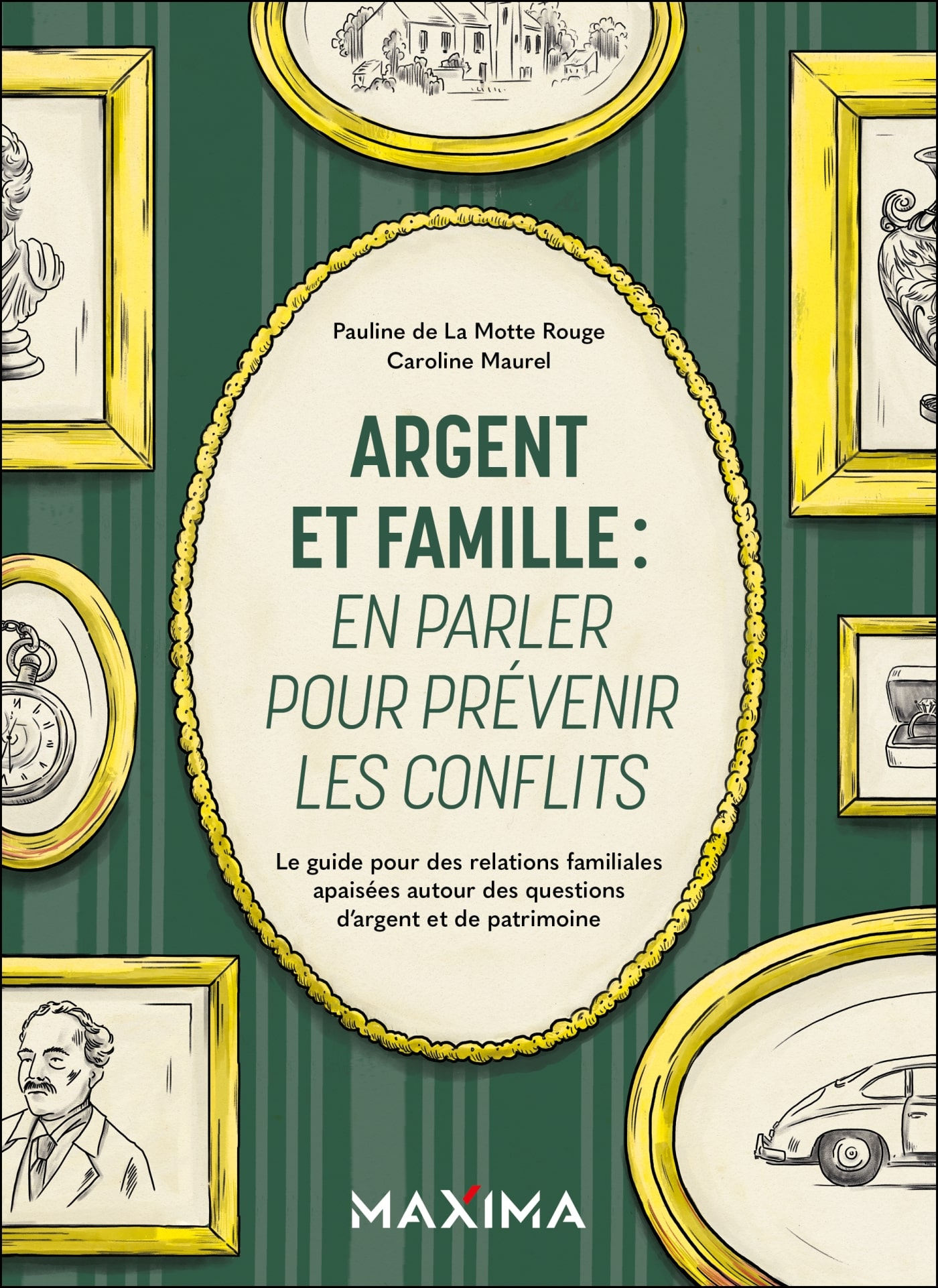
Caroline Maurel: Yes, these family reunions are essential. But indeed they must be prepared.
An impromptu meeting around a family lunch often ends up short. It is not effective or, even worse, it goes wrong. IIt is better to set a clear framework: a precise object, a dedicated time, and sometimes a third party to facilitate if the subject is sensitive. For example: present the broad outlines of a future donation). The idea is not to resolve everything at once, but to open a space for regular dialogue. This habit makes each subsequent topic easier to tackle.
In your opinion, what is the greatest societal transformation in terms of transmission today?
Caroline Maurel: Family reconstitution profoundly changes transmission today: reconstituted families, children from several unions, non-marital cohabitation.
We recently accompanied a mediation involving a remarried father, his children from a first marriage, and his second wife. Everyone had a legitimate, but totally different, vision of what a transmission should be. just “.
Sometimes, traditional transmission patterns are not enough to cover the reality of families. It is now necessary to think about a tailor-made transmission, and above all to communicate it. Because automatic legal benchmarks (hereditary reserve, order of heirs) no longer always reflect what the family really wants or experiences.
If you had to summarize your book in one strong conviction for readers of Business O Féminin, what would it be?
Caroline Maurel: Talking about money as a family is not a risk, it is a protection. Silence does not preserve family harmony, it puts it on hold.
Transmission is a happy intention. By working on its human dimension, we guarantee a transmission that is understood, thought out and accepted. It then becomes technically accomplished, activatable and durable.