




There is a question that runs through the centuries like a red thread: What makes love last?
Not in the sense of surviving, of resisting through inertia or habit, but of flourishing over time, of becoming richer, deeper, truer as the years pass. It is the question that inhabits two of the most beautiful songs of this Sanremo 2026: “Per semper Sì” by Sal Da Vinci and “Ora o per semper” by Raf. Two songs which, despite their stylistic diversity, tell the same truth: love that lasts is not a stroke of luck, it is not a prize for the deserving, but a daily choice, an act of faith in joy, a right that is claimed day after day.
The “yes” that contains eternity
“I know well that the future is a great unknown.” With this statement of disarming honesty, Sal Da Vinci opens his “Forever Yes” and immediately places us in the heart of the nuptial paradox. Because the promise of love, the one that is pronounced on the altar or simply in the secret of the heart when you decide to share your life with someone, is the only promise that is made without knowing the conditions. You promise loyalty despite everything, even if, whatever happens. It’s a bet so bold that only true love can afford it.
In the “Un” document, the Dicastery for the Doctrine of the Faith reminds us that Christian marriage is «a union that opens generously to others, but always starting from that unique and exclusive reality of the marital “we”. That “we” is not the sum of two individuals, but a new reality that transcends them, something that Hans Urs von Balthasar describes as “more than the juxtaposition of their two subjectivities.” It is exactly what Sal Da Vinci sings when he says “Arguing and making love, then what harm is there”: the serene acceptance that life as a couple is made up of everything, high moments and low moments, but that the bond remains, stronger than any temporary difficulty.
Happiness, here, is not the absence of conflict. It is the certainty that conflict does not destroy union. It is that “forever” which is not a chronological measure, but a quality of love. As Saint Thomas Aquinas teaches, a “maximum friendship” exists between spouses, because they unite not only for carnal copulation, but for “the communion of all domestic life”. This friendship is so deep that it can even welcome shadows, misunderstandings, hardships, because it knows that what unites is greater than what divides.
The legacy of time
If Sal Da Vinci celebrates the promise in its making, Raf with “Now or forever” – written with his son Samuele – shows us the fruit of that promise after time has done its work. “And you are always the most beautiful, time suits you”: lines that seem to come from the pen of a poet, and which instead tell the concrete experience of a love that has spanned decades.

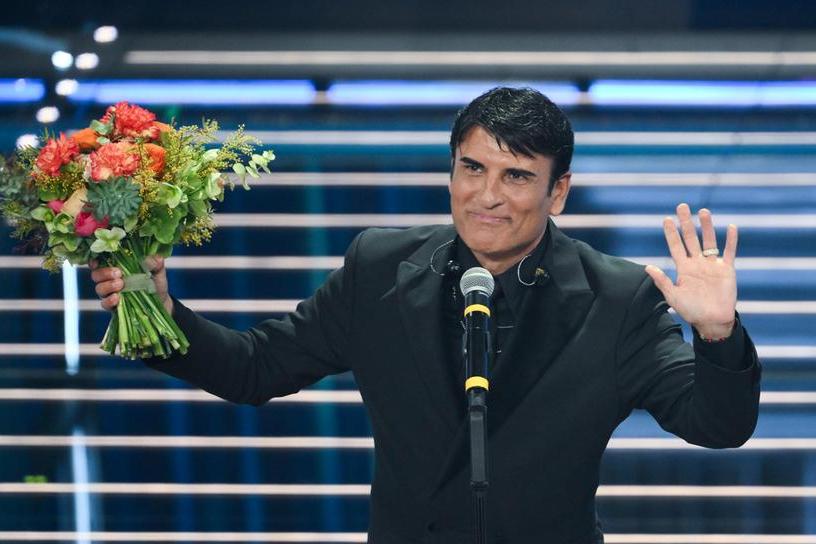
Raf competing in Sanremo with Now and Forever
(HANDLE)
Time, in the common vision, is the enemy of love. Beauty fades, passion wears out, bonds loosen. But Raf offers us a radically different perspective: time does not destroy, it sculpts. It makes the beloved even more beautiful, because it adds the beauty of shared history, of common memories, of battles fought together. It is what the document “UNA CARO” calls “the transformation” of reciprocal belonging: as the years pass, even when the physical attraction fades, “mutual belonging is not destined to dissolve”. Indeed, it deepens, enriches itself, becomes “the pleasure of pertenecerle y que le pertenezca”.
There is a passage in Raf’s text that is striking in its power: “the world that screams and screeches, empty of empathy”. In an era of liquid relationships, of ephemeral likes and chats, of connections that come on and off at the same speed, love that lasts becomes an act of resistance. It is the choice not to be part of that madness, to instead build a safe haven, a place where the other can always return, where there is always someone waiting.
Monogamy as poetry, not as precept
There is a temptation, today, to reduce fidelity to a concept, to a duty, to a rule to be observed. The Vatican document, however, makes a brilliant move: it entrusts the defense of monogamy not to theologians, but to poets. Because only poetry can say the unspeakable of love, it can tell why two are better than three, four or the liquid infinity of contemporary connections.
Poets know that true love always has the face of a single person. Neruda, quoted in the document, writes to his Matilde: «The fifth thing is your eyes». Not “the eyes”, not “beautiful eyes”, but “your eyes”. Those of that unique, irreplaceable person. It is the triumph of uniqueness against the anonymity of multiplication. And this is exactly what Raf celebrates when he sings «And you are always the most beautiful»: not “the most beautiful ever”, but the most beautiful for him, because their story has made that beauty unrepeatable.
Polyamory, open unions, fluid sexuality – all contemporary proposals that deny exclusivity – arise from an optical illusion: thinking that the intensity of the encounter multiplies with the number of partners. But it’s the opposite. As in the myth of Don Giovanni, the number dissolves the name. Quantitative infinity kills qualitative depth. Only in front of a single face can you take on infinite responsibility. Only in an unrepeatable “you” can you recognize the mystery of the person.
Happiness as a daily choice
Both “Forever yes” and “Now or forever” speak to us of a happiness that is not momentary ecstasy, but patient construction. It is not the euphoria of the first meeting, but the profound joy of those who know they have found their place in the world, next to the right person. It is what philosophers call eudaimonia, the happiness that arises from living according to virtue, and which theologians call marital charity. Pope Francis, in Amoris laetitia, describes this charity as patience, benevolence, the ability to ignore the evil received, to always hope, to endure everything. It is love that becomes the art of coexistence. And art, like poetry, requires exercise, discipline, the ability to transform the raw material of life into something beautiful.
Sal Da Vinci sings: «Forever yes, even if I don’t know what it will be». It is the act of faith of those who entrust themselves to the other without knowing the future, trusting only in the strength of that bond. Raf adds: «Now or forever, it doesn’t matter, we’re here anyway». It is the certainty of those who have already experienced that that bond holds, that they have overcome the tests, that they can face anything.
Intimate hospitality
Happiness is “intimate hospitality”. Hosting the other within yourself and feeling good, being satisfied, fulfilled, in peace. Being guests of others, in others and perceiving yourself enveloped in love, affection, friendship, fraternity. This is exactly what happens in love that lasts. The other is no longer “other”, but neither is he fused with me in a symbiotic relationship that cancels out differences. He is a guest in my heart, and I am a guest in his. There is a space that remains mine, and a space that remains his, and there is a common space that is “us”. But in that common space, each brings the best of himself, and each receives something from the other that he could not have alone.
This is why love that lasts is so precious, and so rare. Because it requires a difficult balance between belonging and freedom, between self-giving and respect for otherness. It requires learning to stay in the tension between being “one flesh” and remaining two distinct people, with their own spaces, their own times, their own desires.
The paradox of happiness
There is a profound paradox in all of this: happiness does not want pain, yet it is committed to loving even at the cost of its own pain, in order to drag others into its own joy. It is the paradox of true love, which does not escape difficulties but passes through them, which does not ignore wounds but heals them, which does not forget the past but redeems it.
The songs of Sal Da Vinci and Raf tell us about this paradox. They tell us that happiness is not lightness, but depth. It is not escape, but presence. It is not self-forgetfulness, but self-discovery in the other. And they tell us that all this is possible, that love can last, that “forever” is not an illusion but a promise that can be kept.
As the poet of Nazareth wrote: “By this everyone will know that you are my disciples: if you have love for one another.” Perhaps, today, that love begins with two. And poetry – or song – is his first, irreplaceable, language.
A chorus of voices

Alongside these two songs, other voices from the 2026 Festival chorus on the same theme. In “Nocturnal Animals”, Malika Ayane sings of a love that transforms the two lovers into a species apart: “we are scary” because they live in a harmony that “people will never understand”. It is the otherness of true love, which creates a world apart, a private language, a complicity that excludes anyone else.
In “Sei tu”, Levante explores the same dimension of loss and rediscovery: «I can’t feel my legs», «I can’t breathe» are not symptoms of illness, but physical manifestations of an all-encompassing feeling. Happiness is not a rational choice, but acceptance of what overwhelms us.
And in “Magical fairy tale”, Arisa gives us the story of a woman who retraces the stages of her life until she discovers that true happiness is “returning to my mother’s arms”, it is “the little girl returns innocent”, it is that rainbow that is born inside. It is the happiness of those who, after having lost their way in “romantic disorder”, find themselves again.
The house of “the two of us”
Maybe, in the end, it all comes down to this: Love that lasts is a home. A house that is built day after day, with bricks of patience and mortar of forgiveness. A house that is never finished, because there is always something to fix, to improve, to beautify. A house where you can always return, where there is always a light on, where someone is waiting.
«Let’s go back and forth, / until we return home again, / our two». Szymborska’s verse quoted in “UNA CARO” tells exactly this: we went around and around, we walked the streets, we met people, we had experiences, but in the end we returned home.
The two of us
Here is the deepest truth that emerges from these songs: happiness is not elsewhere, it is not in another person, it is not in another life. It is here, in this house that we built together, in this love that we have chosen and that chooses us every day. It is in the “forever yes” that is renewed every morning, in the “now or forever” which is not an alternative but a certainty.
Because when love is true, the now already contains the forever. And forever is nothing but the sum of all the “nows” experienced together.