






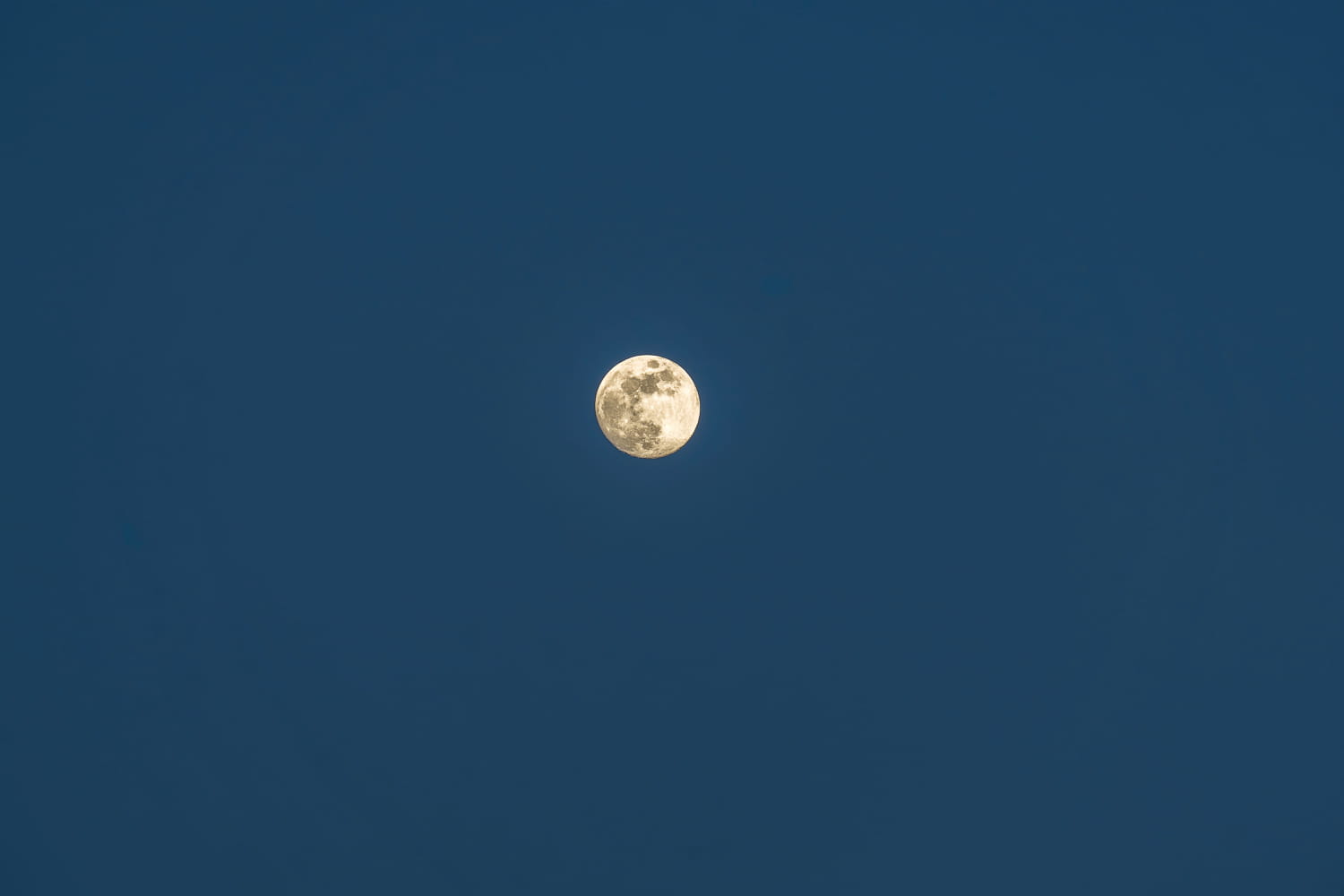
NASA scientists offer a fun trick to see the Moon gigantic and then very small.
The sky has a surprise in store for us to end the month of June in style. The Full Moon scheduled for Monday will become a “Micromoon”. This rare astronomical phenomenon occurs when the Moon reaches its apogee, that is to say the point of its orbit farthest from Earth, more than 400,000 kilometers from us. To the naked eye, it will appear approximately 14% smaller and 30% less luminous than a classic Super Moon like we had the chance to see earlier in the year.
However, an incredible paradox will jump out at us. In their guide to observing the Moon, NASA astronomers share their pro tip for observing this “change in size”: look at the Moon right as it rises in France, around 10:15 p.m. on Monday June 29. When it touches the horizon, it will seem gigantic to you. This is the “Moon illusion,” a mystery that has fascinated scientists since ancient times. Our brain is deceived by the horizon line and wrongly estimates that the star is much closer and larger than it actually is. However, two hours later, once high in the sky and isolated from any landmarks, the Moon will appear to have mysteriously shrunk.
To prove to your loved ones that it’s just a trick played by your brain, scientists offer a fun little test. At the moment when the Moon seems immense on the horizon, extend your arm straight in front of you and close one eye. Try to hide the star with the tip of your little finger (little finger). You will find that it is enough to hide it completely. Repeat the same experiment later in the night, when it seems small: its size on your nail will not have changed a single millimeter.
This is where all the magic of the event lies. Astronomers know that the perceived size of a star in the sky depends enormously on our visual environment. If you observe it in the middle of the night, isolated high up in the void of space, the Micromoon will indeed look like a small, shiny marble. But if you change the timing, you will witness a completely reversed and striking spectacle. Enough to keep astronomy enthusiasts waiting while waiting for the solar eclipse in August.
This meeting is the perfect opportunity to learn sky observation without any equipment. No need for a telescope or binoculars, your own eyes are enough to savor this paradox of nature. Sit back comfortably at the end of the evening, enjoy the summer mildness and let yourself be trapped by this astonishing astronomical illusion.