





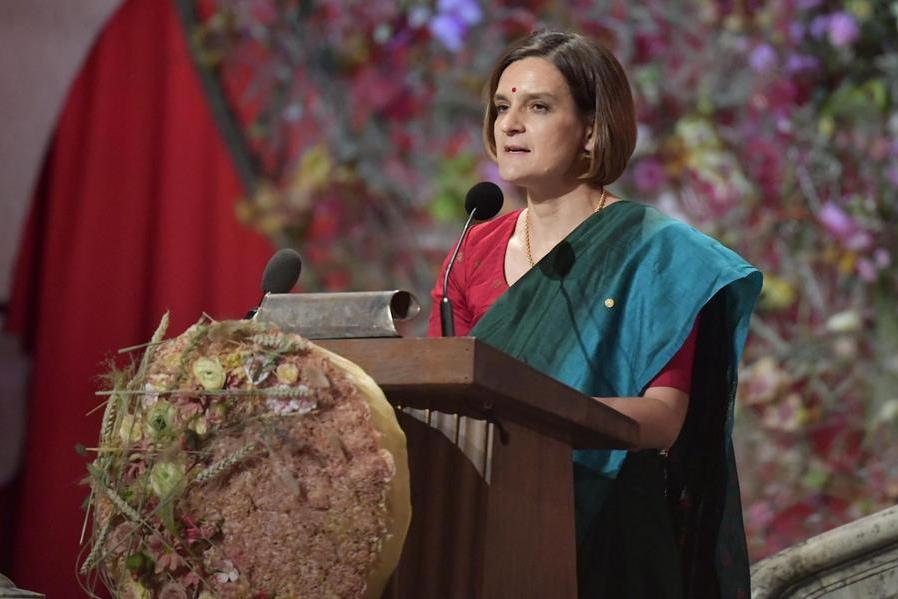
Brilliance and pragmatism go hand in hand Esther Duflo: second woman to win the Nobel Prize for Economics in 2019is the youngest ever to have won the prestigious prize, which was recognized for her studies on poverty and how to fight it. Studies that, putting aside ideological and abstract approaches, he tests the effectiveness of a strategy in the fieldand then abandon it when it proves ineffective, or extend it when the response is positive. In this way the allocated resources – which in his opinion should be increased with fairer taxation of the planet’s ultra-rich – are not wasted but optimised. Topics he will address on June 21st at the Taobuk Festival.
Esther Duflo, one of the questions you have addressed in your research is: why are the poor poor?
«“Why are the poor poor” is not a well-defined question, we ask ourselves instead: “What can be done to improve the lives of those living in poverty and make them less poor?”. Posed in this way, it is a question that contains millions, with millions of answers, because poverty is not a single dimension: being poor means not having access to a good education, healthcare, credit to carry out your business projects, a dignified environment in which to live, and so on. And for each of these aspects there are answers.”
Your research is characterized by an “experimental” and pragmatic approach, through Randomized Controlled Trials (RCTs): what do they consist of?
«RCTs are the equivalent, for social policies, of clinical trials in medicine. If you want to test a new program – for example an AI-based tutor in schools – you can choose a sample of 500 schools: 250 receive the new AI tutor and 250 do not. After a few months or a year, we compare how much the students have learned. J-PAL, the laboratory we created, is a network of over 1,000 researchers who apply this method all over the world and who have carried out around 2,000 RCTs in many countries and in many sectors (education, health, agriculture, climate, etc.). When something works, it can be scaled up on a large scale: today J-PAL projects have impacted the lives of around 850 million people thanks to the extension of interventions proven to be effective.”

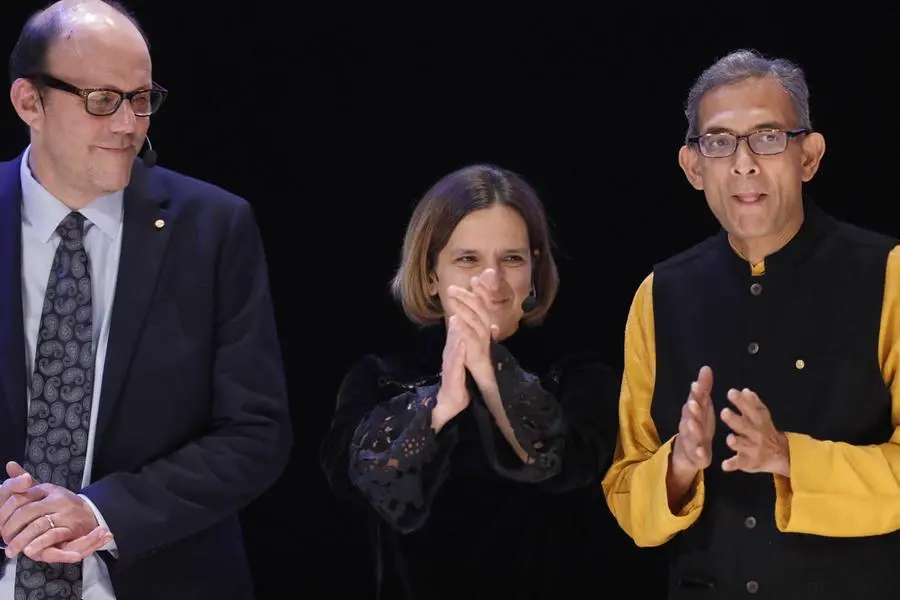
The 2019 Nobel Prize winners in Economics. From left, Michael Kremer, Esther Duflo and Abhijit Banerjee: the latter two are husband and wife.
(EPA)
A central theme of your studies is inequality, which is growing.
«In reality, extreme poverty largely decreased from the 1980s until the Covid pandemic. At the same time, however, inequality has exploded, mainly due to the increase in income and wealth at the top of society. This is mainly because there are no real social limits to how much the ultra-rich can pay themselves, and because they have also managed to keep their taxes very low.”
Could taxing the ultra-rich more be a solution?
«Today the ultra-rich don’t pay the same taxes that most people pay, they pay very low taxes. This is deeply unfair. To begin with, therefore, we should tax the ultra-rich like everyone else. This would generate a lot of resources for governments, and my proposal is that these go directly to the poorest!
What is the relationship between economic development and gender equality?
«There is no automatic relationship in either direction. Some countries develop rapidly without the condition of women improving. For example, even as India grew very quickly, fewer and fewer women worked even if they wanted to. For this reason, part of my research focused on how to guarantee women access to social transfers, political positions and personal bank accounts. Research shows that women make different decisions than men, so their representation in all spheres – from politics to academia to business – is essential for their point of view to be taken into consideration.”
What are the most effective actions against poverty?
«There is no magic solution, it depends on the problem. Interventions that improve the quality of education are extremely effective: they cost relatively little and the benefits for children last a lifetime. In Ghana we have shown that when girls are given a scholarship to pay for high school, ten years later their children are more likely to survive and achieve higher cognitive scores.”
Development aid is sometimes perceived as a waste of money: is this really the case?
«There is no overall evaluation of all international aid, but there are many extremely effective programs and projects: they are those that help countries deal with emergencies that they would not be able to manage on their own – for example, during Covid the rich countries helped their citizens a lot, while the poor ones did not have the resources to do so, and poverty exploded there – or when they help countries to analyze what really works».
Is there a link between poverty and climate change?
«The poor almost do not contribute to climate change, because they consume little and therefore their CO2 emissions are extremely low. Yet, they are the people most affected, because they live in very hot places and are unable to protect themselves from the heat. Almost all additional deaths due to climate change will be concentrated among the poor. One of the great questions of our time is: how will we deal with this problem? Will rich countries turn their backs on them? Will they continue to consume and emit carbon without doing anything to compensate or protect the poor? Pope Francis was deeply committed to avoiding this scenario. I hope his spirit continues to guide us.”