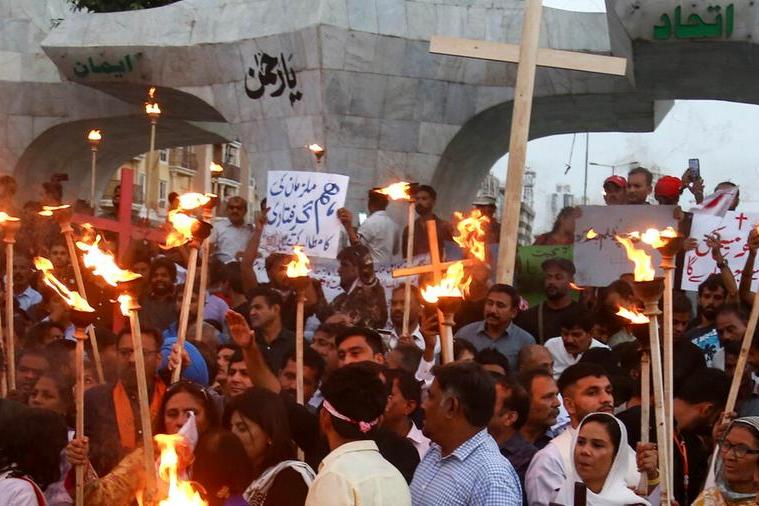
In Baldia Town, a working-class neighborhood on the outskirts of Karachi where the houses lean together as if to keep each other company against the dust and heat, on 8 July an anonymous package arrived in a small grocery shop in the Qazafi colony. Inside was a charred page of the Koran, photographs of a Christian man, Azeem Javaid, and his mother, and a photocopy of the woman’s identity card.. This was enough – an envelope, a few photographs, a blackened sheet of paper – to get the ball rolling a mechanism that has been repeated too many times in Pakistan with bloody results: the rumor that travels faster than the investigation, the crowd that gathers before anyone has ascertained the facts, the suspicion that turns into a sentence.
The Muslim businessman who opened the package was not carried away. He notified the neighbors, then the police. But the news, as always happens in these cases, took its own path. Within a few hours, thousands of people gathered in the colony, while some of the most radical incited revenge. About ten Christian families who live next to Javaid’s have barricaded themselves in their homes, with the sensation – those who assisted them say today – of having suddenly become hostages of an accusation that did not directly concern them, but which still made them targets. It is the cruelest feature of Pakistan’s blasphemy laws: they affect an individual, but the punishment extends to an entire community.
This time, however, the scene was not closed as in Jaranwala in 2023, when the fire of twenty-one churches and dozens of Christian homes told the world about the fragility of a coexistence held together more by resignation than by justice. It didn’t even close like in Gojra, in 2009, when the fury of a crowd left entire families on the ground. TO Baldia Town, the government of Sindh quickly deployed police reinforcements and Rangers, the paramilitary body that enforces public order, rescuing Javaid and his relatives in a protected place. But what made the difference, say the sources gathered in the field, was not just the police.
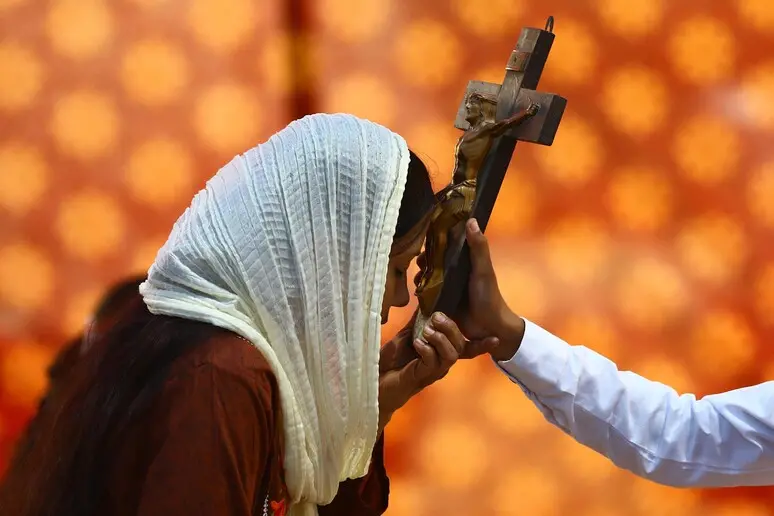
They took to the streets, in front of the homes of Christian families, students of Islamic seminaries, imams, mufti (a jurist and expert in Islamic law authorized to issue legal responses, called fatwā. Unlike the imam, who leads the prayer, or the qāḍī, the judge who issues binding sentences, the mufti provides opinions and doctrinal interpretations that serve to apply the principles of sharīʿa in daily life) of different schools of thought. They spoke to the crowd not to justify, but to stop: they said that that package had all the air of a carefully constructed provocation, designed specifically to ignite a conflict between neighbors who, until the day before, shared the same courtyard. Among them are Mufti Abdullah Noori, Mufti Zubair, member of the Council for Islamic Ideology, and the religious Allama Bilal Saleem Qadri, together with the vice-president of the Sindh Assembly, the Catholic Naveed Anthony, and the provincial deputy Rooma Mushtaq Mattoo, who wanted to personally confirm that Javaid’s family was “under state protection in a safe place”. Alongside them, Catholic priests such as Father Waqas Raza, Father Rizwan and Father Kashif Gouri, all of the order of the Oblates of Mary Immaculate, and Father Shahzad Arshad, leading the Justice and Peace Commission of the Archdiocese of Karachi, who publicly called for complete investigations and respect for the law.
Naeem Yousaf Gill, executive director of the Catholic Justice and Peace Commission of Pakistan, tells the Vatican media in measured words about an episode that could have had another ending. He says that it all began thanks to relationships built over years of patient and almost invisible work: a former Commission collaborator, resident in that very street, raised the alarm to the local coordinator, who in turn contacted the vice-president of the Assembly “and other authorities and religious people who shared the same ideals”. It is not an isolated case of good will: the Commission, explains Gill, had already organized seminars on interreligious harmony in that area over the years, building “a solid network of contacts with the majority communities”. It is in that plot woven over time, rather than in the emergency of the moment, that the reason why this time the tragedy did not occur is to be found.
“It was received and appreciated with great surprise,” says Gill speaking of the intervention of Muslim leaders, almost as if to confess that interreligious solidarity in Pakistan remains more the exception than the rule. And he adds, with the prudence of someone who has seen too many hopes dashed: “With a single episode we cannot say that respect for the law is growing. It is too early.” A caution that weighs as much as a diagnosis. Gill recalls that Pakistani Christians “face discrimination, humiliation and hatred in every area of their lives” and that an accusation, even when it falls on just one person, “the entire community pays the price”. He also points out a geography of fear: the most violent attacks are almost all concentrated in Punjab, while Sindh, where Karachi is located, remains “a relatively more tolerant society”.
To understand the weight of that caution we need to look back. The blasphemy law bears the signature of General Zia-ul-Haq, who in 1986 tightened it to the point of providing for life imprisonment and the death penalty for anyone who offends the Prophet, Islam or the Koran. Since then, more than 1,800 people have been accused, and today at least eighty remain in prison, half of whom risk the gallows or a never-ending sentence. The Pakistani Supreme Court has repeatedly recognized that the majority of cases arise from unfounded accusations, often linked to neighborhood disputes, professional rivalries, disputes over land and informal housing for which religious minorities, without regular property titles, are particularly deprived of protection. Christians and Hindus do not make up five percent of the Pakistani population, yet their incidence among the victims remains disproportionate compared to their demographic weightor: just last month a sixty-year-old Catholic, Amir Joseph Paul, brother of a priest, died in prison due to complications from detention following an accusation that later turned out to be fabricated.
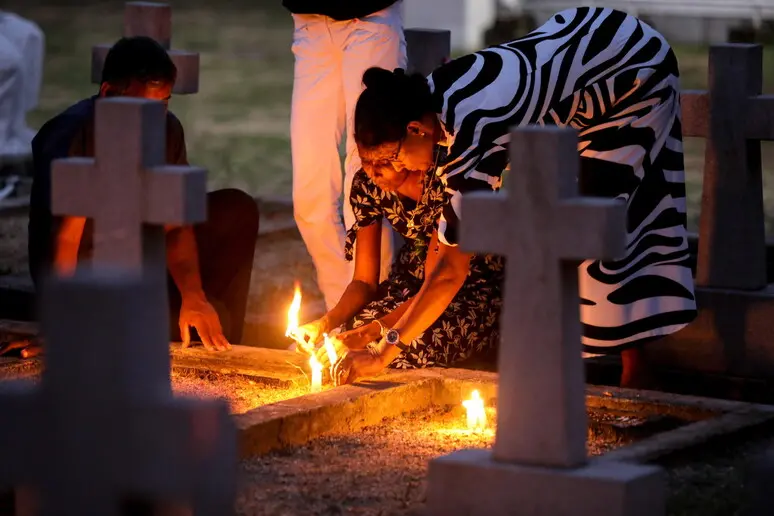
There is, in this story, something that goes beyond the news of a single neighborhood. The Pakistan that has emerged in recent months is a country where suspicion, religious but not only, is transformed with disturbing ease into summary conviction, before a judge, an investigation, or evidence have a say in the matter.. Another painful story tells it in its own way, in the same days: that of a medical examiner from Sindh who has been documenting violence against women for twenty years and speaks of a social tolerance towards abuse that has never been so high, of feminicides disguised as accidents, of a system that struggles to believe the victims. Different stories, which tell the same wound: a social fabric in which private justice and mistrust in institutions still find too much space, and in which whoever is weaker, a woman, a minority, an accused without lawyers, is the first to pay the price for the fragility of the law.
This is why what happened in Baldia Town should not be read just as isolated good news, but as a signal, however immature, of another possible path. Gill says it clearly: “Interreligious dialogue is of great importance. It should be continued. It will break down barriers“. And he asks that that network of relationships, that ability to alert and intervene before violence spreads, becomes a method and not an exception: a public awareness campaign, he says, “through textbooks, television dramas, social media and short messages”, so that people learn to act wisely before anger takes over. The same Islamic scholars who took to the streets in Baldia Town asked the imams of the area to dedicate Friday sermons to the themes of brotherhood and coexistence: a small, almost silent gesture, but which in a country marked by decades of mutual suspicion weighs as an act of courage.
In the background, the image of that page of the Koran burned and sent by post remains: an object created specifically to hurt, to divide, to detonate hatred between neighbors who until a moment ago shared the same neighborhood, the same street, perhaps even the same bread. That that provocation did not achieve its purpose does not erase the fragility of a system that continues to make the same spark possible every time. But it proves, as he says Father Lazar Aslam, Capuchin head of the Justice, Peace and Ecology Commission, that “with good will, collaboration and common sense, violence can be prevented and good relations maintained, for the common good”. A minimal, almost obvious lesson. Yet, in Pakistan, still revolutionary.