





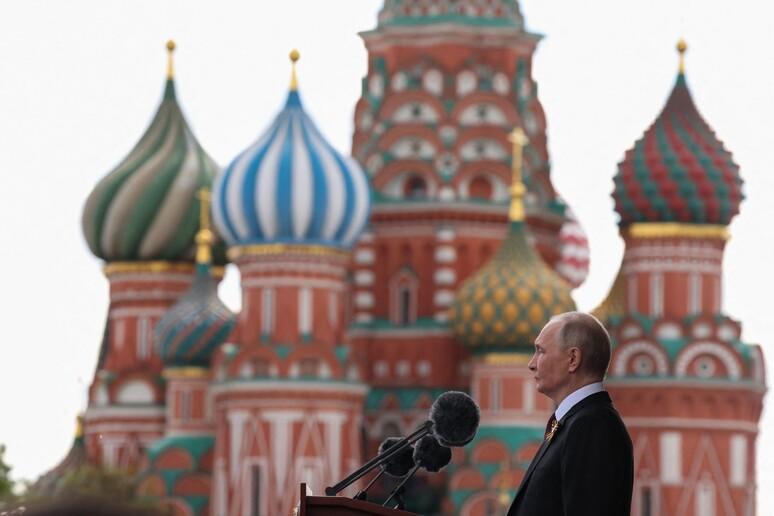
It was supposed to be yet another celebration of Russian strength, the most important civil and military rite on the Moscow calendar. And instead the parade of Victory Day on May 9, 2026 risks turning into a symbol of the Kremlin’s vulnerability. Because this year, to guarantee the holding of the event in Red Square, Russia needed what it had always really refused for over four years of war: a ceasefire with Ukraine.
Victory Day is much more than a historical commemoration. In Vladimir Putin’s Russia it has become the heart of the national patriotic narrative: the memory of the Soviet victory against Nazism elevated to the foundation of the country’s contemporary identity. In recent years the Kremlin has also used this anniversary to legitimize the war in Ukraine, presenting it as a symbolic continuation of the “Great Patriotic War”.
But this time something went wrong.
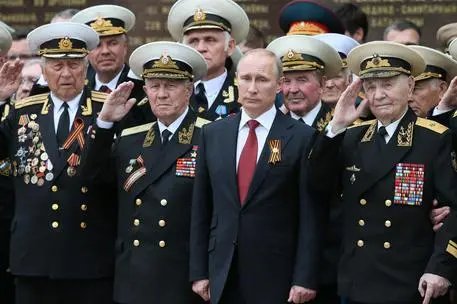
For days Moscow lived under tension. Closed airports, limited mobile communications, strengthened security systems and growing fear of possible Ukrainian drone attacks. The threat was not theoretical: in recent months Kiev has demonstrated that it can strike targets deeper and deeper into Russian territory, including energy and military infrastructure.
The result was paradoxical. Russia, which continues to present itself as an invincible military power, needed to negotiate a three-day truce – from 9 to 11 May – to protect its symbolic event. A situation that many international observers read as a political humiliation for Putin.
Even the form of the parade tells of this difficulty. According to various international sources, for the first time in almost twenty years the event has been drastically scaled down: fewer heavy vehicles, absence of much of the military hardware traditionally exhibited in Red Square, greater sobriety and a much more limited list of international guests than in the past.
Behind these choices there are practical but also symbolic reasons. Many vehicles are busy on the Ukrainian front; others would be too vulnerable to attack. Thus the celebration of power is transformed into a defensive, almost armored demonstration.
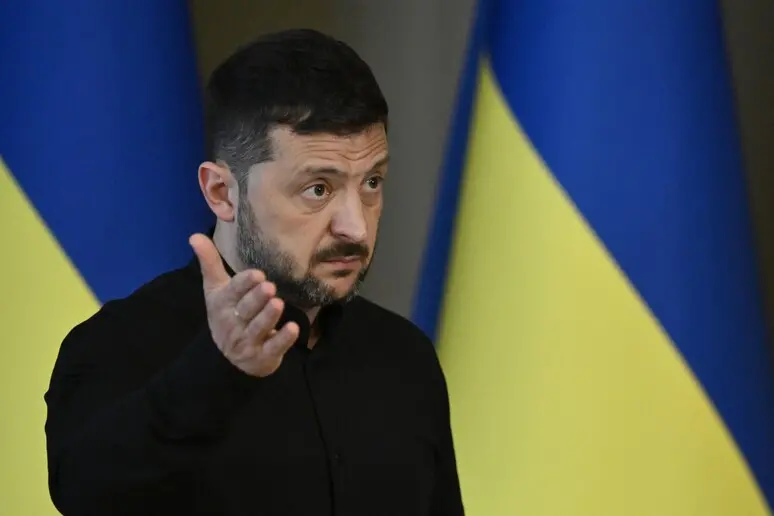
What made the Kremlin’s embarrassment even more evident was the ironic tone used by Ukrainian President Volodymyr Zelenskyy, who sarcastically announced that he “authorized” the holding of the parade in Moscow during the truce. A political gesture designed to overturn the Russian narrative: no longer a safe and dominant Russia that grants humanitarian pauses, but a Kremlin forced to ask for protection for its national holiday.
Meanwhile, on the ground, the truce appears very fragile. Moscow and Kiev continue to accuse each other of violations of the ceasefire, while the prospects of real peace remain very distant.
And this is perhaps the most significant point. The May 9th parade was created to remember the end of a devastating war and the defeat of Nazism. Eighty-one years later, that memory is celebrated while another bloody conflict continues in the heart of Europe, made up of drones, bombings, propaganda and hundreds of thousands of victims.
For Putin, Victory Day was supposed to be proof that Russia remains a superpower capable of imposing itself on the world stage. But the need to stop the weapons even just to secure Red Square perhaps tells the opposite: a power that fears it will no longer be able to control even its own symbolic stage.