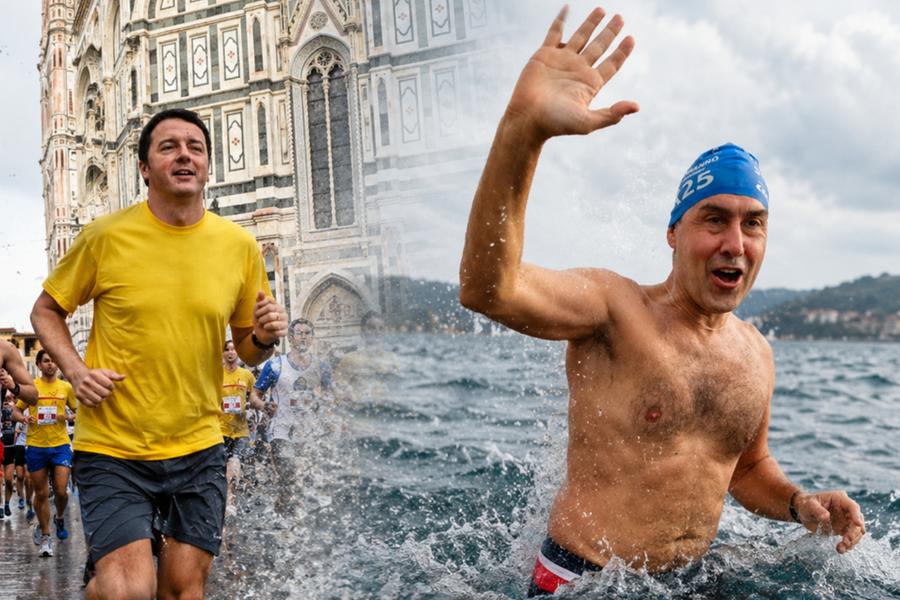
Matteo Renzi and Roberto Vannacci have decided to compete on the terrain most congenial to contemporary Italian politics: the waistline. First two miles of swimming and a half marathon, then a full marathon, because even in the ridiculous you always have to start again. And possibly publish the video and spread it on social media.
The general, soaked and shirtless, summoned Renzi to Sardinia on 4 October. Renzi replied that he isn’t interested in half things. The general would have “softened” by hanging out with Salvini and Tajani. Vannacci, for his part, had ordered him to save his breath and leave his badge at home. All in reel shots. They look like two teenage rappers. Except instead of rhymes they have a heart rate monitor.
Dissing, born in hip-hop culture as a public exchange of insults and provocations, has now become the most accessible form of political confrontation. It requires less effort than an election program and guarantees more views than an industrial or public education conference. In the case of Renzi and Vannacci, however, dissing has evolved into a new discipline: aerobic narcissism. They are the followers of Grillo, who for the 2012 Sicilian regional campaign of the Five Star Movement swam across the Strait of Messina (but then the centre-left and UDC candidate Rosario Crocetta won, without even wearing a swimsuit).
Vannacci even extended the invitation to Calenda, Fratoianni, Bonelli, Tajani, Salvini, Bonaccini and Conte, transforming the challenge into a kind of Games without borders of the Republic. Only Guido Pancaldi and Gennaro Olivieri are missing.
The point is not that a politician must be sedentary, pale and afflicted with gout. Showing yourself in good health is legitimate. Running, swimming and gymnastics are even advisable. But there’s a big difference between keeping fit and turning public debate into a locker room challenge. Politics is not a competition to establish who has more breath, more abs or a higher anaerobic threshold.
Above all, you cannot raise the fear of Vannacci for months at Palazzo Chigi, describe him as a threat to the institutions and then invite him to a sporting challenge, as if in the end we were all joking. Either Vannacci represents a political danger, and then we address him seriously with arguments, programs and votes; or it’s a training partner from the Pontassieve running group with whom you can decide who gets to the finish line first.
The matter becomes even more grotesque because the contenders cannot even agree on the date. On 4 October Renzi has the Leopolda, which he says will also survive the “Vannacci phenomenon”. So we have a race without shared rules, without a defined route and perhaps without an established day. Finally a perfect metaphor of Italian politics.
We are also a little tired of seeing Vannacci shirtless, in a seaside re-edition of Mussolini on the thresher. And even Renzi who dribbles trying to imitate Messi could give himself a break. Political vitalism, that of the strong, athletic, tireless man who runs while others talk, belongs to a national tradition that is not exactly reassuring.
To do politics you don’t need a beastly physique. You need a political mind. We need the ability to understand reality, choose, mediate, administer and pursue the common good. Churchill (si parva licet) would probably not have won a triathlon (his motto was “no sport”). De Gasperi does not appear to have ever challenged Togliatti in the hundred metres. Can you imagine Moro challenging Berlinguer at five-a-side football? Yet they managed, for better or for worse, to deal with the destiny of a country without feeling the need to show off their bib. In short: completely free to run and swim. However, it would be appropriate to remind them that the country does not need to know which of the two arrives first. He would like to know, if anything, where they intend to take him.