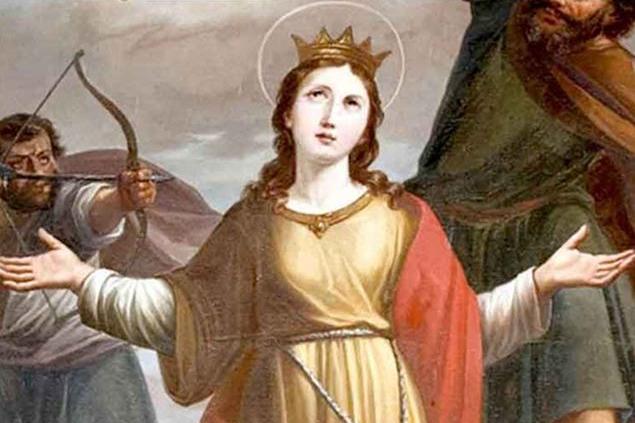
Saint Christina is part of that group of holy martyrs, whose death or the tortures they suffered are attributed to their fathers, who were so distorted and devoid of love, that they inflicted the cruelest torments on their daughters and gave them death for having embraced the Christian faith. His name means “consecrated to Christ”. The Church celebrates it on July 24th.
She is the patron saint of millers and is depicted with the palm, symbol of martyrdom, and the wheel, one of the instruments with which she was tortured. TO Bolsenain Lazio, every year the stages of his martyrdom are re-enacted and the altar where the Eucharistic miracle occurred is made from the stone of his torture.
From archaeological excavations carried out between 1880 and 1881 in the cave located under the Basilica dedicated to the Saint in Bolsena, it was ascertained that the cult of the martyr was already existing in the 4th century; from the bottom of the cave-oratory is the entrance to the catacombs, which contain a lying statue of her in painted terracotta and the sarcophagus where the relics of the saint’s body were found.

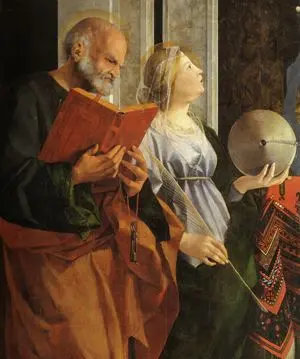
Lorenzo Lotto, Altarpiece of Santa Cristina al Tiverone1504-1506. Detail with Santa Cristina, depicted with the symbolic attributes of martyrdom
Martyrdom and wonders
At the time ofemperor Diocletian (243-312) the girl named Cristina, daughter of the “magister militum” of Bolsena, Urban, had been locked up by her father together with twelve other girls, in a tower so that she could venerate the simulacra of the gods as if she were a vestal virgin. But eleven-year-old Cristina had already known and adhered to the Christian faith in her heart, she refused to venerate the statues and after a vision of angels broke them. Having pleaded in vain to return to the traditional faith, she was arrested and flagellated by her magistrate father, who then referred her to his tribunal which condemned her to a series of tortures, including that of the wheel under which the flames burned.
After this she was taken back to prison full of bruises and sores; here the young Cristina was consoled and miraculously healed by three angels who descended from heaven. This attempt also proving in vain, her unnatural and obstinate father condemned her to drowning, having her thrown into Lake Bolsena with a millstone tied to her neck. Prodigiously the large stone began to float instead of sinking and brought the girl back to the shore, who, trampling on the stone once it arrived, left (another prodigy) the imprints of her feet; this stone was then transformed into an altar table. Faced with this miracle, the shaken and heartbroken father died, but Cristina’s pain did not end, because Urban’s successor, the magistrate Dioneraged even more. He had her flogged but to no avail, then thrown into a boiling cauldron full of pitch, resin and oil, from which Cristina emerged unharmed, had her cut off her hair and dragged her naked through the streets of the lagoon town, finally dragged her into the temple of Apollo, ordered him to worship the god, but the girl with a withering look made the idol fall, reducing it to dust.

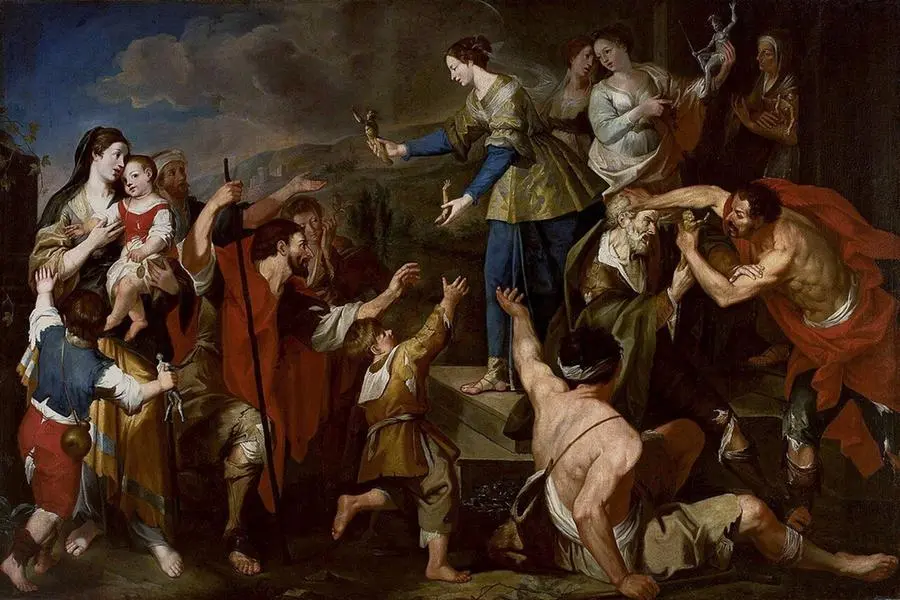
Anonymous Flemish, Saint Christina gives her father’s golden idols to the poorri, first half of the 17th century. National Museum in Warsaw.
An unshakable faith
Dione also died and was replaced by the magistrate Julian, who following his predecessors continued the obstinate work of intimidating Cristina, throwing her into a furnace from which she once again emerged unharmed; this furnace called by the Bolsena people “Fornacella”is located about two kilometers south of the city; in a plot of land located between the Cassia and the lake, in the Middle Ages it was incorporated into a country oratory. Cristina was indomitable in her faiththen Giuliano exposed her to the bites of snakes, carried by a Marsican serpent, who instead of biting her, began to lick her sweat, the less realistic tradition of the legend, according to which the snakes turned against the serpent by biting him, but Cristina, moved with pity, healed him.
Following the “Passio” of famous martyrs such as Saint Agatha, it is said that Julian had her breasts cut off and her tongue cut off, which the girl threw at her persecutor, blinding him. Finally the archers, as in San Sebastiano, mortally pierced her with two arrows. This is the legendary story of the “Passio” written no earlier than 9th centurywhose historical value is almost nil, previous Greek “passios” claimed that Christina, whose Latin name means “consecrated to Christ”, was born in Tire in Phoenicia, but this is an error due to the fact that the first ‘passio’ was written in Egypt and that to indicate the land of the Etruscans called Tyrrhenians by the Greeks, the abbreviation ‘Tyr’ was used, erroneously interpreted as Tyre.

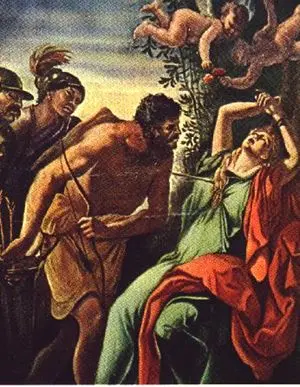
The martyrdom of Santa Cristina
The relics
The relics also had an adventurous fate, they were found in 1880 in the sarcophagus inside the catacombs located under the basilica of Saints George and Christina, a church dating back to the 11th century and consecrated by Pope Gregory VII in 1077. The relics of the body, or rather part of it, are preserved in a shrine, part of which were stolen in 1098 by two pilgrims heading towards Holy Land, but they arrived at Sepinoa Molise town in the province of Campobasso, were no longer able to leave the city with their precious cargo, so they donated them to the inhabitants. This is the beginning of the cult of the saint which is very alive in Sepino; the relics, which today consist of only one arm, are preserved in the church dedicated to her; the other relics were transferred between 1154 and 1166 BC Palermowho proclaimed the martyr his celestial patroness, celebrating her on 24 July and 7 May; the devotion lasted at least until the relics of Saint Rosalia were “discovered” in the 17th century, she later became the main patroness. In Sepino, Saint Cristina is remembered by the faithful on four days during the year.
The “Mysteries of Santa Cristina”
In Bolsena, Saint Cristina is celebrated with a large religious event, on the eve of the feast on the evening of July 23rd, in the darkened square in front of the basilica, the simulacrum of the saint placed on a temple-shaped “machine” is carried in procession, at the same time on the right of the churchyard the curtain of an illuminated stage opens, where a living painting silently represents a scene of martyrdom and this is repeated in every square and on as many small stages where the procession arrives; the event is called “The Mysteries of Saint Christina”. The procession in which a crowd of faithful takes part takes place through the streets and squares of Bolsena, until it reaches the top of the town in the Church of the Santissimo Salvatore, there the statue stops all night and on the morning of the 24th, the day of the liturgical feast of Saint Cristina, the return procession resumes in the same way and finally arriving again in the Basilica dedicated to her. The “Mysteries” are a religious event that since the Middle Ages has honored some patron saints in various cities of Italy, especially in the Center.
The altar on which the Eucharistic miracle occurred
Finally, it must be remembered here that the Basilica of Santa Cristina possesses the altar which, as already mentioned, is formed by the stone of the martyr’s torture and that precisely on this altar in 1263 a Bohemian priest, who had doubts about the truth of the real presence of the Body and Blood of Jesus in the Eucharist, while celebrating Mass, saw drops of blood flow from the consecrated host, which settled on the corporal and on the floor, the event was reported al Pope Urban IVwhich was located in Orvieto, which established the feast of Corpus Domini the following year.
The passion of Saint Christina has been a privileged subject for artists of all times, such as Signorelli, Cranach, Veronese, Dalla Robbiawho not only represented her in scenes of her martyrdom with her symbols, the grindstone, the snakes, the arrows, but enriched the basilica dedicated to her with their works of painting, sculpture and architecture, especially after the Eucharistic miracle occurred.