





John the Baptist he is the only Saint, together with the Virgin Maryof which the day of his earthly birth (24 June) is celebrated, as well as that of his martyrdom (29 August).
Of the two dates, however, the one most used for veneration is the first. He is the patron saint of monksbaptized Jesus in the waters of the Jordan River, died a martyr and is called the “Forerunner” because he announced the coming of Christ. The episode in which leaped for joy in the womb of his mother, Elizabethwhen he received a visit from Mary.
Who was John the Baptist?
It is thelast prophet of the Old Testament and the first Apostle of Jesus, because he bore witness to him while still alive. In the Gospel of Luke (1, 5) it is said that he was born into a priestly family, his father Zechariah was of the class of Abijah and his mother Elizabeth, descended from Aaron.
The “miraculous” birth announced by the angel Gabriel
The mother Elizabeth she was sterile and now elderly. One day, while the husband Zechariah was offering incense in the Temple, the archangel Gabriel appeared to him and said to him: “Do not fear Zechariah, your prayer has been answered and your wife Elizabeth will give you a son who you will call John. You will have joy and exultation and many will rejoice at his birth, for he will be great before the Lord” and continuing to describe his virtues, that is, full of the Holy Spirit, operator of conversions in Israel, precursor of the Lord with spirit and strength of Elijah. After that vision, Elizabeth she conceived a son to the amazement of her relatives and acquaintances; in the sixth month of her pregnancy, the archangel Gabriel, the “celestial messenger”, was sent by God to Nazareth to announce the motherhood of Christ to Mary: “The Holy Spirit will descend upon you, the power of the Most High will overshadow you. He who will be born will therefore be holy and called the Son of God. See also Elizabeth, your relative, in her old age she conceived a son and this is the sixth month for her, who everyone said was sterile; nothing is nothing is impossible with God.”
Maria then went to her cousin Elisabetta to visit her and at her greeting she recited the beautiful song of “Magnificat”, for the wonders that God was working for the salvation of humanity and while an exultant Elizabeth blessed her, even the child she was carrying in her womb leaped with joy. When John was born, his father Zechariah, who had become mute due to his disbelief at Gabriel’s announcement, regained his voice, the birth took place Ain Karim, about seven km west of Jerusalem, a city that boasts this tradition dating back to the 6th century, with two sanctuaries dedicated to the Visitation and the Nativity.

Artemisia Gentileschi, Birth of Saint John the Baptist1635
Why is he called the “Forerunner”?
Because with prophetic action and preaching he announces the coming of Jesus. After his youth, John retired to lead the hard life of an ascetic in the desert, he wore a camel’s hair dress and a leather belt around his hips; his food was locusts and wild honey. In the fifteenth year of the empire of Tiberius (28-29 AD), he began his mission along the Jordan River, with the announcement of the advent of the messianic kingdom now near, he urged conversion and preached penance. From all of Judea, from Jerusalem and from the entire region around the Jordan, many people flocked to listen to him, considering him a prophet; and John, as a sign of purification from sins and birth to a new life, immersed those who welcomed his word in the waters of the Jordan, that is, he gave a Baptism of repentance for the remission of sins, hence the name Baptist that was given to him. Even the soldiers of the King Herod Antipas, they went to him to ask him what they could do if their profession was so unfortunate and disliked by the population; and he replied: “Do not mistreat or extort anything from anyone and be content with your wages” (Lk 3, 13).
Many began to think that he was the long-awaited Messiah, but John assured them that he was only the Forerunner: “I baptize you with water for repentance, but he who comes after me is more powerful than I, and I am not even worthy to untie the thong of your sandals; he will baptize you with the Holy Spirit and fire.”
And to the official delegation, sent to him by the high priests, he said that he was not the Messiah at all, who was already among them, but they did not know him; adding “I am the voice of one crying in the desert: prepare the way of the Lord, as the prophet Isaiah said”.
The baptism of Jesus in the Jordan
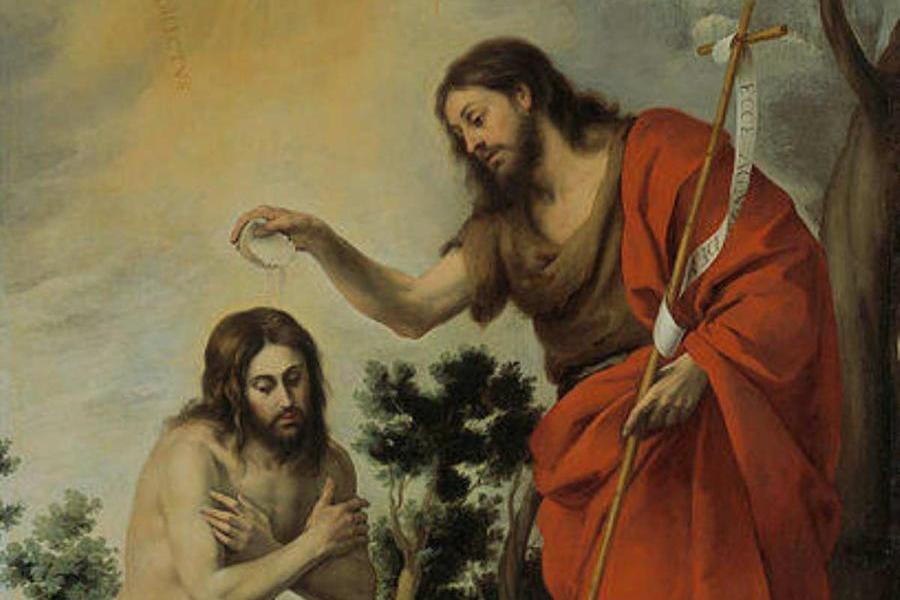
Jesus also presented himself at the Jordan to be baptized and when John saw him in front of him he said: “Behold the Lamb of God, behold he who takes away sin from the world!” and to Jesus: “I need to be baptized by you and you come to me?” and Jesus: “Let it be for now, for it is fitting that we fulfill all righteousness.” Then John agreed and baptized him and saw the Holy Spirit descend on him like a dove, while a voice said: “This is my beloved Son in whom I am well pleased”. From that moment John confided to his disciples “Now my joy is complete. He must increase, but I must decrease” (Jn 3, 29-30).

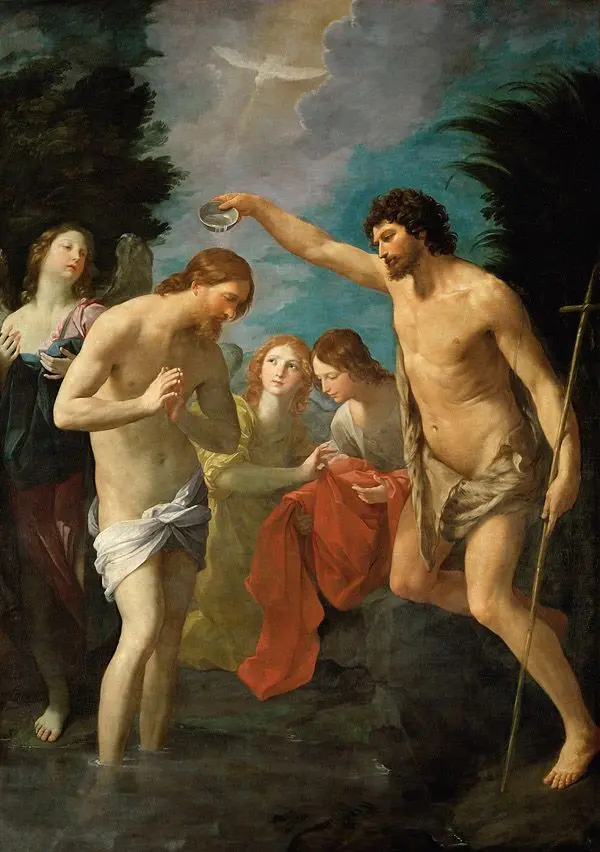
Guido Reni, Baptism of Christ
His mission was accomplished, because Jesus began to preach, had formed the group of apostles and disciples and was followed by a large crowd; he had preached precisely for this reason, to prepare a worthy people who would welcome Jesus and his message of Redemption.
The contrast with the king of Israel Herod Antipas
He had worked without backing down from anything, not even the king of Israel Herod Antipas († 40 AD), who had taken the beauty with him Herodias, wife divorced from her brother; this was not possible according to Jewish law because the marriage had been regular and fruitful, so much so that a daughter Salome was born. For this reason, an observant and rigorous Jew like John felt the duty to protest to the king for his conduct. Enraged Herodias bore him a grudge, but she wasn’t the only one; because the Baptism that John administered forgave sins, thus making atoning sacrifices useless, which at that time were done in the Temple, and this was not appreciated by the Jewish priests.
Decapitation and the head carried on a tray
Herod had John arrested and put in prison at the instigation of Herodias, who wanted him to be killed, but Herod Antipas feared John, considering him a just and holy man, he preferred to watch over him and listened to him willingly, even though he was very upset.
But a favorable day came for Herodias, when the king gave a banquet to celebrate her birthday, inviting the whole court and the notables of Galilee. Salome, the daughter of Herodias and therefore granddaughter of Herod Antipas, also participated in the party with a disturbing dance; her performance pleased the king and the guests very much, so he said to the girl: “Ask me anything and I will give it to you”; Salomé asked her mother for advice and Herodias took the opportunity and told her to ask for the head of the Baptist.
At this request made to him by the girl in front of everyone, Herod was saddened, but due to the oath made publicly, he did not want to refuse and ordered the guards to bring him the head of John, who was in the prisons of the palace.
The Baptist was beheaded and his head was carried on a platter and given to the girl who gave it to her mother. His disciples, hearing of his martyrdom, came to recover his body, placing it in a tomb; the killing aroused horror and increased the Baptist’s fame.

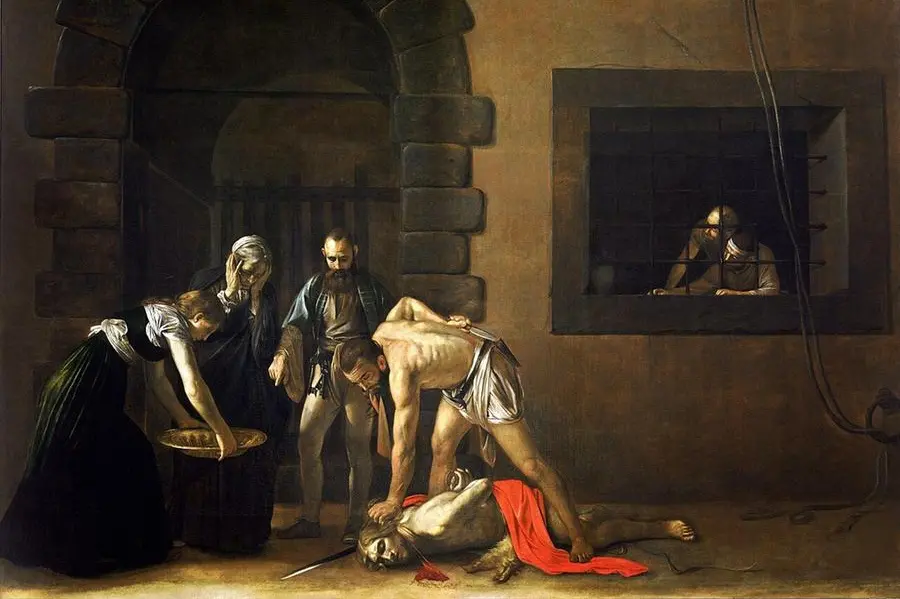
Caravaggio, Beheading of Saint John the Baptist, 1608
Why is June 24th celebrated?
Since the birth of Jesus is set for December 25th, that of John had to be celebrated six months earlier, according to what the archangel Gabriel announced to Mary.
What does his name mean?
Giovanni among male names, but also used in female derivations (Giovanna, Gianna) is the most widespread in the world, translated into various languages; and many other saints, blesseds, venerables of the Church, originally bore his name; like the almost contemporary Saint John the Evangelist and apostle, because the name John was already known in his time and in Hebrew Iehohananmeant: “God is propitious.”
Which churches keep his relics?
Saint John the Baptist, to name a few, is the patron saint of cities such as Turin, Florence, Genoa, Ragusa… As regards the relics, the story is rather long and complex. After being buried without his head a Sebaste in Samaria, where two churches were built in his honor; in 361-362 at the time of Emperor Julian the Apostate, his tomb was desecrated by pagans who burned his body and scattered the ashes. But a Genoa in the cathedral of San Lorenzo, those ashes are venerated, brought from the East in 1098, at the time of the Crusades, with all the related doubts.
For the head that was located at Constantinople, for some instead ad Emesa, Unfortunately, as with many relics from the period of the Crusades, where there was a competition to bring holy and important relics to the West, the head split, one in Rome in the 12th century and another in Amiens in the 13th century.
In Rome it is kept without the jaw in the church of San Silvestro in Capite, while the cathedral of San Lorenzo in Viterbo holds the Sacred Chin.

Guido Reni, Saint John the Baptist in the desert
His figure in the history of art
John the Baptist is the most depicted saint in art of all centuries; It cannot be said that there is no altarpiece or painting of a group of saints, alone or around the throne of the Virgin Mary, without this saint present, usually covered in an animal skin and holding a stick ending in the shape of a cross in his hand.
Not to mention the many pictorial works of the greatest artists such as Raphael, Leonardoetc. which depict him as a child, playing with little Jesus, always covered in sheepskin and affectionately called “St. John”. This testifies to the great interest that this austere prophet has aroused in all ages, so high in the same consideration as Christ, that he defined him as “The greatest among those born of women”.