


«The consequences of international tensions are increasingly reverberating in the lives of citizens and communities, generating concerns and insecurities. In this context, listening skills, intelligent reading of emerging social dynamics, sensitivity to situations of hardship and greater fragility, in order to develop effective responses, are of great value to those who lead public offices in the exercise of their mandates.” And again: «Dialogue, listening, proximity are essential canons for interpreting every civic responsibility oriented towards social cohesion».
These are among the first words dedicated by the President of Sergio Mattarella to June 2nd which celebrates the 80th birthday of the Republic, contained in the message to the Prefects, sent just before starting the celebrations starting from the opening of the Quirinale Gardens to the vulnerable groups.
They are words in which we could recognize a self-portrait, without appearing, like those of which the artists of the modern era, Caravaggio and Titian above all, used to disseminate their works without placing themselves in the foreground, dissimulating themselves in secluded figures. The man who sits at the Quirinale, sitting very little in reality but rather being found every time where there is a need for those representing the Republic and its unity to make their closeness felt to the citizens, exudes a calm solidity: the quiet strength of an authority that unites and does not divide, holding the institutional point when needed, even with firmness, without ever giving space to exploitations of the opposite signwithout ever going outside the lines, whether in terms of institutional architecture (his past as a full professor of Parliamentary Law and his years as a judge at the Constitutional Court help him) or his expressive composure.
His speeches, with a clear lexical and syntactic clarity that is rare in politics, articulated in sentences never longer than two lines, manage to make themselves understood by everyone, hitting every target with simplicity and measure, without ever falling into simplism.but also being unequivocal in their transparency.
Sergio Mattarella has the right pace, never too much, never too little: on the one hand, moral suasion, behind the scenes, with institutional interlocutors, always letting nothing more than what is strictly necessary leak out; on the other, public speeches, always an opportunity to reiterate the values of the Italian Constitution and its presence within the framework of Europe, and to remind institutions and citizens of its perimeter.
A monitored attention to never exceeding one’s role, but also, at the same time, the willingness to use, when perceived the need, all the elasticity, defined by some constitutionalists as “accordion”, which the Charter grants to the President of the Republic. Think of the “decisionist” move of the economist Carlo Cottarelli’s appointment for a technical government on 28 May 2018, which served to break the deadlock of the Yellow-Green coalition and the formation of the Conte 1 Government.
Timeliness and a sense of opportunity are its figures: expressed in the direction of the institutions where they have risked some shockas when on 9 April 2015 he convened an extraordinary plenum of the CSM to demonstrate support for justice wounded by the massacre in the Court of Milan or, as when, a few months ago, in a moment of an over-the-top referendum election campaign, he irregularly participated in the ordinary work of the Superior Council for: «The need and the intention to reiterate the respect that must be nurtured and shown – particularly by other institutions – towards this institution».
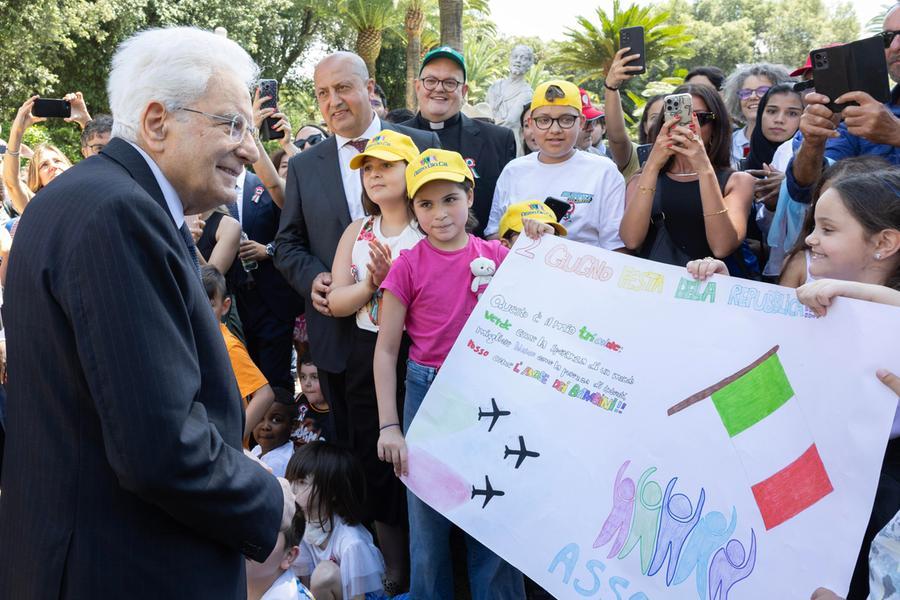
But it is in personal and institutional courtesy when it comes to making citizens feel closeness that the President of the Republic gives the measure of a profound humanity that goes beyond the office: these are the lost victims of great tragedies (who could forget the silent, physical embrace of the mothers of the victims of the Morandi bridge, which spoke without words of all the understanding of those who have been there?) or of the children and young people who ask them questions of integration and the future.
It is to them, to the young people who in fact appreciate him very much, that Sergio Mattarella most often addresses that spontaneous and restrained smile, which many times – even with self-deprecating accents – we have seen spread to his clear eyes, among the athletes: boys too, symbols of the Republic too, of whom he seems to understand very well all the awkwardness when in his presence, intimidated, they stumble into speeches that are too much bigger than them inside buildings to which they are not accustomed. Perhaps the echo of a reluctance he has known.
Despite having, in fact, then given depth, dedication, experience and a straight back to his political commitment, as when he resigned with four other DCs, as Minister of Education in 1990 to avoid voting for the Mammì law, on the subject of TV concessions, on which the VI Andreotti Government had put its trust, Sergio Mattarella would probably have remained, due to natural reserve, far from active politics, if a black page in the history of the Republic had not come across his life on 6 January 1980, when he found himself extracting from the car in front of his house the riddled body of his brother Piersanti, who as president of the Sicily Region had made the “wrong” of putting himself in the way of those who had wanted the sack of Palermo.
It is no coincidence that surveys (even different ones) reiterate that Sergio Mattarella is today the only institutional figure in whom citizens, across their affiliations, largely trust today: «With 61.8% of expressions of trust, in fact”, we read in the summary of the latest Italia Eurispes Report, presented on 28 May, “the appreciation for Sergio Mattarella differs considerably from the result, not very high in percentage and well below half of the sample, recorded by Parliament, the Government and also, although with less intensity, by the Judiciary”. And if it is true that the role of the President of the Republic was created to unite, while the parties, both government and opposition, necessarily divide: «The observation of the data in a historical series gives us a picture to be considered growing over time in terms of trust granted by Italians. Suffice it to consider that in 2015, the year President Mattarella took office at the Quirinale, the percentage of approval was 45.3%”.
A sign that citizens perceive coherence between words and life, when Mattarella says, as in the message to the Prefects, that: «Dialogue, listening, proximity are essential canons for interpreting every civic responsibility oriented towards social cohesion». And that: «Consolidating the architecture of trust between institutions and citizens, reviving in each one the most authentic sense of democratic participation, is a persistent task in the life of the Republic».