






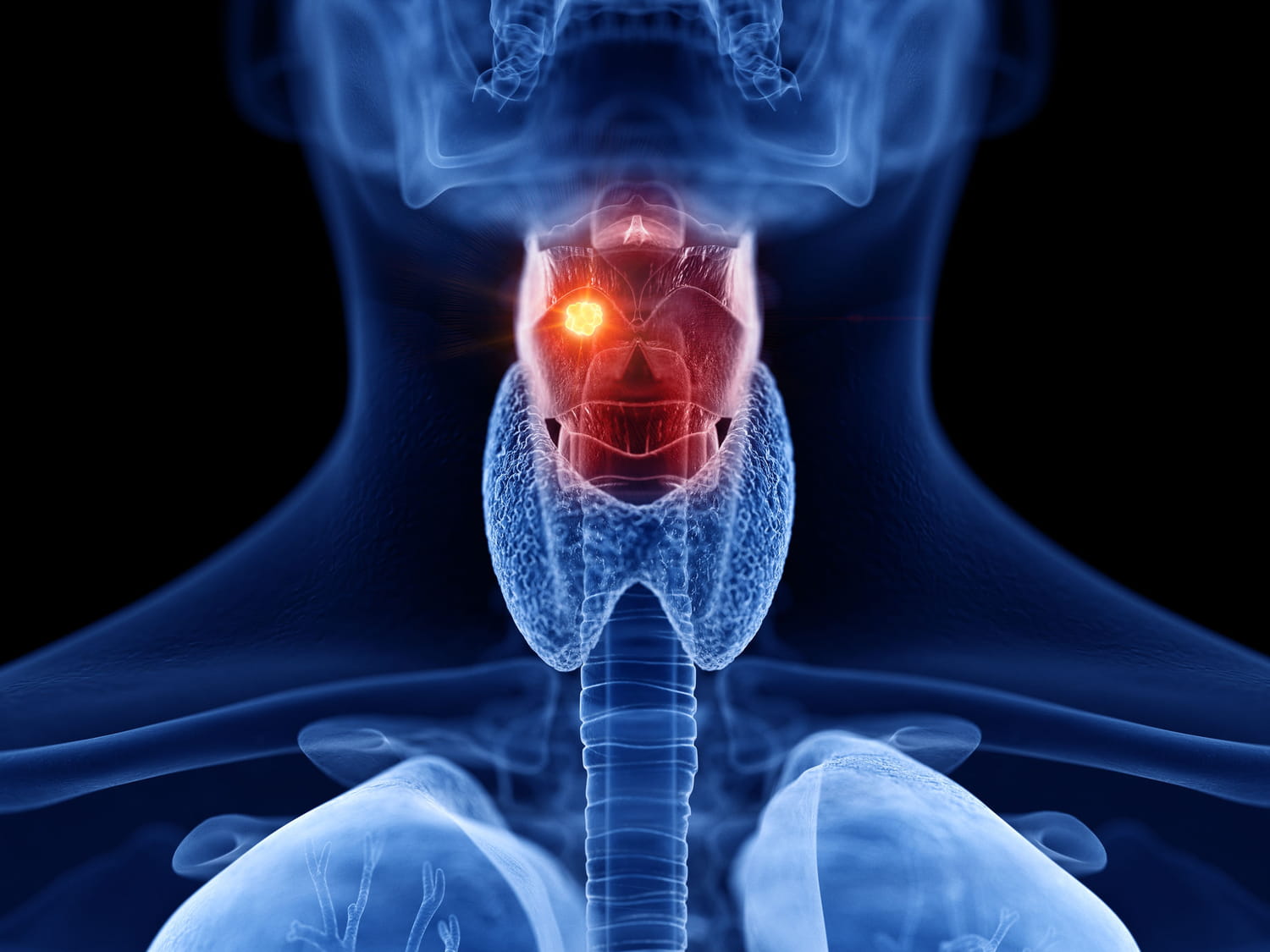
Head and neck cancers form in the mouth, tongue, throat, but also in the nasal cavity or sinuses. We also speak of “ENT cancer” or “cancers of the upper aerodigestive tract (VADS)”. Update with Dr Ingrid Breuskin, surgeon and head of the ENT committee at Gustave Roussy.
In France, head and neck cancers – also called ENT or upper aerodigestive tract cancers – occur approximately every year. 15,000 to 16,000 new peopleor around forty diagnoses per day. They cause almost 3,500 deaths annual, a relatively stable level in recent years. They affect around 70% of men, but the progression among women is now well documented, particularly in relation to changing tobacco and alcohol consumption habits. The majority of tumors are located in the mouth and pharynx, and almost 70% are discovered at an already advanced stagewhich complicates their care. If tobacco and alcohol remain the main risk factors, papillomavirus (HPV) infections also play an increasing role, particularly in oropharynx cancers.
A head and neck canceralso called upper aerodigestive tract cancer Or ENT canceris a cancer that affects the entire ENT sphere, going from the base of the skull to the base of the neck. ENT cancers can involve:
- the oral cavity (mouth, tongue, lips, jaw, etc.)
- the oropharynx (the soft palate, tonsils and base of the tongue)
- the larynx
- the hypopharynx
- the nasopharynx (also called cavum which is located behind the nasal cavity)
- nasal passages and sinuses
ENT cancers generally develop in the mucosa, in other words the pink surface which lines the oral cavity and the upper aerodigestive tract. A cancer that develops from the mucosa is called “squamous cell carcinoma.”
- Approximately 90% of ENT cancers are squamous cell carcinomas.
- 10% of ENT cancers are rare tumors.
ENT cancers generally appear around 50-60 years old but they can occur earlier, around 30-40 years of age, particularly when they are linked to the human papillomavirus (HPV).
ENT cancers are symptomatic, but symptoms are not specific And can resemble a cold or a sore throat, such as:
- the hoarse voice
- loss of voice
- lymph nodes in the neck
- ear pain
- sore throat
- pain or difficulty swallowing (dysphagia)
- the presence of lesions that resemble canker sores on the mucous membrane of the oral cavity
- a blocked nose
- repeated nosebleeds
“All of these signs are obviously not specific symptoms of ENT cancer. On the other hand, we start from the principle that if these symptoms persist for more than 3 weeks, you need to consult a doctor“insists Dr. Breuskin.
It is the duration of the symptoms that should lead to consultation. his general practitioner. The latter will be able to direct towards an ENT specialist a patient who has any of the symptoms listed above for more than three weeks.
Squamous cell carcinomas are mostly linked to tobacco and alcohol : smokers are more at risk than non-smokers and people who consume excessive alcohol are more likely to develop ENT cancer. “Tobacco consumption associated with alcohol consumption has a synergistic effect, that is to say that double intoxication, tobacco and alcohol, increases the risk of head or neck cancer.“, the specialist would like to point out. For more than ten years, there has been a lot of talk oropharyngeal cancer linked to papillomavirus human (HPV) and these can occur in patients without intoxication. When cancer occurs, there is no longer any infection with the virus. “HPV infection is common in the general population, but very few people will develop cancer“, wants to reassure Dr. Breuskin.
“Furthermore, diseases, such as oral lichen planus which affects the skin and mucous membranes, can, in the long term, degenerate and develop into ENT cancer. These inflammatory diseases require regular monitoring to detect possible cancer and, if necessary, consider early and appropriate treatment.“, underlines our interlocutor. We do not always know the causes of rare tumors. Some, such as among woodworkers, are linked to prolonged exposure to wood tannins.
Many lesions (localized on the oral cavity or on the tonsils for example) are visible during the clinical examination. Then, it is generally necessary to carry out a nasofibroscopy which consists of introducing a small endoscope into the natural passages to explore the entire nasal cavity, pharynx and larynx and identify possible cancerous lesions. Then, we carry out an imaging assessment which generally includes a head and neck scan (with injection of a contrast product) and lungs, an MRI of the head and neck and a PET scan. “In addition, we carry out a endoscopic examination (under general anesthesia) during which we will examine all locations of the upper aerodigestive tract as well as the esophagus. This will make it possible to map the lesions and take biopsies which will make it possible to establish the diagnosis in an extremely reliable manner.“, indicates Dr Breuskin. Since ENT cancer is mainly associated with tobacco and alcohol consumption, examining the esophagus helps detect the presence of possible synchronous cancer. Carrying out all these examinations makes it possible to make a diagnosis, to define the classification of cancer according to the TNM nomenclature (staging of the cancer according to its size, lymph node invasion and possibly metastasis) and to consider appropriate treatment.
Treatment of head and neck cancer is generally based on a combination of surgery, radiotherapy and chemotherapy.
• Surgical treatments consist of removing the tumor and the lymph nodes. In general, these are so-called “open technique” surgeries, but more and more minimally invasive techniques are being developed such as endoscopic surgery in the nasal cavity and sinuses, robot surgery and laser surgery for laryngeal lesions. Note that for advanced lesions, reconstruction is very often necessary and carried out at the same time as the surgery to excise the lesion.
• Radiotherapy can also treat ENT cancers. It can sometimes be associated with chemotherapy to potentiate the effects of radiotherapy.
→ If the cancer is at an early stage (when it is a small tumor of less than approximately 4 cm), we will prefer unimodal treatment: either exclusive surgery or radiotherapy possibly associated with chemotherapy.
→ If the cancer is locally advanced (when it is a large tumor of more than 4 cm or with lymph node invasion), we will head towards multimodal treatment which combines surgery, then post-operative radiotherapy (with possibly chemotherapy). Sometimes, primary chemotherapy may also be offered.
→ If the cancer has recurred or metastasizedwe will immediately move towards chemotherapy, the objective of which will be to regress the disease and reduce the symptoms. .
Currently, immunotherapy is also used in the therapeutic arsenal against these cancers. Either for recurrent and/or metastatic cancers, or in combination with radiotherapy as part of therapeutic trials. “The management of these cancers is still multidisciplinary. Most patients will benefit from oral health care, primarily to prevent damage to the teeth from radiotherapy. Nutritional support is very frequently offered to these patients who have difficulty swallowing, or even addiction treatment, essential when the cancer is associated with alcohol or tobacco consumption.“, develops Dr. Breuskin.
Overall, despite technical and technological advances in recent years, the prognosis of these cancers remains stable with a 5-year survival rate of approximately 50%. However, when the cancer is early, this 5-year survival rate can be closer to 80%. Furthermore, the prognosis for cancers linked to HPV is around 90% at 5 years. In all cases, remember that early treatment can considerably increase the survival rate.
Prevention consists of avoiding risk factors for ENT cancers:
► Reduce your tobacco and alcohol consumption
► It is very likely that vaccination against HPV will modify the incidence of ENT cancers linked to it. The High Authority for Health recommends vaccinating young girls aged 11 to 14 (with a booster from 15 to 19). Recently, these recommendations have also been extended to young boys.
Thanks to Dr Ingrid Breuskin, surgeon and head of the Gustave Roussy ENT Committee.