






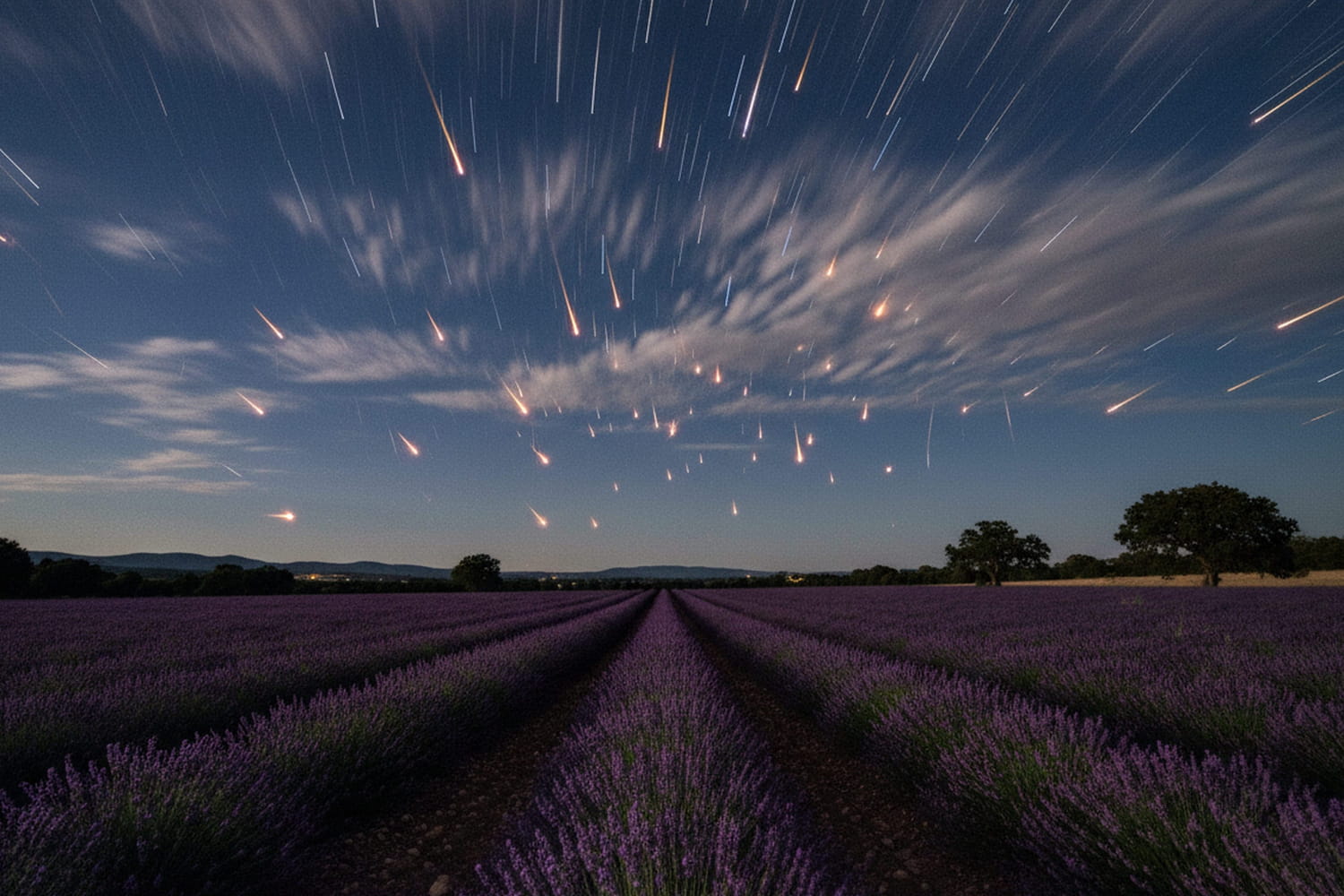
With 60 shooting stars per hour, it is the most powerful daytime meteor shower known to date.
This shower of shooting stars is one of the most intense astronomical phenomena, but also one of the most secret of the year. While we are used to scrutinizing shooting stars in the heart of dark nights like the last one which took place at the beginning of May, our planet is preparing to cross an immense cloud of celestial dust in broad daylight. The challenge of seeing them is immense because the meteors hurtle towards us while the Sun shines brightly, making them invisible to the naked eye during the day. However, there is a trick to intercepting this visual spectacle.
This event is called the Arietid rain. Very active, this flow of space debris hits the Earth’s atmosphere at more than 39 km/s according to data from the International Meteor Organization. Concretely, the vast majority of these shooting stars will burn up invisibly in the blue sky, masked by the light of the Sun. Astronomers manage to detect them during the day using special radars. For the “ordinary” observer on the ground, the whole challenge consists of watching for “earthgrazers”. These are grazing meteors that enter the atmosphere horizontally, just above the horizon line. They leave behind them long, very spectacular luminous and colorful trails, which spring from the bottom of the sky to rise towards the stars.
Peak visibility in France will take place on the morning of Wednesday June 10, 2026, around ten days after the Blue Moon shines in the French sky. To have a chance of observing them, you will have to position yourself very precisely between 4:15 and 5:15 a.m., just before dawn. This is the only shooting window according to the EarthSky site: the sky will still be dark enough to discern the glow, and the constellation Aries (the point of origin of the meteors) will just begin to rise in the East. However, a small trap is slipping into the sky this year: a waning gibbous Moon will be present, so it is advisable to take shelter behind a building or a tree to hide your light and keep your eyes well accustomed to the darkness.
No need for binoculars and a telescope: these instruments reduce the field of view as shooting stars streak across the sky in completely unpredictable ways. The best way to see them is with the naked eye. Look towards the North-East/East horizon (use a compass), where the sky is slowly starting to lighten. Let your eyes adjust to the dark for about fifteen minutes and keep an eye on the horizon. Up to 60 meteors per hour are expected, leaving memorable trails in the sky.
This phenomenon is not so rare because the Earth passes through this debris flow (probably left by comet 96P/Machholz or the asteroid Icarus) every year at the same time, between mid-May and the end of June. If you miss the June 2026 appointment, you will have to wait one more year, until the beginning of June 2027.