






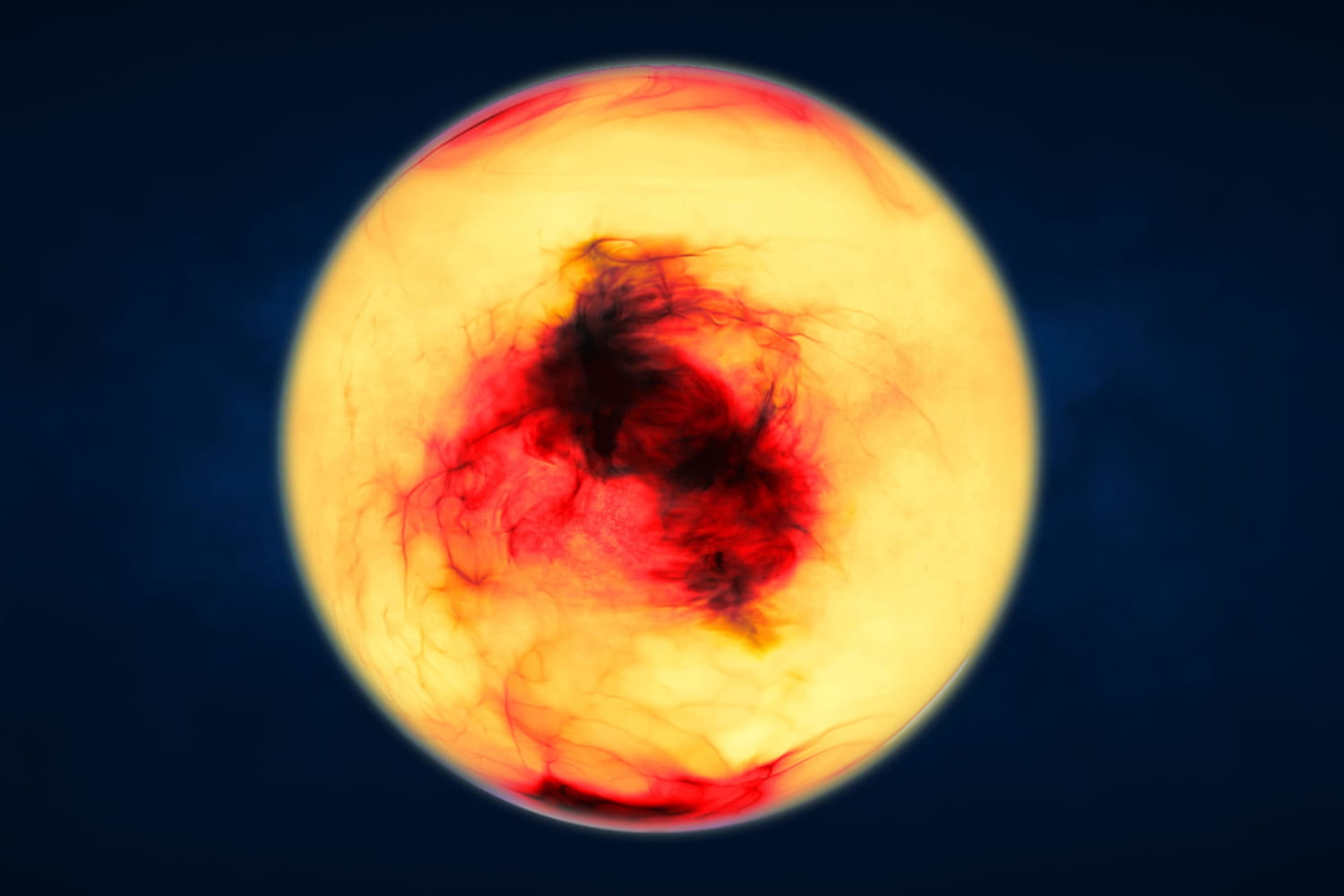
NASA presents this moon as a star in perpetual boiling. It’s a rare sight that won’t happen again anytime soon in such a favorable light.
The solar system is about to offer us a fascinating celestial rendezvous. After the Pink Full Moon, in a few days, all eyes will turn to Io (pronounced “io”), the most volcanic object in the known solar system. Composed of sulfur and molten lava, this star is a natural satellite: it does not revolve around the Sun, but escorts the giant planet Jupiter in its course. As NASA points out, Io is a world in permanent turmoil with more than 400 active volcanoes that project plumes of gas and particles that can rise several hundred kilometers in altitude. Its surface covered with sulfur gives it its very particular orange-yellow hue.
To enjoy the show, conditions are favorable in April, especially in the northern hemisphere. First, the sky must be clear, far from the light pollution of large cities, so that Jupiter’s brightness is not disturbed. To spot the giant planet, just look to the west at the start of the night: it’s one of the brightest points in the sky. It is then possible to see several of its moons in the form of tiny aligned points of light, including Io.
To see this volcanic moon, you will have to look at the sky on Thursday, April 9. The show will be most interesting from 9:30 p.m. Be careful though: Io is impossible to see with the naked eye because it is drowned in the powerful glow of Jupiter. To distinguish it, you will need at least a pair of binoculars (well stabilized on a support) or a small astronomical telescope. If you have binoculars, first look at Jupiter: you will then see four small aligned points (the Galilean moons), like tiny light sources moving around the planet.
The most spectacular phenomenon will be reserved for telescope owners. That evening, you will be able to observe an impressive phenomenon: the passage of Io’s shadow over the clouds of Jupiter. The European Space Agency (ESA) describes this world as a unique geological laboratory, specifying that “Io’s volcanic eruptions are so powerful that they permanently alter the face of the moon, covering impact craters with glowing lava flows and sulfur dioxide snow“.
It must be said that Io is an exception among the more than 90 known moons that revolve around Jupiter. Discovered by Galileo in 1610, it is the closest of the giant planet’s large moons. It orbits approximately 422,000 km from the center of Jupiter, barely further than the Earth-Moon distance. It maintains its orbit thanks to a very high speed: around 17 kilometers per second (nearly 61,000 km/h).
If you miss this April 9 appointment, know that Jupiter and its moons regularly offer this type of configuration. However, some periods are more favorable than others. The next opposition of Jupiter, scheduled for the summer of 2027, will once again offer particularly interesting observation conditions, with a higher and brighter planet in the sky.