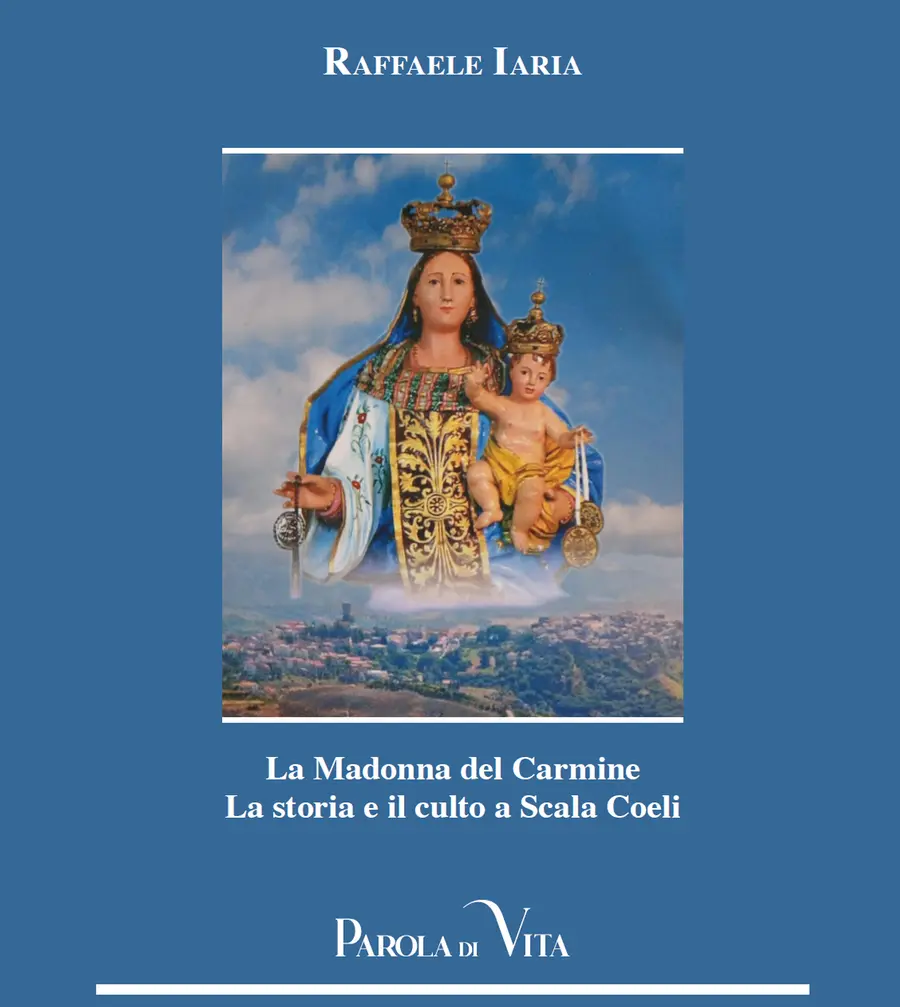
There are books that are not just born from an editorial project, but from a debt of love. The Madonna del Carmine. History and worship at Scala Coeliby Raffaele Iaria, belongs to this rare and precious category: it is not simply a small volume of local religious history, but an act of gratitude towards a land, a community and a devotion that has spanned generations.
The main merit of the work lies precisely in its double soul. On the one hand there is the rigor of the research, with the patient work on the sources, on the documents, on the historical traces of the Carmelite cult and of the presence of the Carmelites in Scala Coeli, the author’s town of origin. On the other hand there is the affective heartbeat of the writer not as an external observer, but as a child of that community. Iaria does not pretend detachment: he declares from the beginning that these pages arise from the desire not to forget. And it is precisely this sincerity that gives strength to the book.
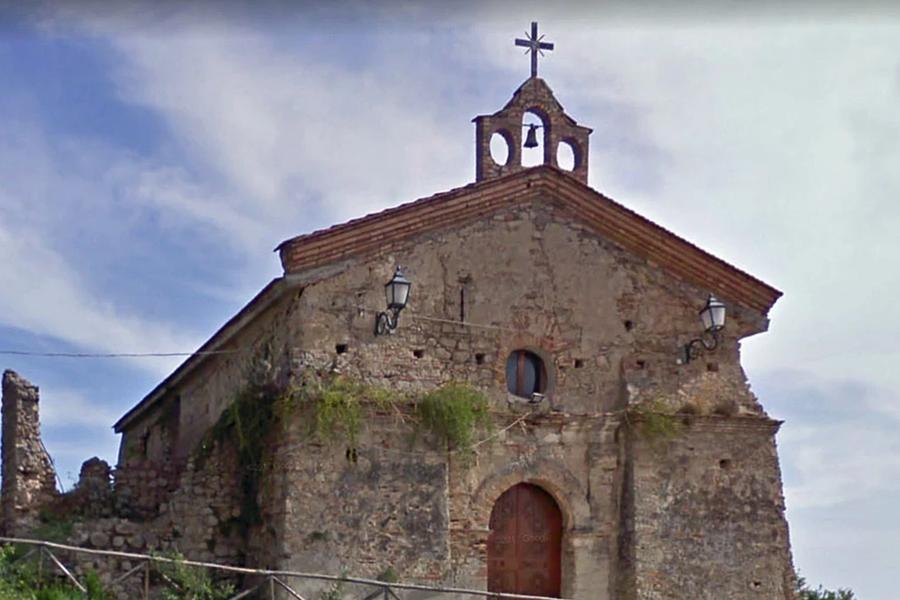
Scala Coeli, this wonderful village perched on a mountain overlooking the Calabrian sea from afar, emerges not as a simple setting, but as a protagonist. The town in the Upper Ionian area of Cosenza, with its mother church dedicated to Santa Maria Assunta, the statue of the Madonna del Carmine venerated by the people of Scale in Italy and around the world, its religious and civil memories, becomes the place where popular faith shows its tenacity. In times in which many small towns risk disappearing from memory rather than from geographical maps, this book makes a necessary gesture: it puts a community, its roots, its symbols back at the centre. Because popular piety is inextricably born not only from a sincere and genuine faith, but also from love for one’s land, wherever the roads of the world lead.

The part dedicated to Carmelite spirituality is particularly successful. The author accompanies the reader from the origins of the Order, on Mount Carmel, in Palestine, to the spread of the Marian cult, without weighing down the narrative. The story remains accessible, warm, understandable even to those without specialist training. It is a book that informs, but above all it restores a climate: that of simple devotion, of processions, of novenas, of songs, of images kept in homes, of the people who recognize themselves under the maternal gaze of Mary.
The chapter on the Scapular is one of the most intense passages. Here the symbol is not reduced to a devotional object or a folklore residue, but is presented for what it is in the Carmelite tradition: a sign of belonging, protection and Christian lifestyle. It is beautiful that Iaria manages to keep together theology and people, doctrine and feeling, memory and current affairs. Because true popular religiosity, when told well, is never a superstition to be pitied: it is the language of faith, the grammar of the heart, the concrete form with which a people has learned to turn to God.
The volume also has a civil value. In an Italy that often looks at villages only when they become a tourist postcard or a demographic emergency, Iaria reminds us that villages also live through their festivals, their altars, their brotherhoods, their rites. Rites that the author began to love since he was a child, like in a Tornatore film. The feast of the Madonna del Carmine is not the tired repetition of what has always been done: it is a community pact that is renewed, a way of saying that a story continues, even when emigration disperses the inhabitants and time wears away the stones.
The preface by Monsignor Maurizio Aloise captures the heart of the book well: this work is “a small treasure chest” that holds a great treasure. And it really is like that. It does not claim to be a definitive treatise, and perhaps for this reason it is convincing. It has the sober measure of notebooks destined to last, of those publications that a family keeps, a parish consults, an emigrant takes with him to find a piece of home.
Raffaele Iaria delivers a flattering, devoted and useful work to Scala Coeli. A book that saves a page of local history from oblivion and at the same time speaks to all those who know how much roots matter. Because a community that remembers its Mother, its saints, its churches and its celebrations does not remain a prisoner of the past: it finds in the past the strength to continue walking. And at the end of the reading we all find ourselves from Scalesi.