




The abuses of ICE agents against migrants in American cities, the devastation of Gaza, the bloody raids of the Brazilian police in the favelas, the revolts of the youth of the Z generation in Nepal and Madagascar, the women violated in their rights, the devastating fires in Los Angeles, a cheerful Filipino wedding in a flooded church. These are some of the themes captured by the lenses of the finalist photographers of the international photojournalism competition World Press Photo.
The 42 winning projects of the 2026 edition were selected by an independent jury from 57,376 photographs sent by 3,747 photographers from 141 countries. Until June 29th the chosen photos will be presented as a national preview at Palazzo Esposizioni.
Family stories, moments and events that made the news are presented, as well as stories that have remained unpublished or little told. The photographs oscillate between global perspectives and deeply personal and intimate points of view, offering a layered understanding of the world we live in.
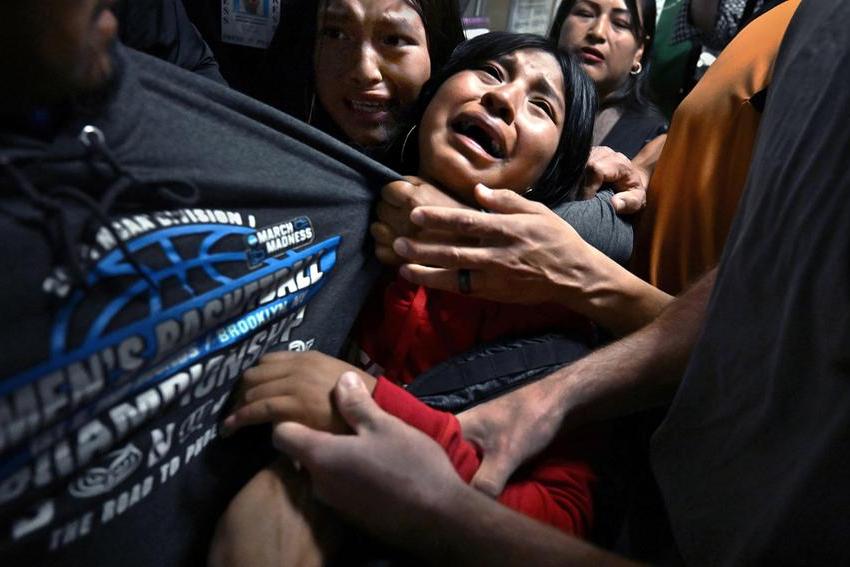
The Photo of the Year is signed by the American photographer Carol Guzy with the shot Separated by ICE, taken for the Florida newspaper Miami Herald.
The photograph, taken inside the Jacob K. Javits Federal Building in New York on August 26, 2025, documents the moment Luis, an Ecuadorian migrant, is stopped by Immigration and Customs Enforcement (ICE) agents after a hearing in immigration court. Luis’s distraught daughters cling to their father as he is arrested. The man was the only financial support for his wife Cocha and their three children, aged 7, 13 and 15, who found themselves facing immediate economic difficulties and profound emotional trauma. Photography was awarded for its ability to make visible, in a direct and human way, the impact of migration policies: not an isolated case, but a systemic condition that affects people who present themselves to institutions in good faith. The executive director of World Press Photo, Joumana El Zein Khoury, said: “This image shows the inconsolable pain of children losing their father in a place built for justice. It is a stark and necessary testimony to family separation following US reform policies. In a democracy, the presence of the camera in that corridor becomes an act of testimony: it tells of a policy that has transformed the courts into places of destroyed lives. It is a powerful example of how important independent photojournalism is.”
Together with the winning photo, the two finalist projects were selected. The photo Humanitarian Emergency in Gaza by Saber Nuraldin, (EPA Images), taken on July 27, 2025, shows Palestinian civilians climbing onto a humanitarian aid truck in an attempt to obtain flour. The truck entered the Gaza Strip through the Zikim crossing, during what the Israeli army called a “tactical suspension” of operations to allow aid to pass through.
The second finalist is Victor J. Blue with the shot The trials of the Achi women for The New York Times Magazine.
For more than forty years, a group of indigenous Maya Achi women from Rabinal continued to live in the same communities as the men who raped them, sometimes as neighbors. The civil war in Guatemala led to the genocide of thousands of Achi Maya people at the hands of the army and local state-backed paramilitary forces, who used sexual violence as a systematic weapon to subjugate indigenous communities. In 2011, 36 women broke their silence, launching and winning a 14-year legal battle against their attackers. Their collective resilience is transforming a legacy of war-related impunity into a historic achievement of justice.
Among the winners also Chantal Pinzi, the only Italian photographer among those awarded this year, who won the prize in the Stories category for the Africa region. Her project, ‘Farīsāt: Gunpowder’s Daughters’, tells of a group of women in Morocco who participate in the Tbourida, a historic patriarchal equestrian tradition. For centuries, Tbourida has been an exclusively male activity, but female riders have consistently fought for inclusion since the reform of the Moroccan family code strengthened women’s legal rights.