


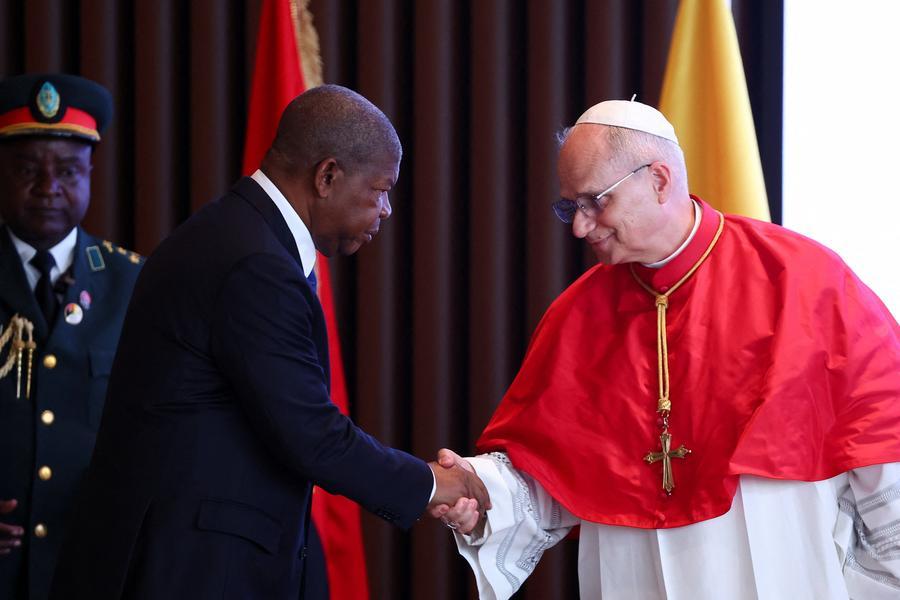
Luanda, the capital of Angola, welcomes Pope Leo XIV with an embrace full of warmth, affection and enthusiasm. After greeting Cameroon, encouraging its people to remain steadfast in Christ to be “salt and light of this earth”, and having thanked the Cameroonian president Paul Biya with a telegram from the plane for the hospitality received, the third stage of the Pope’s apostolic journey to the African continent began: Angola, where Leone will stop until April 21st, before flying to Equatorial Guinea.
After the festive and colorful procession that accompanies the Popemobile’s route along the streets, the Pontiff’s first official appointment is the meeting with the political authorities, representatives of civil society and the diplomatic corps. The slogan of the trip is: “Pope Leo XIV, pilgrim of hope, reconciliation and peace, blesses Angola”. Country overlooking the western coast of southern Africa, on the Atlantic Ocean, seventh largest African country, independent from Portugal since 1975, Angola is a mosaic nation, highly multi-ethnic, with a population that reflects the great diversification of tribal groups.
The vast majority of the population is Christian and Catholicism is by far the predominant faith; there is no shortage of various Protestant confessions (such as Methodists and Pentecostals), as well as a small Muslim minority, made up in particular of immigrants from other African countries. Angola is a country rich in resources, minerals, rare earths and oil (it is one of the main producers of crude oil in Africa), its economy is growing very rapidly, but at the same time it is riddled with rampant corruption, profound socio-economic inequality, with wealth concentrated in the hands of a small elite, while a large part of the population lives in poverty, especially in rural areas.
In front of around 400 people, including political and religious authorities, entrepreneurs, representatives of civil society and culture, gathered in the Protocol Pavilion of the Presidential Palace, after a tribute of traditional music in his introductory speech iAngolan President João Manuel Gonçalves Lourenço underlines the institutions’ commitment to the poorest, driven by the daily struggle against inequalities, indifference, social exclusion.
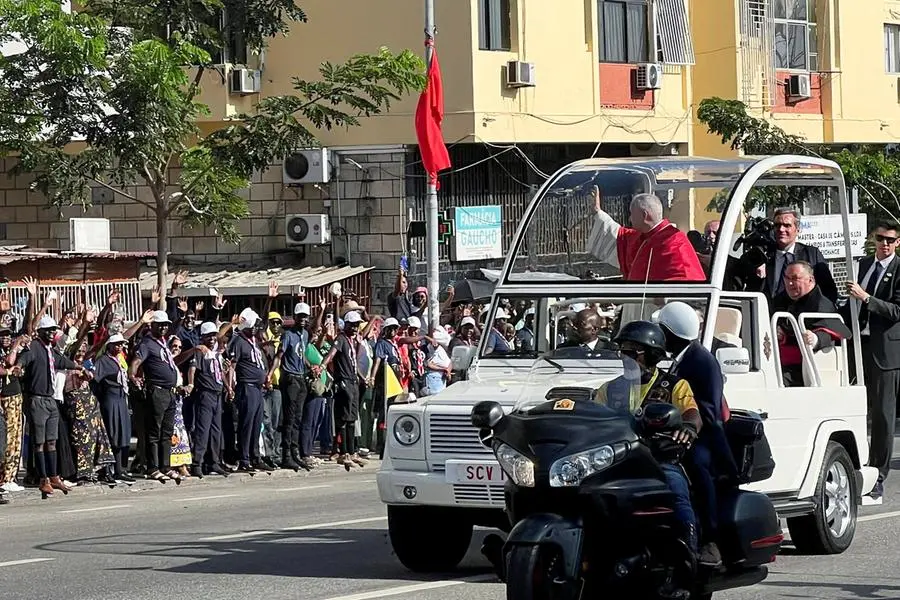
Welcome to the Pope on the streets of Luanda.
(REUTERS)
After the president, Pope Leo takes the floor, speaking very naturally in Portuguese. In his speech, the Pope addresses the issue of plundering of African resources by foreign powers, insists on the plague of exploitation of the nation’s wealth. «You know well that too many times we have looked and continue to look at your regions to give or more often to take something. It is necessary to break this chain of interests which reduces reality and life itself to a commodity of exchange. For the entire world, Africa is a reserve of joy and hope that I would not hesitate to define as political virtues. Because its young people and its poor still dream, they still hope, they are not satisfied with what already exists, they wish to get up again, prepare for great responsibilities, commit themselves personally.
Leone continues: «I am here among you at the service of the best energies that animate people and communities, of which Angola is a very colorful mosaic. I wish to listen and encourage those who have already chosen good, justice, peace, tolerance, reconciliation.”
The Pontiff does not mince words and speaks clearly and openly about «material riches that overbearing interests get their hands on, even in your country. How much suffering, how many deaths, how many social and environmental catastrophes this extractivist logic brings with it. We see in every part of the world how it fuels a model of development that discriminates and excludes, but which still claims to impose itself as the only possible model.” And he continues: «Africa has an urgent need to overcome situations and phenomena of conflict and enmity, which tear the social and political fabric of many countries, fomenting poverty and exclusion.”
The Pope recalls the need for peace, for overcoming conflicts. “Blessed are the peacemakers,” he recalls. «Angola can grow a lot», observes Leone. Who, addressing the authorities, launches an exhortation: «Do not be afraid of differences, do not extinguish the visions of the young and the dreams of the elderly. Know how to manage conflicts by transforming them into paths of renewal, put the common good before that of a party, never confusing your part with the whole. History will then prove you right, even if someone is immediately hostile to you.”
The Pontiff further observes: «Discontent, the sense of impotence and uprootedness separate us, instead of connecting us, spreading a climate of extraneousness to public affairs, contempt for the misfortune of others and the denial of all fraternity. This discordance breaks down the constitutive relationships that everyone has with themselves, with others and with reality.”
Citing Pope Francis, Leone underlines that today in many countries the political mechanism of exasperation and polarization is used. And again: «Without joy there is no renewal, without interiority there is no liberation, without meeting there is no politics, without the other there is no justice. Together you can make Angola a project of hope. The Catholic Church, whose work of service to the country I know you esteem, wishes to be leaven in the dough and encourage the growth of a fair model of coexistence, free from the slavery imposed by elites with a lot of money and false joys.”