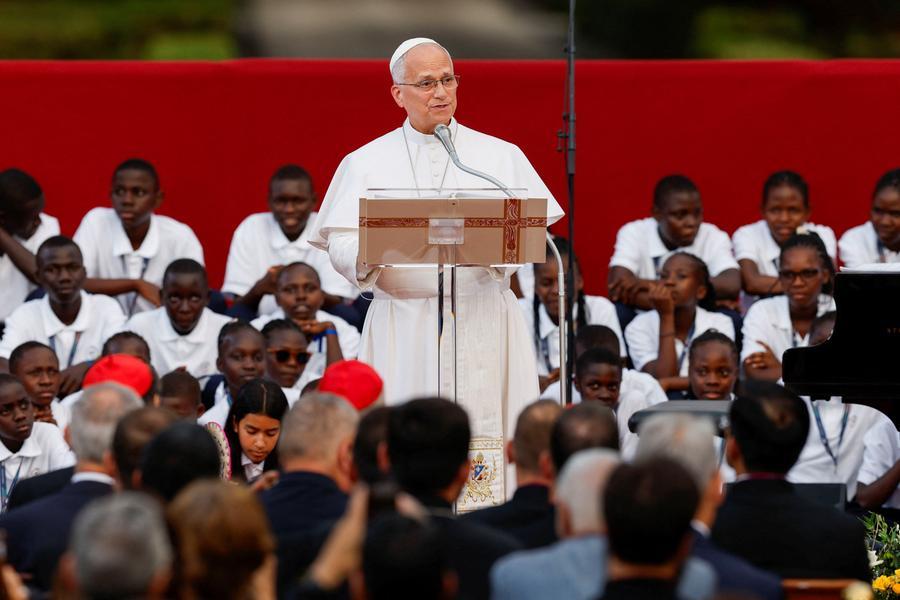




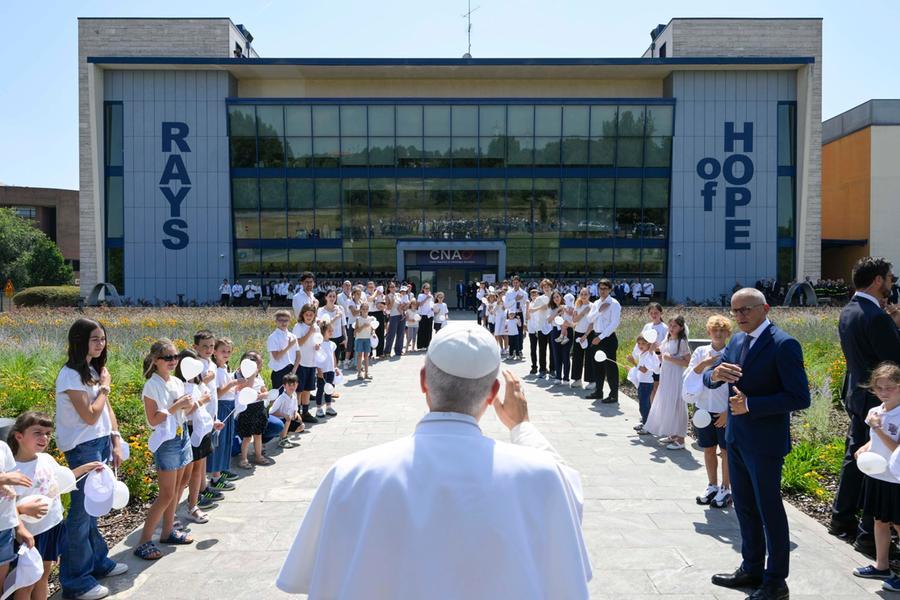
It is with the most terrible mystery, that of the suffering and illness of children, capable of shaking even the most solid faith, that he was confronted Pope Leo at the beginning of his visit to Pavia. “God doesn’t want anyone to suffer” said the Pontiff while meeting 10 young patients and their families at National Center for Oncological Hadrontherapy (Cnao)the first stop on his afternoon of June 20th. “What God promises us” in pain, he assured, “is that he will always be present. When things are difficult, let’s rely on him.” And he recommends to parents: “Make the whole world understand that when there are difficult moments, if there is no family presence, everything is more difficult.”
The Cnao is a global excellence in the treatment of complex tumors through an advanced form of radiotherapy that uses protons and carbon ions, capable of targeting selected, otherwise inoperable cancer types. Since 2011, when the treatments began, the Cnao has taken care of more than 6,000 patients, adults and children, within the National Health Service, with over 600 new cases faced every year. Leone thanked the centre, “which works miracles”, he said, and the staff, “because God works in our lives also through doctors, nurses, many people”. And finally he recalled the importance of research, as a way to prepare for the future.
A faith to be re-announced in the footsteps of Augustine
It was then the turn of the religious heart of the visit to Pavia, the part dedicated to Saint Augustine. The author of Confessionsthe “doctor of grace”, as the prior of the Augustinians, Father Joseph Farrell, presented him to the Pope, rests in San Pietro in Ciel d’Oro, medieval basilica entrusted to the Augustinian fathers, to which Robert Prevost had already visited several times and where, when he was himself prior general, he had welcomed Benedict XVI on a visit in 2007. Augustine, born in 354 in Tagaste, in today’s Algeria, arrived in Milan around the age of thirty and converted to Christianity after meeting Saint Ambrose. For 34 years he was then bishop of Hippo, in his homeland, and he died there at the age of 75. His body was moved first to Sardinia and then to Pavia in the year 722.
It was precisely Augustine’s conversion that characterized Leo’s speech: “There is an ever-increasing need, today, to accompany people in the discovery or rediscovery of faith,” he recommended. «Therefore, we must announce the nucleus of the Gospel, that is, Jesus, who in his incarnation, death and resurrection reveals to us the mystery of God and at the same time the mystery that we ourselves are.” In this sense, Leone pointed out that Augustine’s thought, the story of his conversion and the spirituality “remind us of the value and primacy of interiority: ‘Do not go outside yourself. Return to yourself: the truth lives in the inner man'”.
No to hateful words
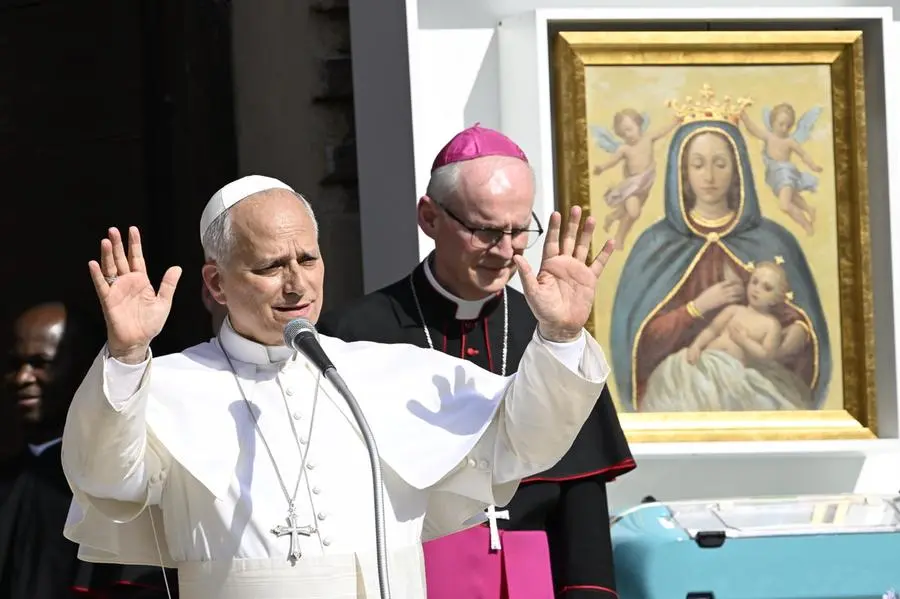
Having crossed Pavia with the Popemobile, the pontiff then arrived in Cathedral Squarewelcomed by the children and animators of the parish events and by the Peruvian community of Pavia. The protagonists of the churchyard setup were an olive tree and twelve baskets of bread, accompanied by hundreds of pieces of paper with the thoughts of the children, to which were added the messages left during the evening and the previous night by young people passing by. At the altar, the painting of the Madonna della Colombina by Copianoa sanctuary in which Cardinal Prevost was supposed to close the Marian Jubilee in May 2025. An appointment that was missed with his election to the papal throne. And so, a year later, that meeting between the Pope and the Madonna took place, albeit in a different way. «Persevere in friendship», he recommended to the boys: «If we want the world to live in peace, we must all be peacebuilders. No to hateful words! No to bullying! (the Pope said it in English: bulling). No to wars between countries!

At heart the common good
Then it was the turn of Victoria Squarewhere he met the citizens. «The city is one for all, it is singular and plural. Being social means being in solidarity, behaving like authentic partners: motivated by the common good and not by partisan interests”, he recommended. «Since the people are responsible for public space, in the face of current challenges, let’s ask ourselves what strengthens and what erodes our homes: let’s ask ourselves what makes our society stable and what hurts it. Otherwise, what belongs to everyone risks becoming no one’s: when indifference seems to disintegrate our community, we need to renew everyone’s active participation in city life.” And he commented: «Today I invite each of you to repeat within yourself: I am interested in our city!».
Meanwhile, the visit also took the form of an act of charity: the Italian Farmers Confederation of Pavia donated two tons of Carnaroli rice to the Pope, excellent product of the area. Through the Apostolic Charities, the rice will be partly distributed to the poor of Rome and 800 kilos will be sent to Ukraine.
«This visit is «a great gift. A beautiful moment for the civil and ecclesial community. An experience of faith and hope for many”, commented the bishop of Pavia, Monsignor Corrado Sanguineti.