




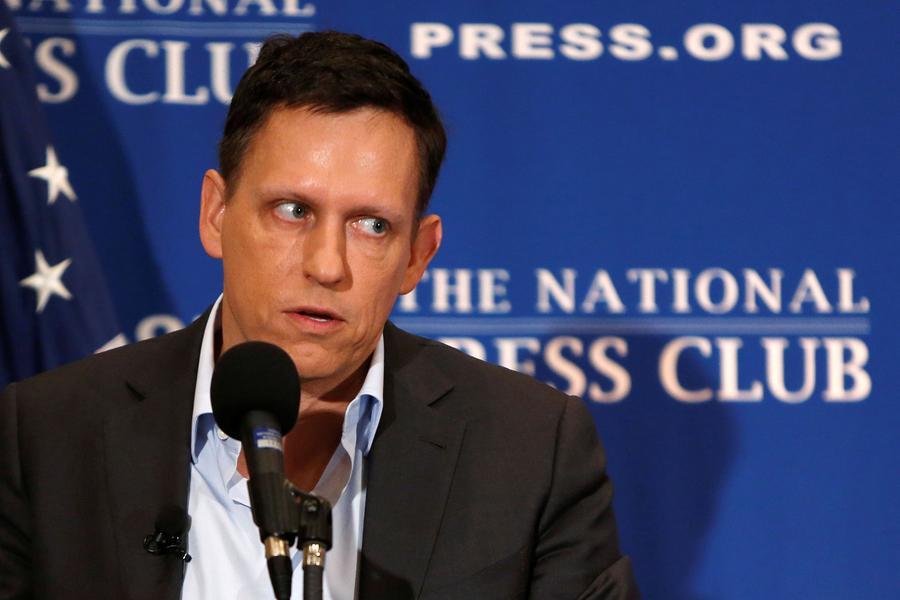
We publish the full text of the monsignor’s reflection Antonio Staglianò, president of POntificial Academy of Theologyon the thought of Peter Thiel who in recent days was in Rome for a series of conferences on the Antichrist. Thiel is considered one of the most influential and controversial figures in Silicon Valley for his conservative and anti-environmental political positions and his interests in transhumanism. Founder of PayPal and owner of Palantir, Thiel has also been a major proponent of Donald Trump in the race for the White House in 2016 and direct financier of the current US vice president JD Vance.
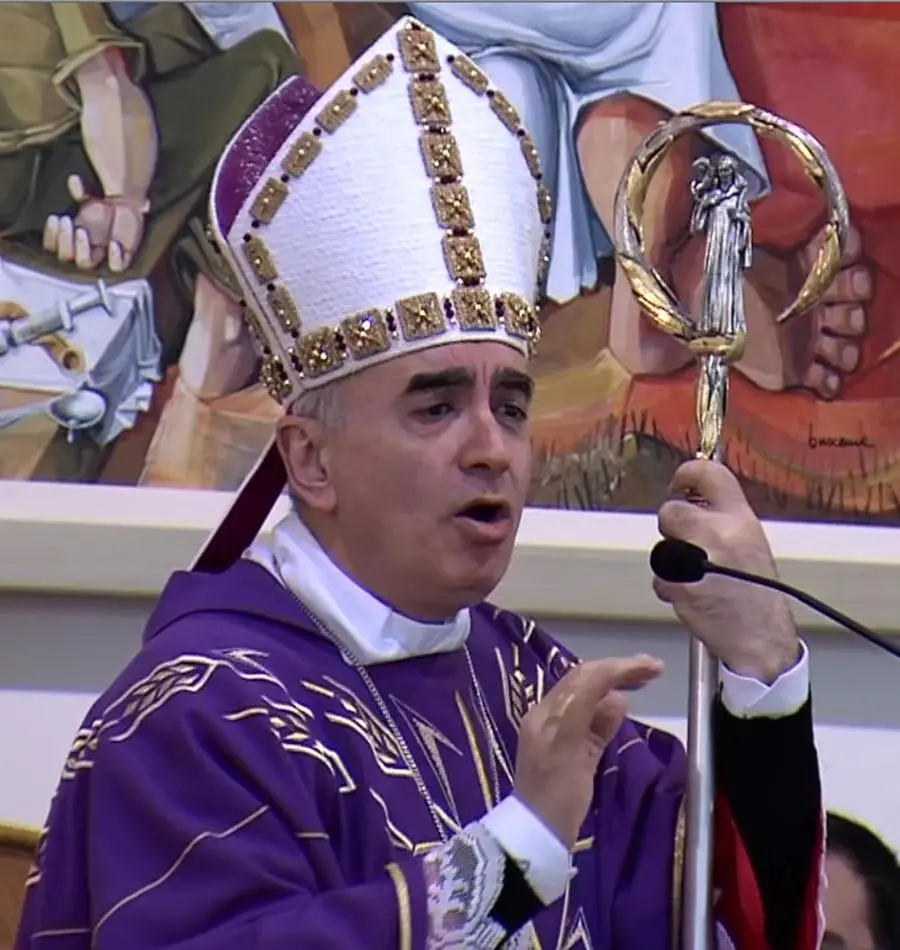
The president of the Pontifical Academy of Theology, the Hon. Antonio Staglianò
(HANDLE)
There is a phrase that Peter Thiel, the Silicon Valley billionaire who became an ideologue of the new American right, has repeated on several occasions: “The problem of violence has been ‘whitewashed away’ by the Enlightenment.” With this expression – “cleansed”, “whitewashed” – Thiel means to say that modernity has removed violence from its image of man, deluding itself that reason, law and institutions are enough to make it harmless. Then, Thiel draws a radical consequence: since violence is not an accident but the deep structure of history, then attempts to build global peace – UN, international law, democracy – are lies, even “figures of the Antichrist”. Better a “just” war than a false peace.
The provocation is strong, and for this reason it deserves to be taken seriously. Thiel deserves credit for unmasking a removal: the Enlightenment effectively removed the problem of evil, reducing it to a defect in education or social organization. But the paradox is that Thiel, in denouncing this removal, does not overcome it: he overturns it. If the Enlightenment said “violence can be eliminated with reason”, Thiel says “violence cannot be eliminated, so let’s accept it as destiny”. In both cases, the thought that the Judeo-Christian tradition has always preserved is missing: violence is real, but it is not original; man was created good, he bears the image of God, and sin is a wound, not a nature.
Here’s the thing. The Enlightenment’s removal was not just forgetting original sin; was having constructed an alternative anthropology: the self-founded individual in place of the person; a reason reduced to technical calculation instead of reason open to truth; freedom as self-determination of the autonomous subject rather than as dynamism towards the good; a state of “pure nature” that claims to think of man without grace and without the fall. Thiel, despite declaring himself an enemy of this construction, remains a prisoner of it: for him violence becomes a sort of “original sin without redemption”, an inevitable ontological structure.
The decisive difference is that for the Christian faith, original sin – which is not a fairy tale for idiots – explains why there is so much violence in humanity, but it does not make it the last wordto. Because the same tradition knows that man, even if wounded, is capable of good, and that salvation does not come from the cynical acceptance of violence nor from the technocratic illusion of erasing it, but from the conversion of the heart and the forgiveness that breaks the spiral of revenge.
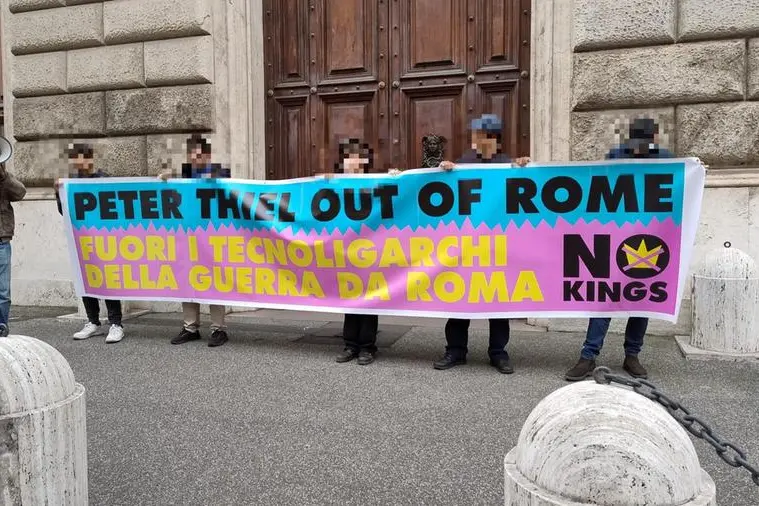
Flash mob of the No Kings movement against Peter Thiel in front of the Ministry of Defense in Rome on March 15th
(HANDLE)
Thiel draws on René Girard, the great anthropologist who showed how every society is based on a scapegoat mechanism. But Girard was also a Christian aware that the Gospel is the only text that unmasks this mechanism from the point of view of the innocent victim. Thiel instead uses Girard to say: violence is the engine of history, let’s organize it wisely. In doing so, he ends up rediscovering an old power politics, that of Carl Schmitt, for which politics is defined in friendship and in the fight against the enemy. In this horizon, peace is not a value, but a form of weakening.
And here comes the most disturbing question: what is happening in our public debate? For decades we believed that secularization was the inevitable destiny of Western culture. Today we realize that theological categories have not disappeared at all: they have only emigrated to new places. Thiel speaks of “Antichrist” to brand European bureaucracy and climate activism; he speaks of “original sin” to explain the inevitability of the conflict. In short, theology returns – but in the form of ideology, without the critical memory that the Church has accumulated over the centuries. He returns to legitimize war, not to build peace.
Faced with this scenario, the question is not whether theology should have a place in public debate. He already has it, even when he denies it. The real question is: what theology? The one that reduces faith to a lexicon to ennoble power, or the one that, faithful to Scripture and Tradition, knows that the only way out of violence is not the sacrifice of the other but the gift of oneself?
When Thiel says “violence is inevitable”, he is not describing a fact of nature, but is performing an act of will: he is deciding to consider inevitable what can instead be redeemed, following Girard, with Schmitt, with a certain reading of Nietzsche.
The Catholic tradition, from Augustine to Thomas, from Benedict XVI to Pope Francis, has always held two truths together: the reality of sin (and therefore the legitimacy of defense in the face of aggression) and the priority of peace as a work of justice and love. It is not a naive tradition: it knows that peace is not the absence of conflict, but the order of love that overcomes the conflict without destroying the adversary. For this reason, in recent decades, the Magisterium has followed a path: from the Catechism which still codified the conditions of the “just war” to the words of Pope Francis, according to which “there is no just war!”.
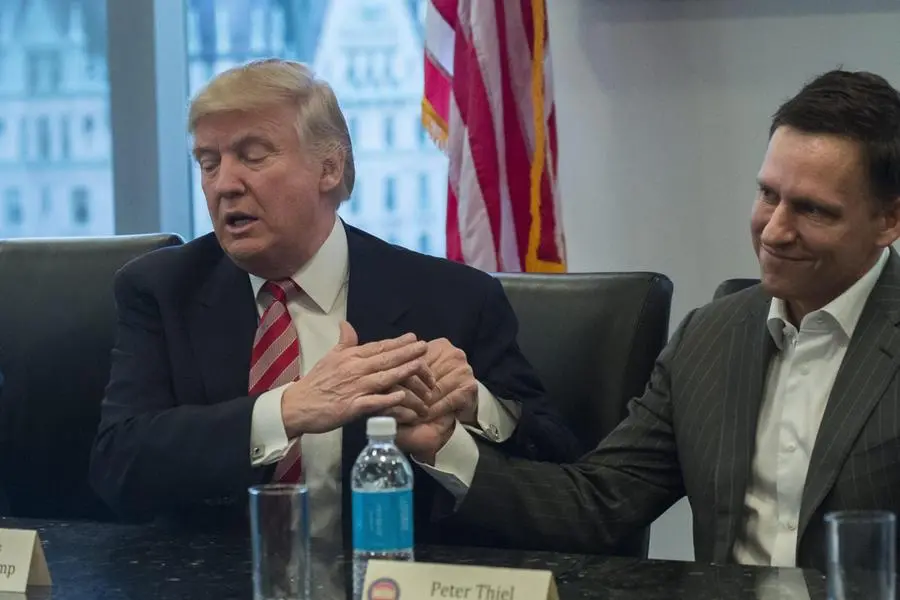
Donald Trump with Peter Thiel in 2016
(EPA)
This is not a pacifist surrender, but an act of higher realism: in the atomic age, with increasingly destructive weapons and wars that mainly affect civilians, it has become effectively impossible to satisfy the criteria of proportionality and ultima ratio. The Church does not say that the defense is not permissible; he says that today we can no longer delude ourselves that we can wage war without becoming violence ourselves.
It is a vision of the human. If man is the image of God, wounded by sin but redeemed by Christ, then violence cannot be the last word. There is a path that is neither the technocratic utopia (which promises to eliminate violence with the sole tools of law and global governance) nor Thiel’s cynicism (which accepts violence as destiny). It is the path of conversion: the creation of a humanity that recovers its original goodness, beauty, capacity for forgiveness, following the teaching of Jesus who overcame the logic of the scapegoat by becoming an innocent victim himself and giving peace not as the absence of conflict, but as reconciliation.
Bringing this memory back into public debate is not a nostalgic exercise. It is an operation of clarity. Because without the dogma of original sin – which explains violence without absolving it – we oscillate between two extremes: either we deny violence (and end up in the fragility of progressive illusions) or we make it absolute (and end up in the cult of power).
Theology as critical knowledge of the truths of faith is the only one that can hold together the awareness of human frailty and the hope in a peace that is not the fruit of technology, but a gift of the Spirit.
There are those who believe that talking about theology in public is out of place. In fact, it is more urgent than ever. Because when ideologies disguise themselves with the language of faith – as happens with Thiel and other new prophets of violence – the only response cannot be the embarrassed silence of secularists, nor the nostalgia of traditionalists. The answer is to let the living Tradition of the Church speak, the one that has passed through the centuries knowing that man is neither an angel nor a beast, but a wounded being who can only heal if he accepts to be loved.
Today, in universities, in classrooms, in digital squares, there is a need for those who do philosophy and communication with this method: historical, critical, but also animated by the hope that ideas produce worlds, and that the world does not necessarily have to be that of inevitable war. It can be that of possible peace. Not because peace is easy, but because love is stronger than death. And on this, theology still has much to say.