





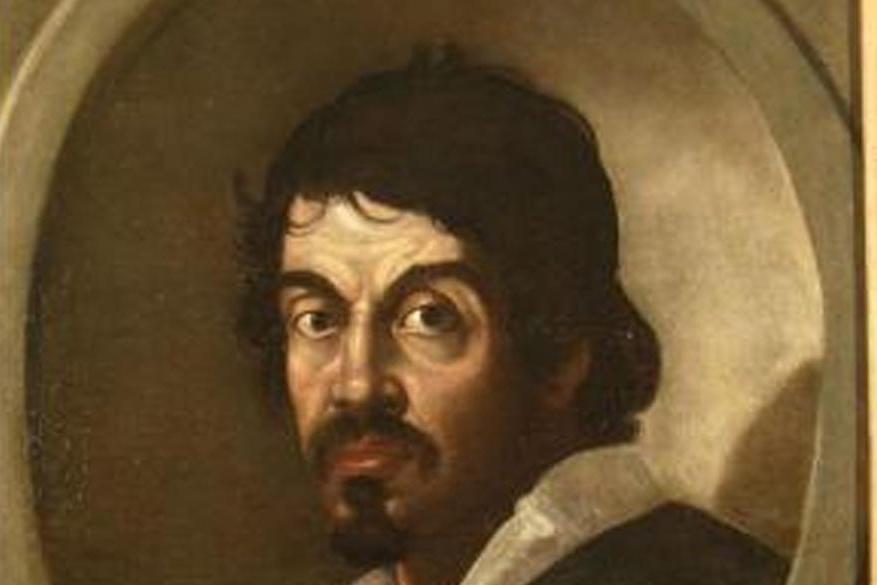
«This Michelangelo therefore earned fame, honor and renown with his work (…). In fact, he says that all things are nothing more than trifles, childishness or nonsense – whoever painted them – if andthey are not made from reality, and there can be nothing from them as good or better than following nature. (…) Now he is a mixture of wheat and chaff; in fact it is not consecrated continuouslyor studying, but when he has worked a couple of weeks, he goes about for a month or two with his broadsword at his side and a servant behind him, and goes from one ball game to another, very inclined to duels and brawlsso it is rare that one can frequent it.” So, in his Art bookKarel van Mander, portrait in 1604, Michelangelo Merisi known as Caravaggio.
At that time Caravaggio was 33 years old and lived in Rome where he had settled since he was in his early twenties, he is a well-known artist who has important commissions, both private and from the ecclesiastical world, but also controversial in the opinion of his contemporaries: his works capture the gaze, nailing the viewer into a reality, which today we would call photographic and cinematographic ante litteram, truly very “different” from the idealized long-necked figures that characterized the aesthetic canon of mannerism that established itself between 1520 and 1600.
A revolutionary style
It is a style born when Caravaggio arrived from Lombardy in search of artistic fortune and perhaps shelter from one of the problems with the law that would characterize his life. He settled in Rome, a city in turmoil that saw many young people competing in many workshops, in the hope of finding clients in the city which in the midst of the Counter-Reformation was an open construction site of churches under construction. His real name is Michelangelo Merisi, born in Milan in 1571 and then landed with his family in Caravaggio, a town in the Bergamo area, the site of a Marian sanctuary which had already been a destination for pilgrimages for a century. Hence the nickname that will accompany him throughout his short and intense life. Caravaggio trained in Milan in the workshop of Simone Peterzano, a pupil of Titian, but influenced by the Milanese school of Moretto and Savoldo. In Rome he found space in the workshop of the Cavalier d’Arpino, in via della Scrofa, but when he started his own business he needed to economize on materials and even more so on models: he could not afford expensive ones and used them from the street, while his canvases are characterized by a revolutionary contrast of light and shadow, which the icon of the cursed painter will also apply to the artist’s life. It is in that workshop, from which he will soon free himself, that Caravaggio meets his friend Prospero Orsi, the first to introduce him to the great commissions of the time: above all the meeting that will open doors and safe conducts for him. The one with Cardinal Francesco Maria Del Monte that first he will buy him for a paltry sum his first painting, The Good Fortune, in which a fortune teller reads the hand of a knight taking the opportunity to take off his ring. From there the cardinal, who goes against the grain and has sympathies for Galileo and Tommaso Campanella, will become his patron.
It is a moment in which the city, the Church and art see ferments and contradictions intertwined: the post-Ridentine rigor coexists in which the Academy of San Luca flourishes, an artistic fiefdom of the dapper and we would today say “politically correct” art of the Counter-Reformation which forced Daniele da Volterra from 1564 to cover Michelangelo’s nudes in the Sistine Chapel, consigning him to history with the nickname of Braghettone. And the sensitivity of a saint of the people and for the people like San Filippo Neri. And Caravaggio was called by Cardinal del Monte in 1597 to fresco the ceiling of Villa Ludovisi in which mythological figures appear with nudes that were anatomically much cruder and more realistic than those in the Sistine Chapel.
Sacred art and extreme realism
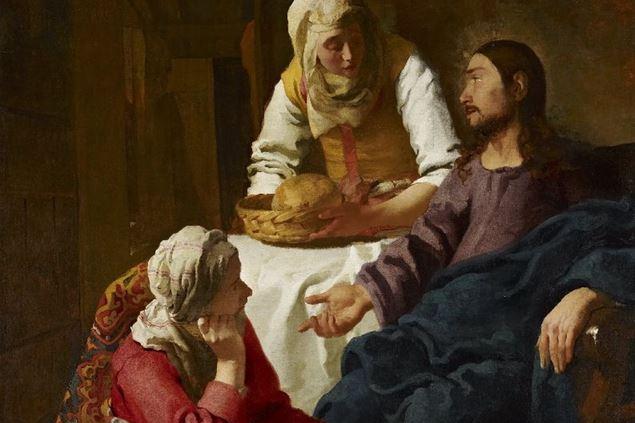
Just two years pass and Caravaggio’s Revolution is completed with the three canvases dedicated to San Matteo in San Luigi Dei Francesi, a place of worship for the French community in Rome, the first public commission he receives: it is there that Caravaggio’s contradictory worlds come together for the first time. His sacred art hosts very human figures, with dirty hands from the slums of life: people coming from the common people, from the taverns, from the dirty streets, from the taverns inhabit in his works, as never before, the scenes of the Bible and the Gospel and it will be so forever: from the Matthew’s vocation at the Supper at Emmausfrom Judith and Holoferneswhich must carry the echo of some exemplary performances seen live in counter-reformation Rome, up to the death of the Virgin of the Louvre, among the most discussed and loved works for its realism which dresses the sacredness of life and death with everyday life. As years before he had given realistic hints of infinite tenderness to the Madonna and Child of Rest from the flight into Egypt now he chooses extreme realism in Death of the Virginwhich leads him to portray a real lifeless body of a young woman in an unpretentious red dress. There are those who have gone so far as to doubt that it belonged to a courtesan fished out of the Tiber, but it is difficult to distinguish suspicion from slander.
These are choices that cause a sensation among contemporaries, sensation and attention because they represent a unique and different way. There Palafrenieri altarpiece in 1605 it remained in St. Peter’s for just a week, the readings on the reason for the rapid purchase by Scipione Borghese diverge: one wonders whether the nude of the Child, the cleavage of the Virgin and the wrinkles of St. Anne were not too much for the times and the context or whether instead it was not Michelangelo Merisi’s prices that led collectors to snap up his work, raising the stakes.
A life without peace
Michelangelo Merisi is returning from Genoa where he had to flee after getting into trouble on one of his many wild nights. Historical documents, thanks to a provident landlady tired of unpaid rent, preserve the inventory of the house in which Caravaggio lived for a period in Rome: it is known that alongside the common and rather poor furnishings, and some untitled books, he held sidearms, two swords and two daggers. One of these will force him to leave Rome shortly thereafter: in May 1606 he is accused of killing Ranuccio Tomassoni da Terni in a brawl. Sentenced to death, he fled to Naples where he left the Seven Works of Mercy and the Madonna of the Rosary, the following year he repaired to the island of Malta where he painted the monumental altarpiece of the Beheading of the Baptist, the only work bearing the signature of Michelangelo Merisi. They find him, he flees again: Messina, Palermo, Naples, he has time to leave the Adoration of the Shepherds and the Resurrection of Lazarus to the world, in 1610 he obtains a pardon from Pope Sixtus V and tries to return to Rome: he won’t make it in time, a fever (perhaps malarial) leaves him lying on the beach of Porto Ercole at the age of 39. There in 2001 in the Parish of Sant’Erasmo and among other older papers a document was found: «On 18 July 1609 in the hospital of S. Maria Ausiliatrice Michel Angelo Merisi da Caravaggio, a painter due to illness, died». Historians agree that the date is due to the use of the Marian calendar adopted by Siena which made the year begin on September 1st.
Hidden portraits and consecration
Caravaggio’s face is known to us from the quantity of mostly hidden self-portraits that he disseminated in his sacred and profane works, the most unlikely of which is found in the face of the giant Goliath defeated by David: there are those who saw in it the portrait of repentance. The definitive artistic and critical consecration of Caravaggio is due to Roberto Longhi who in the first half of the twentieth century definitively consecrated him as “The first painter of the modern era”. His story and his fame as a cursed artist have inspired cinema several times. The last time in 2022 with The Shadow of Caravaggio directed by Michele Placido with Riccardo Scamarcio playing the painter.