





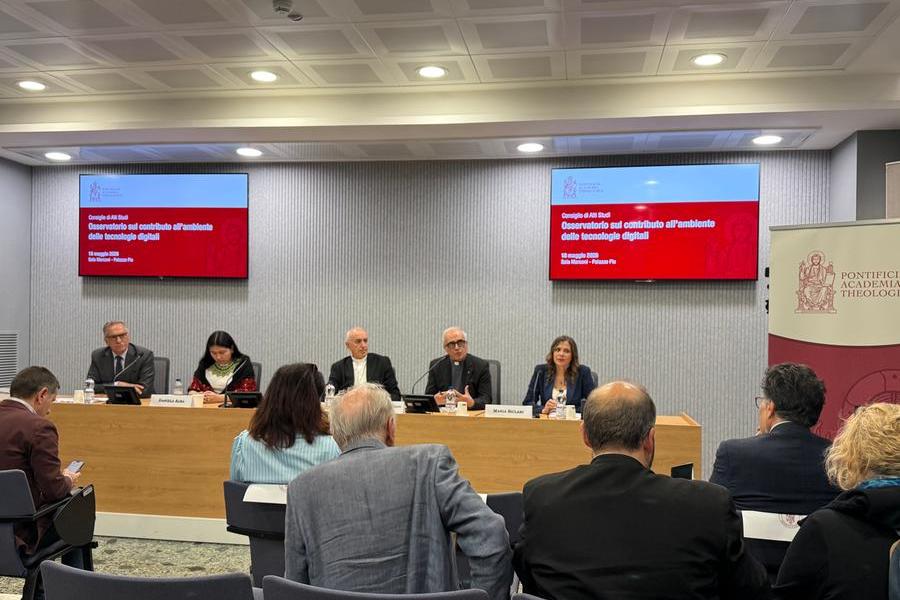
Increasing energy consumption from data centers, hectares of agricultural land taken away from farmers and populations, millions of liters of water to cool servers, and a basic question: what humanity lies behind the algorithms? It is with these questions that the Pontifical Academy of Theology today presented its new Observatory on the environmental, social and anthropological impacts of digital technologies and artificial intelligence.
The initiative, born under the pontificate of Pope Francis and now taken up by Pope Leo. «We want bring love out of the romantic bubble of flaccid sentimentalism”, explained Monsignor Antonio Staglianò, president of the Academy, «to rediscover it as energy that creates and regenerates bodies and humanity».
According to data provided at the conference, the ICT sector is already responsible for around 4% of global CO₂ emissions, with data centers absorbing more than 1.5% of the world’s electricity. “There is a public belief that the digital world is light, almost without physical weight,” explained MAria Sicari, general director of Ispra and president of the Council of Higher Studies of the Academy«instead data centers occupy land: in Italy, in the latest report, we surveyed 40 hectares of transformed agricultural and natural land”. AND the consumption of fresh water for cooling reaches millions of liters per day, with the risk of worsening water stress in already fragile areas.
Added to this is the problem of critical minerals and conflicts over their supply, as well as the accelerated obsolescence of devices. “We must rigorously apply the principles of the circular economy,” added Sicari. «reuse, repair, and environmental governance that imposes transparency and renewable sources».
Monsignor Staglianò, for his part, warned against a purely ethical approach: «It is not enough to say “let’s place limits on artificial intelligence”. Without a vision of man, even the best code of ethics will be manipulated by those who hold economic power.” The Observatory’s proposal is a revolution of the human heart inspired by the evangelical commandment of active love: «Do not “do to others what you do not want done to you”, but “love one another as I have loved you””, underlined the president of the Academy, “a theological ethic that pushes towards self-giving, not towards aseptic conformity”.
Father Marco Salvati, secretary of the Academy, recalled the recent document of the International Theological Commission Quo vadis humanitas, which questions transhumanist and post-humanist tendencies. «Digital could foster an idea of man who is no longer man. We must ask ourselves: is this development at the service of every human being or of other ideologies?”.
Not just criticism. The Observatory wanted to bring concrete evidence of responsible innovation. Maria Vittoria Trussoni of NTT Data (Japanese group) presented the iOWN project, based on photonics (light) instead of traditional electronics, with up to two orders of magnitude higher energy efficiency. «It’s not about mitigating impacts after the fact», he explained, «but about designing sustainable infrastructures from the beginning, from software to hardware. Sustainability must be an intrinsic property of digital.” The global iOWN initiative involves over 170 players including Sony, Intel, Microsoft and Nvidia.
In the Marconi hall, in the headquarters of Vatican Radio, the voice of the indigenous peoples also arrived: “We are not silent, we are silenced”, explained Daniela Alba, a Colombian of indigenous origin, responsible for the environment for the Jesuits. “I must ask permission from Mother Earth to speak in this space,” he began, “because we are nothing without her.” Alba remembered that indigenous communities, despite representing less than 20% of the global population, safeguard over 80% of the world’s biodiversity. «We have age-old knowledge of welcoming and protecting the territory, we have survived 500 years of colonialism. But we are often silenced. It’s not that we don’t have a voice: they don’t listen to us”. She then linked the exploitation of land to the exploitation of women and children, and to her own experience as a survivor of violence and displacement. «Integral ecology is everyone’s task. This Observatory was created to dialogue between generations, communions, different paths of life.”
The Observatory will not remain abstract. It has already been announced that on Saturday 23 May a delegation will be in Acerra, in the Land of Fires, following Pope Leo XIV. Maria Sicari, who also leads Ispra, recalled that the body is tasked by the government with monitoring reclamation in that territory. “We don’t collect data to archive it,” he said, “but to transform it into knowledge and public participation. We want to move from compliance to responsibility.”
Finally, responding to journalists, the speakers assured that the Observatory’s work will also address the issue of large companies which, increasingly less profitable due to the high costs they have to bear, are pouring into investments coming from the world of war. Furthermore, it was specified that the works will also be made available in English and that, although autonomous, they will be put at the service of the Dicastery for Culture and‘Education and the new interdicasterial commission on AI wanted by Pope Leo. «Christianity», concluded Monsignor Staglianò, «does not sell an intimate devotion. Changing the human heart is the true political and social revolution.”
The appointment is at next international forum scheduled for October, where the Observatory will present an initial mapping of companies, technologies and good practices for a digital finally “in the image and likeness” of the human.