



Mental load, cognitive overload, hyperperformance: thinking too much has become a health and leadership issue, particularly for active and managerial women.
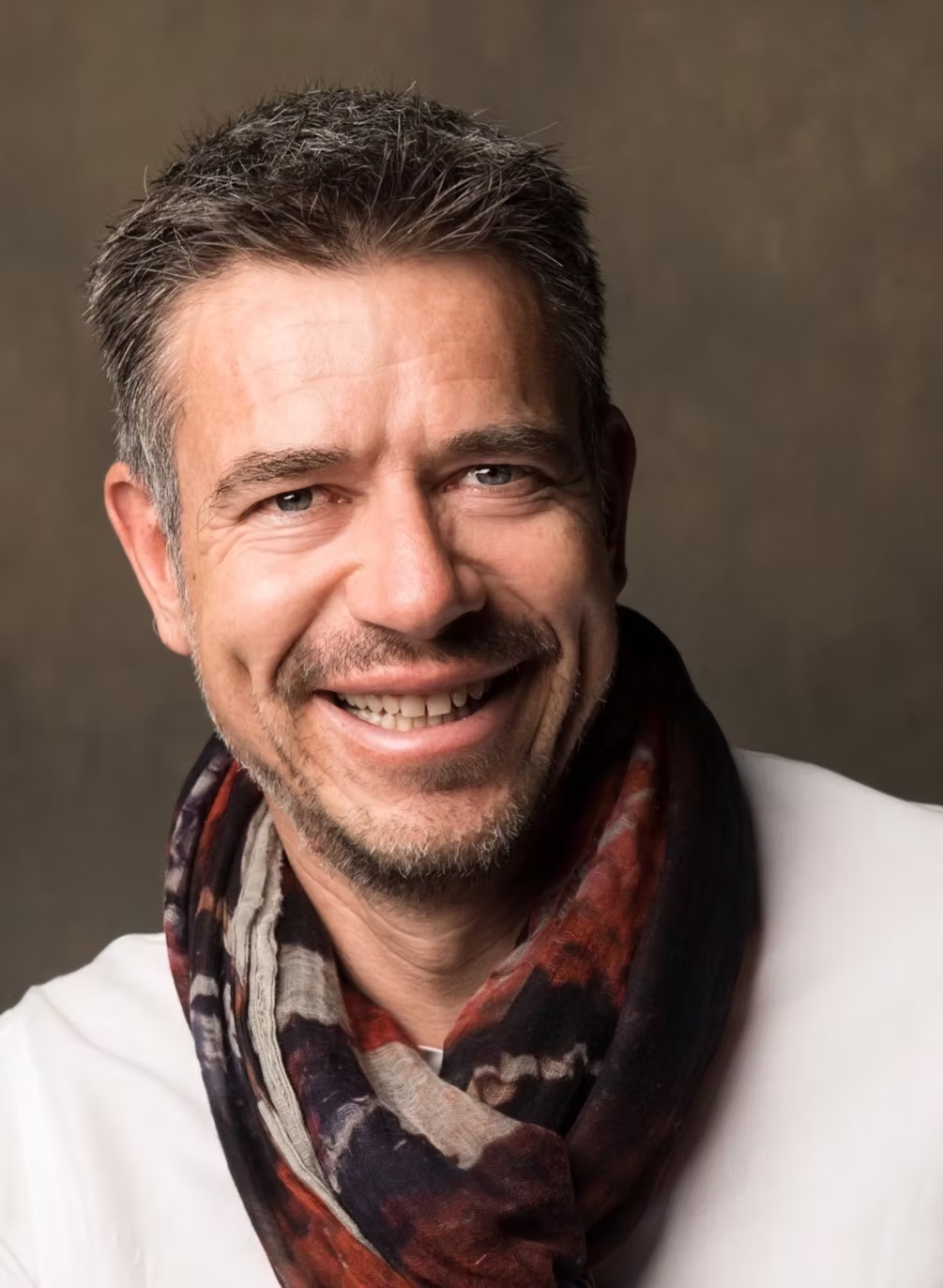
In ” 10 minutes to think less and better” (Ed. Jouvence)David Perroud, author and specialist in consciousness sciences, offers an accessible method to reduce mental noise and reconnect with intuitive intelligence. Inspired by the Japanese concept of Ma, its approach invites you to create inner space to improve decision-making, regain mental clarity and lead with more discernment.
For Business O Femininehe deciphers the mechanisms of invisible mental overload and the keys to getting out of it sustainably.
“10 minutes to think less and better” is based on a very contemporary observation: we think too much. When did you realize that this mental overload had become a health and social issue, and not just an individual discomfort?
David Perroud: The trigger came while listening to a podcast where Mo Gawdat, former manager at Google X, predicted that AI would become a billion times more intelligent than humans within 20 years. As a specialist in consciousness science, this prediction shocked me and I immediately asked myself: but what is he talking about? Does he believe that machines will be able to develop a consciousness comparable to humans? Does he know the nature of our consciousness?
These questions gave me the idea for a novel (The Pacific Shaman) which led me to do in-depth research on AI. I noticed that AI was trying to reproduce a very specific type of intelligence that we can call IQ intelligence – intellectual intelligence. But humans have other forms of intelligence, including intuitive intelligence: Archimedes’ Eureka, the athlete’s Zone, the artist’s trait of Genius. It is a more natural, less mental intelligence.
By focusing on this intuitive intelligence, I realized that few of us used it. And I discovered why: our intuitions, our genius traits are constantly obstructed by our mental noise, our thoughts. That’s when I realized that we are a society that thinks too much, to the point of cutting itself off from this intuitive intelligence – the most powerful that we possess.
At Business O Féminin, we often talk about invisible mental loadparticularly among active and managerial women. Is your method particularly aimed at those who carry “too much” responsibilities?
David Perroud: The Ma method is aimed at anyone whose mind is constantly spinning, but women leaders are particularly concerned, moreover in my workshops they represent the vast majority of participants. They arrive with several layers of thoughts that intersect: strategic professional decisions, management of daily family life, organization of multiple agendas, emotional needs of those around them.
This less invisible mental load is pernicious because it is never ” finished“. Even when the professional computer closes, another opens: tomorrow’s meal, the call to the pediatrician, the urgent email… Although the Ma method does not reduce the to-do list, it brings clarity and mental serenity. It allows you to remove layers of unnecessary and negative thoughts and reduce limiting beliefs.
What participants discover is that with a clearer mind, they can finally prioritize effectively, set healthy boundaries, and ask for help without guilt. They continue to manage as much, but they do it with discernment rather than in survival mode
The concept of My, this space, full of potential, is at the heart of your approach. What does Japanese culture teach us that the West tends to forget?
David Perroud: The Ma (間) designates “ the space between things » – the silence between two notes, the pause between two breaths. In the West, we value the full: more productivity, efficiency, information. Empty space is seen as a gap to be filled.
But in Japanese philosophy, it is precisely in this space that value resides. In architecture, for example, it is the empty spaces that give design its splendor. Applied to thoughts, Ma reminds us that it is not by cluttering our minds that we achieve more, but, even if it seems counterintuitive, by creating space between our thoughts. The West has forgotten that value is not always in accumulation. We have developed a culture of “ TO DO“extraordinary, but lost the art of “ be“. The Ma method does not suggest adding something, but consciously creating space – full space
of potential.
You explain that thinking less allows you to think better. Concretely, how does the method My can it transform decision-making for a manager or an entrepreneur?
David Perroud: Let me give you a concrete example. In a recent interview, Coldplay’s Chris Martin talks about how he created the song ” We Pray » from his latest album which is a hit! He says literally: “ It arrived in my head fully formed – music, lyrics, direction – in the middle of the night. I had to get out of bed and write everything down before going back to sleep. » The interviewer asks him if this happens to him often. Chris responds: “ All the time, yes. »
I understand perfectly what he means. I have written 6 novels including 3 bestsellers and the process is similar: I receive images which reveal a story, I do not know it in advance and I discover it as these images are revealed.
Before being a writer, I was the manager of an international company. My best decisions were those for which I had a ” flash of intuition“. Whether it was a feeling, an idea coming from nowhere, or the conviction that this path was the best. Even the idea of becoming a writer, even though I have a master’s degree in finance and running my business took up all my time, came to me intuitively.
Creating space in your thoughts allows you to increase this intuitive intelligence which is essential for a leader.
Many women tell us they doubt, overprepare, try to be “irreproachable“How can reformulating thoughts help get out of this exhausting perfectionism?

David Perroud: What you say touches me a lot because it is exactly what I see in my workshops. I think women are victims of collective macho beliefs. Although society is changing rapidly on this subject, societal beliefs are harder to eradicate. As a result, consciously or not, many women leaders feel the need to prove that they are up to the task, which adds a considerable mental and real burden.
Reformulation is ideal for separating yourself from a limiting belief, whether personal or collective. Let’s take an example: a manager repeats to herself “ I must be irreproachable otherwise people will doubt my legitimacy. » By rephrasing: “ My value does not depend on my perfection, but on my competence and my authenticity“, we activate new neuronal connections.
Repeated for about 2 months, this new thought literally creates new circuits in the brain. This is neuroplasticity. The old belief gradually loses its strength, the new one becomes automatic. Exhausting perfectionism gives way to a more serene confidence.
What would you say to those who think they don’t “don’t have time” to stop for 10 minutes a day?
David Perroud: I would tell them: it is precisely because you think you do not have the time that you need it the most. This thought indicates that you are already in mental overload, in survival mode.
I was CEO of an international company. I know about 70 hour weeks. It is precisely in these periods that these 10 minutes are the most precious. When your mind is clear, you are more efficient, you make better decisions the first time, in reality these 10 minutes repeated daily will save you a lot of time.
The list of busy people who dedicate a ritual of 10 minutes a day or more is very long. Here are some examples: Chris Martin, Oprah Winfrey, Bill Gates, Richard Branson, Tim Ferriss… Do you believe that these people would have time for this ritual if they had not decided to make it a priority?
Finally, if you had to offer just one invitation to our readers of Business O Féminin for 2026, what would it be: what should they stop thinking about… to start living better and deciding better?
David Perroud: Stop thinking that you have to be different from what you are to succeed.
This thought takes a thousand forms: “ I should be more assertive« , « I should be less emotional“…It’s an exhausting inner war. It is particularly insidious among women leaders who operate in environments where codes have been established by and for men.
We are entering an era where AI will replace everything that is standardized and analytical. What will make the difference is what isn’t: your awareness, your empathy, your presence, your ability to feel what is right.
The world urgently needs more women in key economic and societal positions. He doesn’t need more women trying to be like someone else. He needs women who are fully themselves.