




The month of May is an ancient popular devotion which is deeply felt by the faithful and is traditionally dedicated to the Madonna with various moments of prayer, from processions to pilgrimages to the Sanctuaries to the recitation of the Rosary.
But why is May the Marian month par excellence? Let’s try to answer.
The cult of fertility in Greek and Roman antiquity
In ancient Greece and ancient Rome the month of May was dedicated to the pagan goddesses connected to fertility and spring (Artemis and Flora respectively). This, combined with other European rituals commemorating the new season of spring, led many Western cultures to consider May a month dedicated to life and motherhood.
Mother’s Day
It is no coincidence that in many countries this month is Mother’s Day a civil occasionnot religious. In Italy it falls on the second Sunday of May as in most European states, the United States, Japan, Australia and numerous other countries. In Spain on the first Sunday of May, in the Balkan countries on 8 March; in many Arab countries the holiday instead falls on the day of the spring equinox.
In the Middle Ages, Alfonso X and Maria “Rose of Roses”
In the 13th century Alfonso Las Cantigas de Santa Maria celebrated Mary as: «Rose of roses, flower of flowers, woman among women, only lady, light of the saints and of the heavens away (…)». Shortly thereafter, the blessed Dominican Enrico Suso of Constance, a German mystic who lived between 1295 and 1366, addressed the Madonna in the Little Book of Eternal Wisdom: «Blessed be you rising dawn, above all creatures, and blessed be the flowering meadow of red roses of your beautiful face, adorned with the ruby red flower of Eternal Wisdom!». But the Middle Ages also saw the birth of the Rosary, whose reference to flowers is evident from its name.
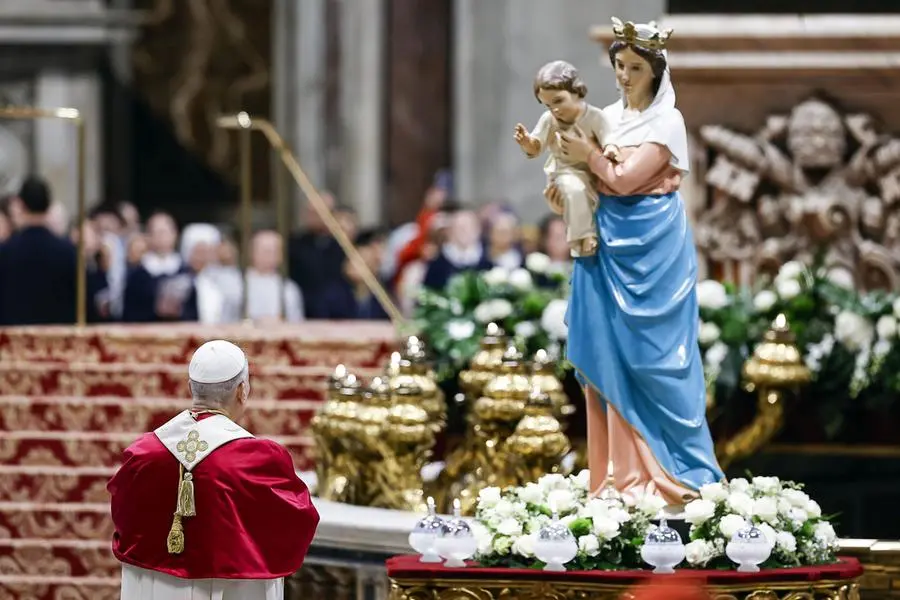
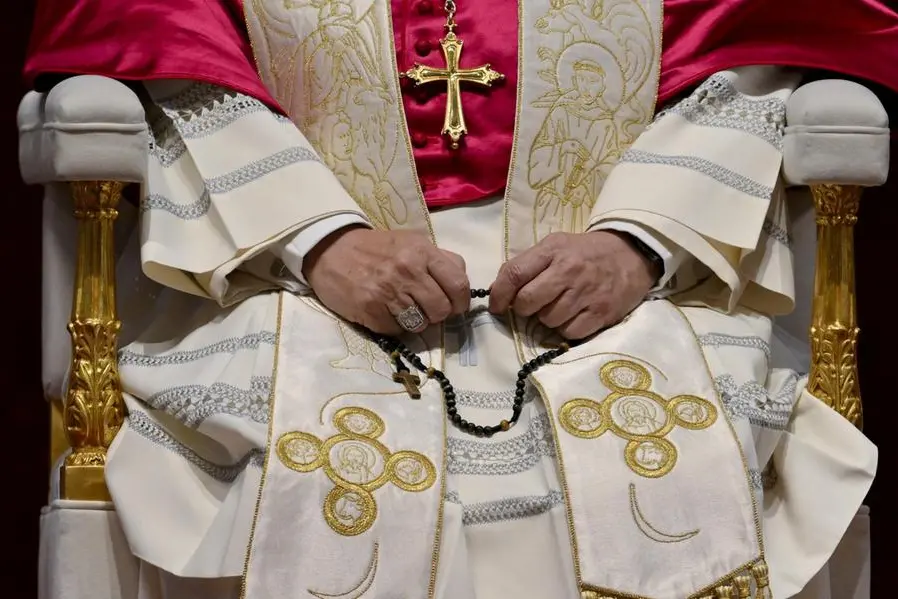
Pope Leo XIV reciting the Rosary for peace on 11 April 2026 in St. Peter’s Basilica
(HANDLE)
The devotion was born in the Jesuit College of Rome at the end of the 18th century
In the times of the early Church there is evidence of the existence of a great feast in honor of the Blessed Virgin Mary which was celebrated on May 15th each year, but only in the 18th century was the month of May associated with the Virgin Mary. In particular, the May devotion in its current form originated in Rome, where Father Latomia of the Roman College of the Society of Jesus, to counter the infidelity and immorality widespread among students, at the end of the 18th century he vowed to dedicate the month of May to Mary. From Rome the practice spread to other Jesuit colleges, and from there to almost every Catholic church of the Latin rite. Dedicating an entire month to Mary was not new, and there was an earlier tradition of dedicating a thirty-day period to the Virgin, called Tricesimum.
Various private devotions to Mary soon spread throughout the month of May, as is remembered in the Collectiona series of prayers published in the mid-19th century: «It is a well-known devotion to consecrate the month of May to the most holy Mary, as the most beautiful and flower-filled month of the whole year. This devotion has long prevailed throughout Christianity, and is common here in Rome, not only in private families, but as a public devotion in many churches. Pope Pius VII, to exhort all Christians to practice such a tender and pleasing devotion to the Blessed Virgin, and considered to be of such spiritual benefit, granted with a Rescript of the Secretariat of Memorials of 21 May 1815 (preserved in the Secretariat of His Eminence the Cardinal-Vicar) to all the faithful of the Catholic world to honor the Blessed Virgin in public or private with some special homage or devout prayers or other virtuous practices”.
Saint Philip Neri and the custom of surrounding Marian icons with flowers
However, the first devotional practices, linked in some way to the month of May, date back to the 16th century. In particular in Rome, Saint Philip Neri taught his young people to surround the image of the Mother with flowers, to sing her praises, to offer acts of mortification in her honor. Another leap forward and we are in 1677, when the novitiate of Fiesole founded a sort of confraternity called “Comunella”. The chronicle of the archive of San Domenico reports that «as the May holidays had arrived and the day before we heard many secular people starting to sing better and celebrate the creatures they loved, we decided that we too wanted to sing it to the Most Holy Virgin Mary…». It began with the Calendimaggio, i.e. the first day of the month, to which Sundays and finally all the other days were soon added. They were mostly simple popular rites, nourished by prayer in which litanies were sung and Marian statues were crowned with flowers. At the same time, publications multiplied.
The Jesuit Annibale Dionisi published “The month of Mary” in 1725
However, we owe the indication of May as the month of Mary to a Jesuit father: Hannibal Dionisi. A religious man of noble extraction, born in Verona in 1679 and died in 1754 after a life, according to his brothers, marked by patience, poverty and sweetness. In 1725 Dionisi published in Parma under the pseudonym Mariano Partenio May the month of Mary be consecrated to Mary with the exercise of various flowers of virtue proposed to her true devotees. Among the novelties of the text is the invitation to live and practice Marian devotion in everyday places, in the ordinary, not necessarily in church “to sanctify that place and regulate our actions as if done under the very pure eyes of the Most Holy Virgin”. In any case, the scheme to follow, we can define it like this, is simple: prayer (preferably the Rosary) before the image of the Virgin, consideration i.e. meditation on the eternal mysteries, foil or homage, ejaculation. In the same years, the testimonies of the other Jesuit Father Alfonso Muzzarelli were also important for the development of Marian devotion, who in 1785 published The month of Mary or May and Don Giuseppe Peligni.
The devotion of Pius XII
In 1945 Pius XII confirmed the idea of May as a Marian month after establishing the feast of Mary Queen on May 31st. After the Second Vatican Council this feast was moved to August 22nd, while the feast of the Visitation of Mary to her cousin Elizabeth is celebrated on May 31st. The invitation not to neglect the recitation of the Rosary, especially in the month of May, comes from afar. In the Encyclical Ingruentium malorum of 1951, Pius XII wrote: «It is above all within the family that We desire that the custom of the Holy Rosary be widespread everywhere, religiously preserved and increasingly developed. In fact, it will be in vain to try to remedy the faltering fortunes of civil life if domestic society, the principle and foundation of human society, is not brought back to the norms of the Gospel. To achieve such an arduous task, we affirm that the recitation of the Holy Rosary in the family is a most effective means.”
Mayo canteensthe 1965 encyclical signed by Paul VI
The Magisterium also understands and encourages this devotion born from the people. In the encyclical Mayo canteens dated 29 April 1965, Paul VI indicates May as «the month in which, in temples and within the domestic walls, the most fervent and affectionate homage of their prayer and veneration rises to Mary from the hearts of Christians. And it is also the month in which the gifts of divine mercy flow to us more widely and abundantly from his throne.”
However, there should be no misunderstanding about the role of the Virgin in the economy of salvation, «since Mary», writes Pope Montini, «is still the road that leads to Christ. Every encounter with her cannot fail to result in an encounter with Christ himself.” Pope Montini also attributed extraordinary importance to the Rosary recited in the family: «There is no doubt», he wrote, «that the Crown of the Blessed Virgin Mary is to be considered one of the most excellent and effective “common prayers” that the Christian family is invited to recite. In fact, we love to think and we sincerely hope that, when the family meeting becomes a time of prayer, the Rosary will be the most welcome expression.” (Marialis Cultus 53).