






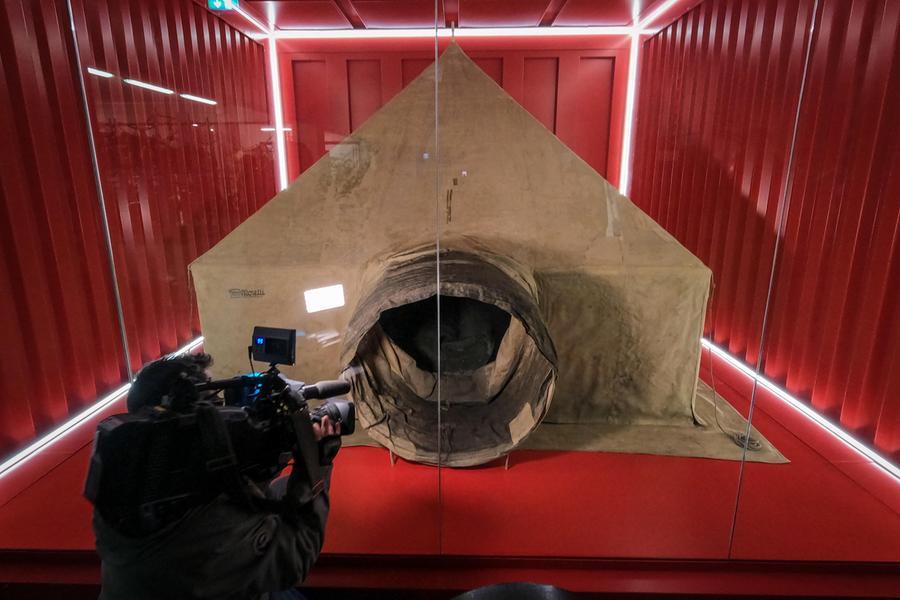
Square plan, 270 cm per side, igloo entrance. What is striking is the fragility and small size which nevertheless allowed the Red Tent to be the only refuge and salvation of the ten men who survived the disaster of airship Italy crashed at the North Pole in 1928. This historical artifact, now completely restored, finally visible to the public, It owes its name to the stripes drawn by survivors with aniline so that rescuers could identify it with more ease. The tragic expedition, led by Umberto Nobile, took place in a period in which our country was also contributing to scientific research and the discovery of lands that remained unexplored (the two Poles). The purpose of the trip was to carry out experiments in the fields of atmospheric electricity, oceanography and terrestrial magnetism.
The expedition left Milan on 15 April 1928 with a crew made up of technicians, scientists, journalists, on the airship Italia. Five overflights are planned; during the third, a storm and then the crash on the pack. Nothing more will be heard of six men, trapped in the balloon and thrown into the atmosphere. Ten others, together with various material and the red tent, resisted on the pack for seven weeks and, thanks to the small Ondina 33 field radio, managed to launch the SOS which was picked up by a Russian radio amateur. One of the first international rescue vehicles moved to help. They were rescued on July 12, after several failed recovery attempts, by the Russian icebreaker Krassin, and among the rescuers there were nine victims. The explorer Roald Amundsen, Nobile’s rival friend, also died when his seaplane crashed.
The Red Tent, produced by the Milanese company Ettore Moretti, it was then brought back to Italy and exhibited at the Castello Sforzesco in Milan already in August, and after various arrangements it landed at the Museum of Science and Technology. The last exhibition was in 1998, but the state of conservation was now compromised and fragmented. This definitive restoration, started in 2008, was entrusted to Cinzia Oliva, a fabric restorer: «It immediately proved to be a complex and laborious intervention. First of all due to the extreme degradation of the material. The silk tent had remained exposed on the pack in extreme weather conditions. Furthermore, the artefact was large in size and above all it was three-dimensional. We had to understand, with little documentation, how it was built. And then the exhibition in the museum and the conservation in the various deposits had left a significant quantity of dust and debris on the fibres”.

From 15 February 2023 it is visible to the public in a fascinating basement of the Museum of Science and Technology in Milan.