





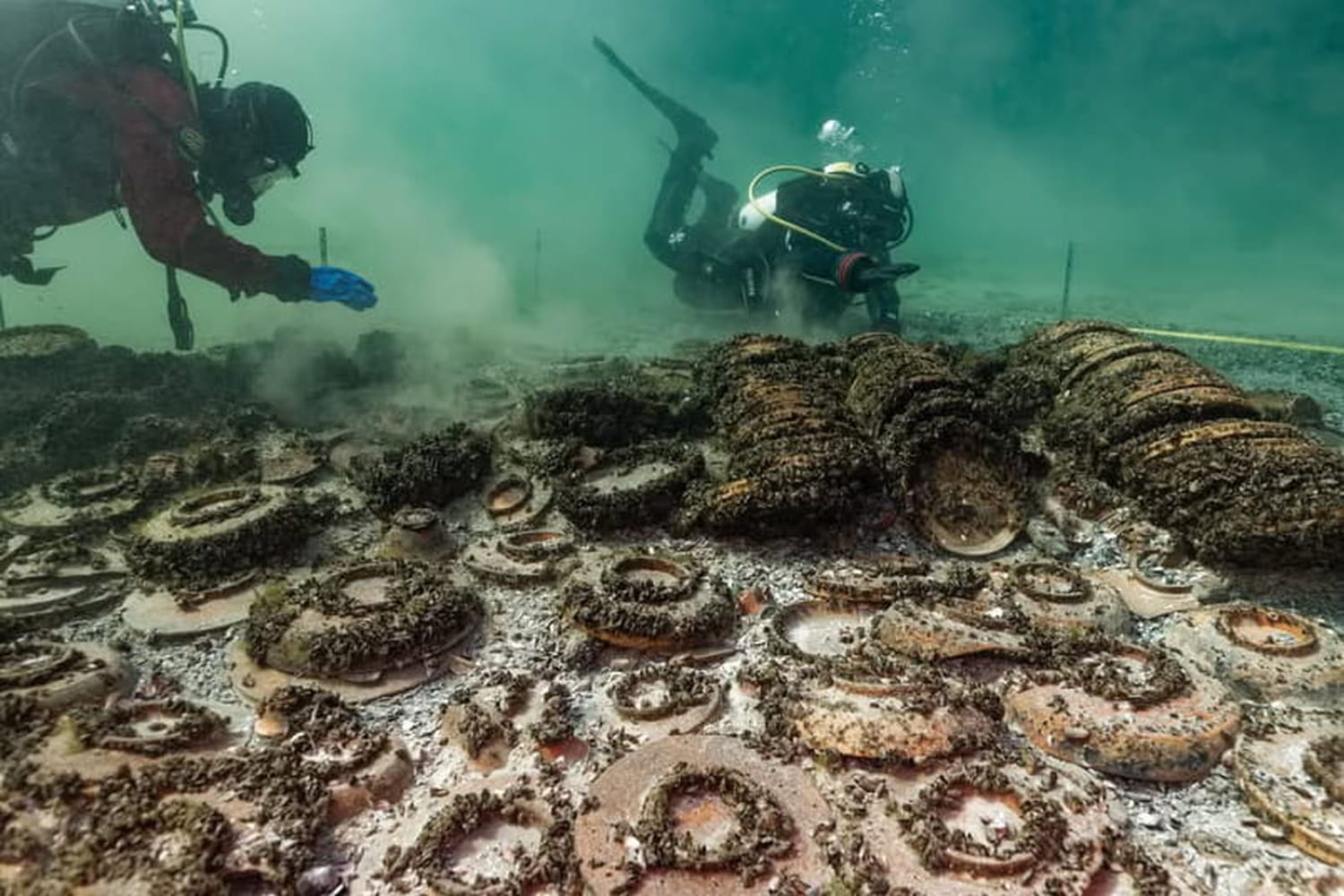
The moment of the find was particularly impressive for divers Fabien Langenegger (OPAN) and Julien Pfyffer (Octopus Foundation).
It’s a discovery worthy of an underwater adventure film. At the bottom of dark and silent waters, a team of underwater archaeologists got their hands on a real time capsule that has remained frozen for two millennia. These are not simple debris, but the remains of a cargo from a Gallo-Roman boat carrying a real treasure. Revealed to the general public in April 2026, this discovery fascinates historians.
The timing of the find was particularly impressive for divers Fabien Langenegger (OPAN) and Julien Pfyffer (Octopus Foundation): they brought up several hundred ceramic objects, such as plates or olive oil amphorae from Spain, as well as swords dating from 20 to 50 AD and wooden chariot wheels. All of these objects were incredibly well preserved, which is quite unprecedented.
This historic treasure was located in the depths of Lake Neuchâtel, Switzerland, just 20 kilometers from the French border. This strategic position made the lake a key commercial crossroads of the time, we can read in a press release published by the canton of Neuchâtel. While Swiss waters reveal their Roman past, French soil also continues to surprise researchers, as evidenced by the recent discovery of 500 dinosaur eggs in the south of France, revealing biodiversity several million years old.
“What makes this discovery exceptional is the state of conservation of the cargo. She tells us precisely about the methods of transport and the economy of building in Antiquity.“, explain these specialists involved in the excavations. In order to avoid any looting, this spectacular discovery was first kept secret while the perimeter was secured. The excavations then required the use of cutting-edge technologies, notably 3D modeling, in order to precisely document the wreck before beginning a precise ascent of the remains to prevent them from falling into dust on contact with the air. The sinking of this ship seems to have occurred suddenly, probably due to a sudden storm or an overload which threw the boat to the bottom.
Beyond the technical feat linked to the ascent of this cargo, this discovery highlights the intensity of commercial exchanges which already animated our region 2,000 years ago. Historians will now be able to study these everyday objects closely to uncover the last secrets of ancient trade.
Lake Neuchâtel has long been a gold mine: with the rise and fall of the waters over the centuries, it is home to dozens of prehistoric and ancient sites. In the past, perfectly preserved monoxyl canoes (carved from a single trunk) were even found there.