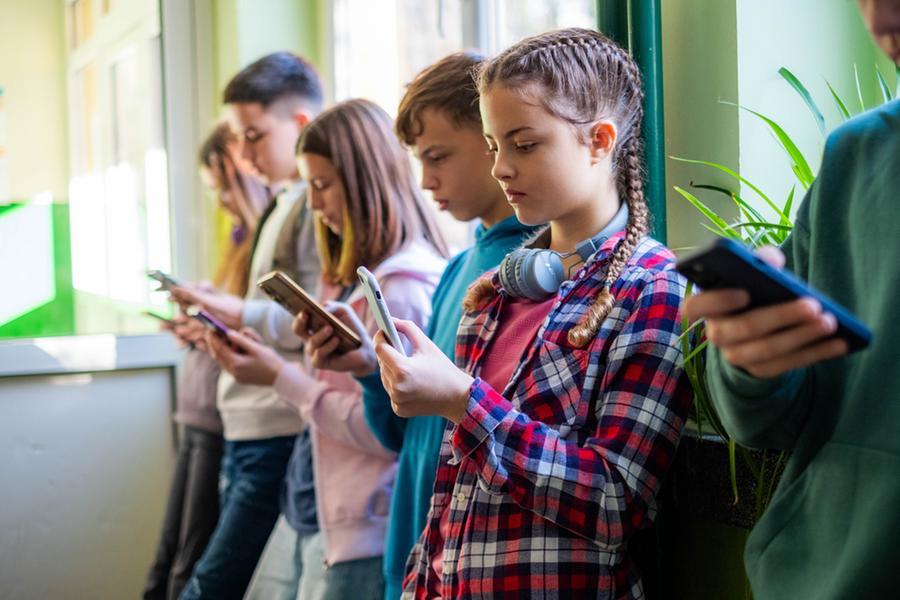





Veneto is seething against social media. Too many problems arise from there for teenagers and children who have unfiltered access to text, images, violent or sexual videos. A state law proposal initiated by the Veneto Region is taking shape, in accordance with the provisions of the Constitution. This was announced by the president of the Veneto Region Alberto Stefani. «I have activated the regional offices and we will involve all the political forces in the proposal. Together we will decide how to develop it.” The access limit should be set at 14 years and should take advantage of systems for the recognition of digital identities. Today, younger people easily bypass social media membership limits by lying about their age.
The alarm has been ringing for some time in Veneto. In Spinea, in the province of Venice, in February 2025, a little girl was brutally attacked in the square and the video of the beating ended up directly online; the baby bullies were between 12 and 16 years old. In December, bullies attacked four young people in the center of Treviso and then posted the stunt online. They called themselves the “San Liberale gang”. In Verona, in February 2024, police officers stopped three boys for a check who reacted with threats, insults and pushes, also starting a live social media broadcast to show their exploits.
But the phenomenon is more pervasive. This was reported by Unimpresa CNA Treviso, the National Confederation of Artisans. «The sentencing of a Los Angeles court against Meta and YouTube to compensation of 6 million dollars to the family of a girl suffering from social media addiction demonstrates that the platforms are capable of engineering psychological addiction in minors. As with tobacco, you gain from addiction. Infinite scrolling, autoplay, intermittently reinforcing notifications are deliberately designed to be addictive». Why does Cna raise his voice? Because the damage has repercussions on the productivity of companies. «An important part of the young people who join companies – states the president of Cna Treviso, Lucia De Bortoli – have difficulty concentrating, poor tolerance to frustration, inability to cope with the wait and the sacrifice that every manual job requires. It’s not laziness, it’s not a lack of character: it’s the result of years of exposure to mechanisms designed to seize attention and weaken willpower.”
If on the one hand the Cna recognized the efforts of the Venetian Local Health Authorities, in particular mentioning the Local Health Authority 2 of Treviso with the “S-connected” project, on the other hand it asked for a leap in scale: from a support service to a structured, systematic and universal programme.
The governor immediately intervened Alberto Stefani: «We need to change perspective and put young people’s health and their psychological well-being back at the centre. The safety of families and the future of our community is at stake.”
His commitment in this area is not new: «The latest bill that I signed as a member of the Chamber of Deputies goes in this direction and provides for a stop to the use of social networks for children under 14 years of age. At that age, young people need real experiences and real encounters, not fictional ones. And, above all, they must be protected from the risk of emulation and exposure to violent content that can influence them and push them to commit crimes in the real world. The Veneto Region is doing its part to promote psychological well-being and prevent forms of discomfort. The text that I filed in recent days, for the institution of the territorial psychologist, is an example of this. But, faced with what is happening in our country, such as the stabbing of the teacher in Bergamo, we can no longer wait.”
Stefani didn’t just propose a law. «Our children need real life, educational experiences, real relationships with their peers and, secondly, with adults. The ban on the use of social networks by children under 14 is urgent and necessary, but alone it cannot be enough. We need moments of sharing and community. For this reason we have decided to file an amendment to the budget which allocates 100 thousand euros to finance summer camps for young people, promoting social commitment paths that help young people to test themselves, discover their abilities and feel part of something bigger, for example in Civil Protection groups. It can be an opportunity for personal growth and responsibility, outside of social media, in real life.”
The emergency is global: since 2012 – the year in which the use of smartphones among adolescents became mass – there has been a 150 percent increase in serious cases of depression among adolescentsthe 188 percent increase in girls who self-harm compared to 2010 and the 91 percent suicide rate among young people. Furthermore, one in four minors has problematic smartphone use and 78 percent of children aged between 13 and 17 check the device at least once an hour.
There were many reactions to the governor’s proposal. “Social media produces real effects” says the psychologist Cesia Pollonipsychotherapist active for forty years in Castellana and coordinator of the Mastermind Center of Castelfranco Veneto. «The problem is that children and adolescents are unable to self-regulate their emotional response. Emotions are activated very quickly and intensely and often cannot even be recognized. If you don’t understand what you feel, it becomes difficult to organize your thoughts and reflect. The ability to “mentalize” is weakened, that is, giving a name to emotions, understanding where they arise from and evaluating whether what you are experiencing is good or bad.”
Comments also from the world of school. Alessio Perpollihead teacher in Bosco Chiesanuova, in Verona, and representative of the area for middle schools, declares to L’Arena: «Age restrictions already exist, but parents above all play a fundamental role. Not a total criticism, but a conscious and controlled use.”
To the diocesan newspaper La Vita del Popolo, Don Paolo Magogapresident of the Fonte professional training center (around 800 students), reminds parents: «Today, with localization apps, parents know where their children are, but much less what they are doing. More than banning, it is important to understand how we control them. How many adults really look at the history of their cell phones and PCs? It is common for parents of very young children to have passwords and be able to access messages and reports. With serenity, you need to know where your children are, not only physically but also online.”