

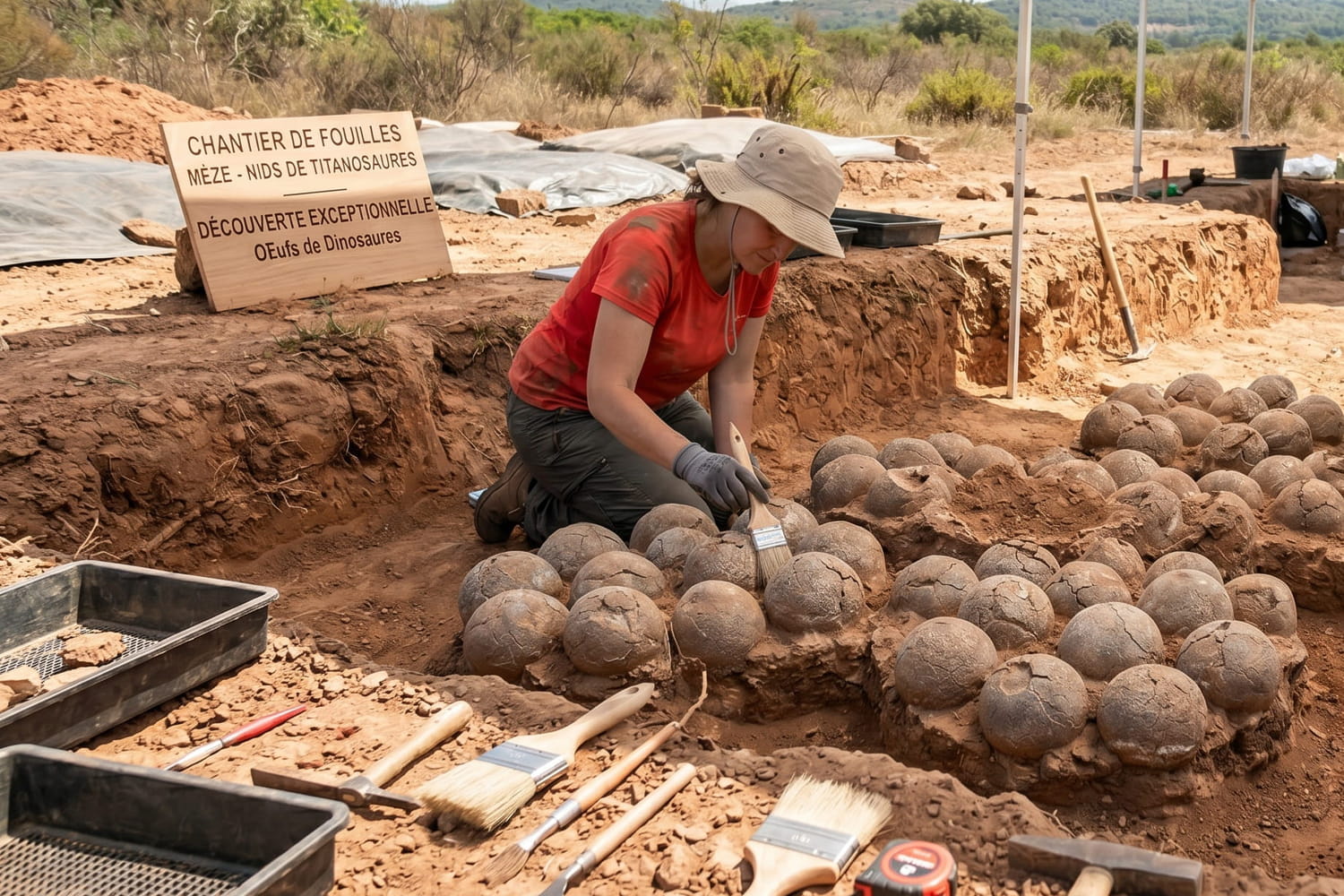



In the south of France, paleontologists have discovered around a hundred dinosaur eggs the size of a football buried underground for 72 million years.
The depths of French soil never cease to surprise us. After the historic discovery of 500 eggs at the foot of the Sainte-Victoire mountain in Bouches-du-Rhône, a recent excavation campaign validated by the Regional Archeology Service (SRA) of Occitanie has taken the site into another dimension. These are not a few isolated fragments, but hundreds of fossilized dinosaur eggs that were unearthed last October. This exceptional discovery, documented by researchers associated with the CNRS, reveals a real prehistoric “maternity”, where females returned to lay their eggs season after season, leaving behind them a testimony frozen in time.
It is in Hérault, more precisely in the Mèze plain nestled on the north shore of the Étang de Thau 7 km from Sète, that these eggs were found. During the Cretaceous period, it was a hot and humid area, crossed by large rivers. It is in this lush environment that the Titanosaurs, impressive herbivores up to 15 meters long, came to deposit their offspring.
The paleontologist Alain Cabot, founder of the site and expert recognized by the Mèze Town Hall for the development of local heritage, specifies that the eggs, the size of a football, were found in their original position. This “nest” arrangement makes it possible to study with rare precision the social and reproductive behavior of these extinct giants. “I usually come across clutches of four, five, six… sometimes around ten eggs maximum.” he tells the microphone of Ici Hérault, but a hundred, “I’ve never seen that!”
Beyond the quantity, it is the diversity of the finds that fascinates international experts. A previously unknown species has been formally identified and recorded in the annals of paleontology: Prismatoolithus caboti. This small egg, probably belonging to a carnivorous dinosaur, represents an absolute rarity according to the inventories of the Dinosaur Museum-Park. Even more incredible, the perfect preservation of certain unhatched specimens, analyzed according to the conservation protocols of the Ministry of Culture, gives hope for the presence of fossilized embryos inside the shells, a boon for understanding the development of these species.
Today considered one of the most important in Europe, the Mèze site cultivates its particularity: everything found there remains there, under the supervision of the competent archaeological authorities. This desire for local conservation allows the public to admire the eggs “in situ” in the red sediment, directly within the Mèze Dinosaur Museum-Park. Around a hundred pieces are already on display, but thousands of others are probably still sleeping underground and will be excavated over the coming years under the control of experts. One more reason to keep a close eye on this land of Hérault which has not finished rewriting history.