





Faced with a sometimes unpredictable school climate, many teachers are turning to a new type of training. Forget traditional teaching, they now learn alongside law enforcement.
When students are a little too dissipated in class, we all remember hearing a teacher say: “I’m not here to police!” And yet. School safety has become a real social problem. If classroom management has always been part of teachers’ daily lives, the profession is today experiencing a profound change in the face of the deterioration of the school climate and the aggressiveness of students, and even parents. While learning mathematics or French remains of course the heart of the profession, a National Education diploma no longer seems sufficient to prepare teachers for everyday life in a middle or high school.
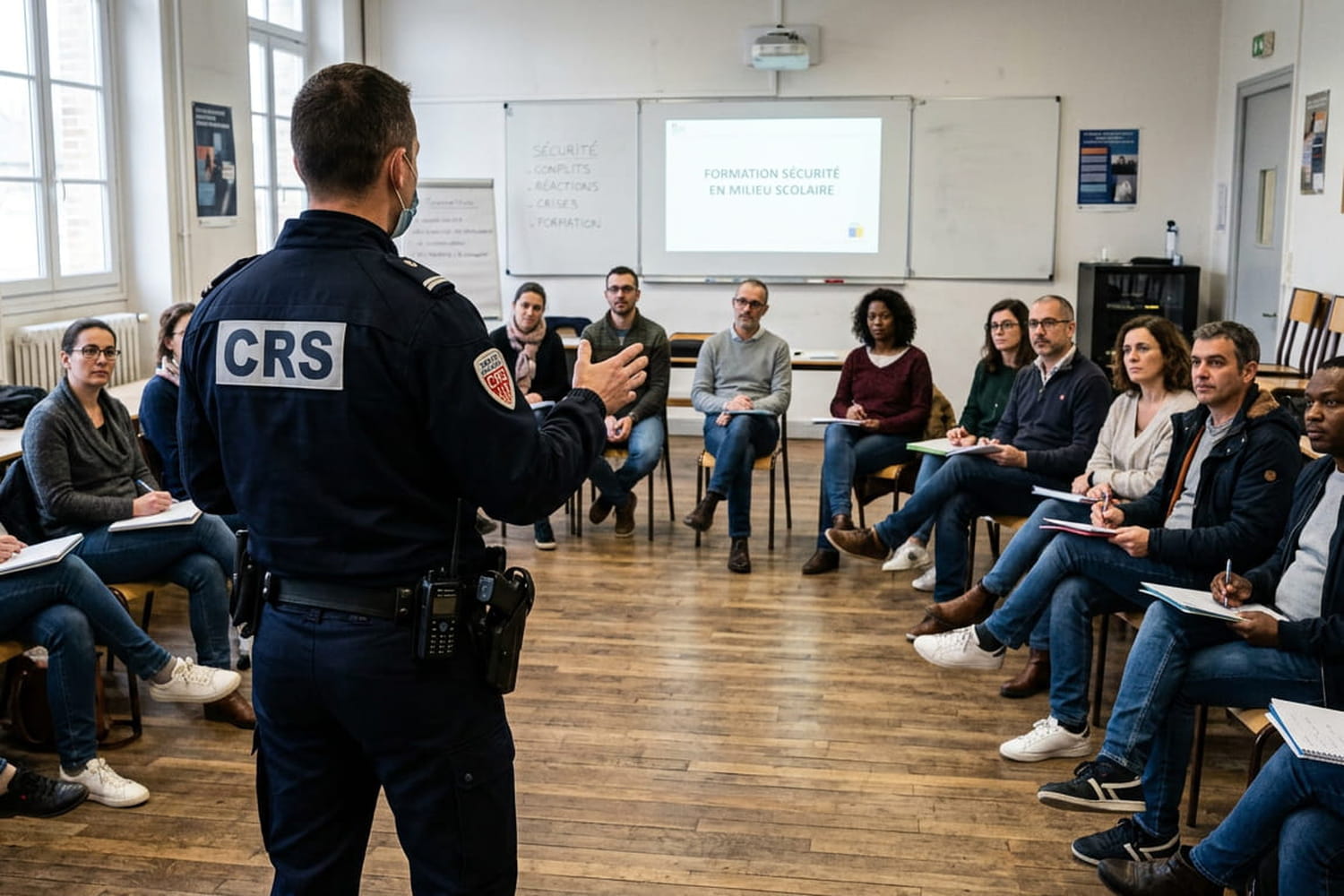
Some school staff are even turning to surprising training, to face the new risks of the profession that they had probably not considered when turning to a career with young adolescents. Our colleagues from M6 and RTL followed one of these courses “not like the others”... led by CRS of the national police. This concept has existed for several years now, but until now it was mainly intended for school directors. From now on, the demand “explodes” on the side of teachers, more and more of whom want to learn how to protect themselves in class.
Indeed, the aim of this free training offered by certain unions such as the UNSA for example, is to know how to react in the event of a knife attack by a student. A phenomenon that is unfortunately increasingly common in educational establishments. The trainers therefore teach participants to back away from an armed teenager, to protect their vital organs, or to bring any object that can help to act as a barrier, such as a chair, a large ruler or even an umbrella.
Other concrete advice is given: do not leave any object that could be used to hurt someone on your desk, like a simple coffee cup for example, or do not receive the parents of a student alone in your office in case the situation could, again, degenerate. The whole point is to develop reflexes to protect yourself, but also to protect the other students in the class.
Ultimately, the success of these courses proves the extent of the phenomenon and the climate of fear that has taken root in our middle and high schools. If these practical training courses offer concrete tools to reassure teaching teams in the face of the unexpected, they also raise a fundamental question about the evolution of the profession. The whole challenge of supporting teachers arises today to enable them to concentrate on their primary mission: teaching.