



Charcot’s disease imprisons the body without altering the mind. Xavier has suffered from it since the age of 55. Discovery of the disease, first symptoms, organization of daily life… He testifies in Le Journal des Femmes.
Amyotrophic lateral sclerosis (ALS) or Charcot disease is a degenerative disease that progressively leads to the death of motor neurons in the nervous system. It is characterized by weakening and then paralysis of the muscles of the legs and arms, respiratory muscles, as well as the muscles of swallowing and speech. Charcot disease often occurs between the ages of 50 and 70. Xavier was diagnosed at the age of 55. Testimony.
It all starts with a slight sensation, a fasciculation. It was “an uninterrupted tremor in one toe” he remembers. Gradually the tremor spreads “in every muscle of my body”. “My GP didn’t really have a diagnosis, other than it was probably related to my nervous system. He told me to see a neurologist, which I did.” After several visits to a neurologist, no diagnosis was made. Xavier then went to the neurology department of the Pitié-Salpêtrière hospital in Paris. “My body had spiraled out of control. The diagnosis was confirmed at the first appointment. I learned that I had ALS, or Charcot’s disease. My life expectancy was then estimated at 2 years.”
We are in 2015. For Xavier, this verdict sounds like a hammer blow. “It’s monstrously difficult to hear, especially when you’ve had a very healthy life like me: no cigarettes, no drugs, lots of sport and a balanced diet.” There are several forms of Charcot disease: the spinal form, the bulbar form and the genetic form. “I have the most complex form, combining spinal and bulbar disorders. The spinal form begins at the end of the limbs, as I had felt in my toe. The bulbar form is characterized by problems with swallowing, phonation and motor skills of the tongue. There is no curative treatment to date.”
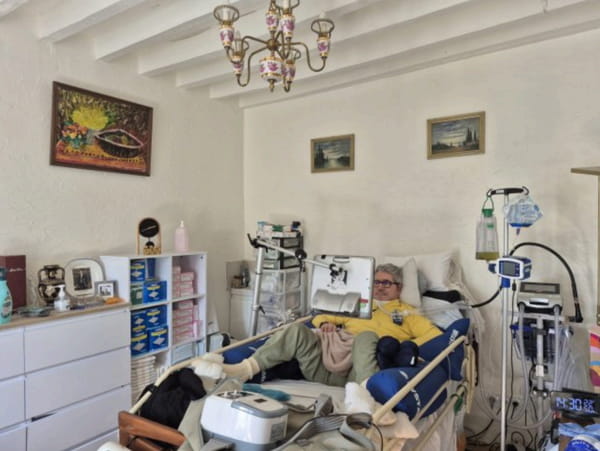
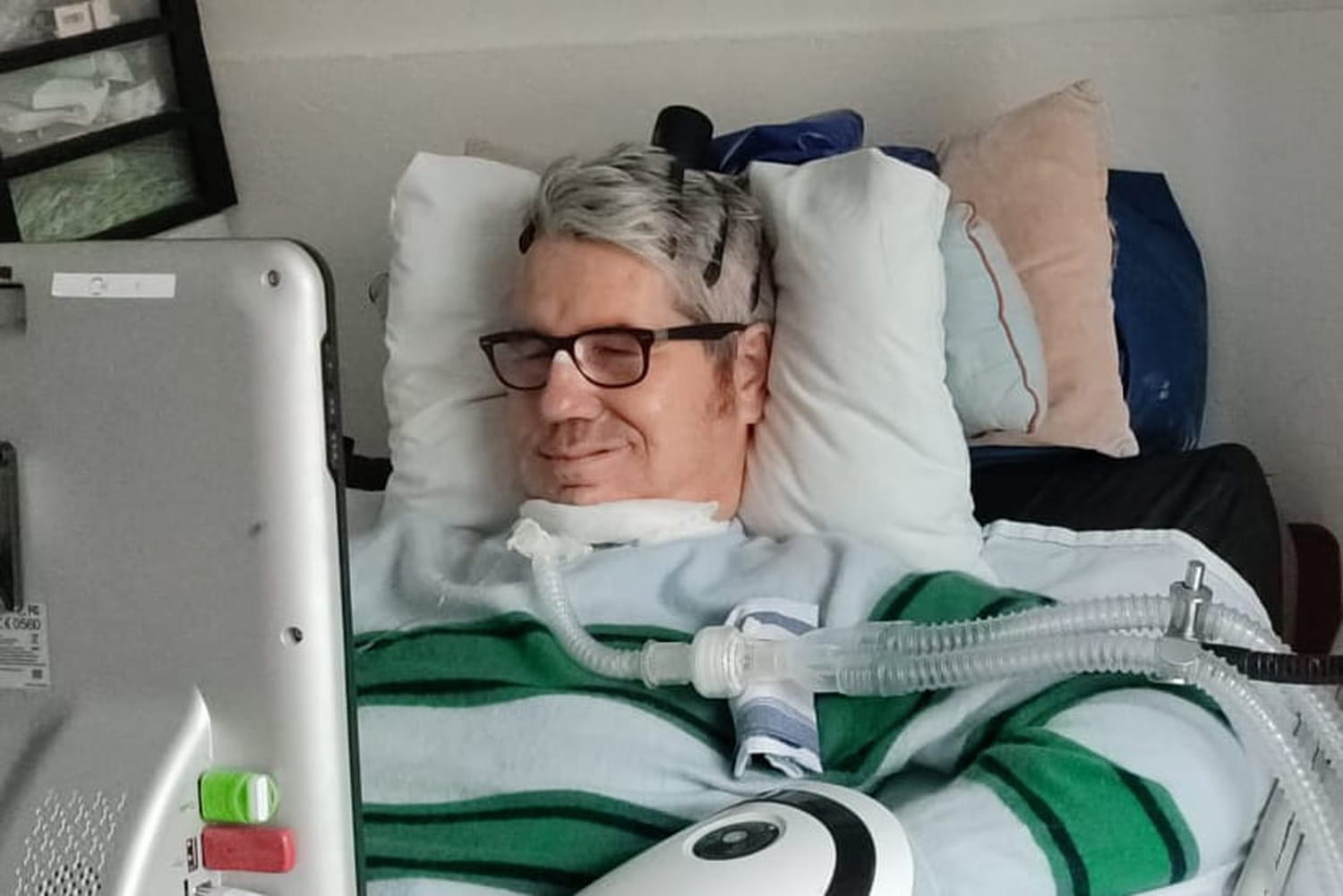
Daily life then begins for Xavier with a degenerative illness. “Quickly, I no longer spoke, no longer ate; I was totally paralyzed, in hypersalivation, with the worst trauma: respiratory failure. Surprisingly, I still have the possibility of moving a thumb, the researchers cannot explain this particularity.” Xavier underwent two operations. First a gastrostomy to be fed directly into the stomach, then a tracheotomy to be able to breathe.
“Twelve years later, I’m still here. Why?”
“It is necessary to be supported by quality medical staff: general practitioner, nurse, physiotherapist coming to your home, and a specialized hospital service for neurological and pneumological monitoring, in particular for changing the cannula every four weeks.” As degeneration is very rapid, the need for adaptation is constant. “We must anticipate solutions to support the illness. Choose quality equipment, such as an adapted wheelchair or a medical bed with an anti-decubitus mattress. You also need an excellent equipment provider (patient lift, NIV for respiratory assistance, food pump) and a company of motivated care workers.” Xavier underlines the importance of the entourage: “It is imperative to be able to communicate with loved ones using an eye tablet.”
Today, at 66, his fight continues: “Doctors are amazed by this longevity.” For him, it is essential to remain active, despite the illness. “Beyond care, it is vital to have plans. I explain all this in my book, “La Dolce Vita until ALS”, written with my eyes using my eye tablet. No one had done it before me. And as I always say: researchers search and patients wait, with the hope of a treatment.”
Thanks to Xavier Bertrand for his testimony. He is the author of “La Dolce Vita until ALS” (ed. Les 3 Colonnes). Comments collected on February 13, 2026.