






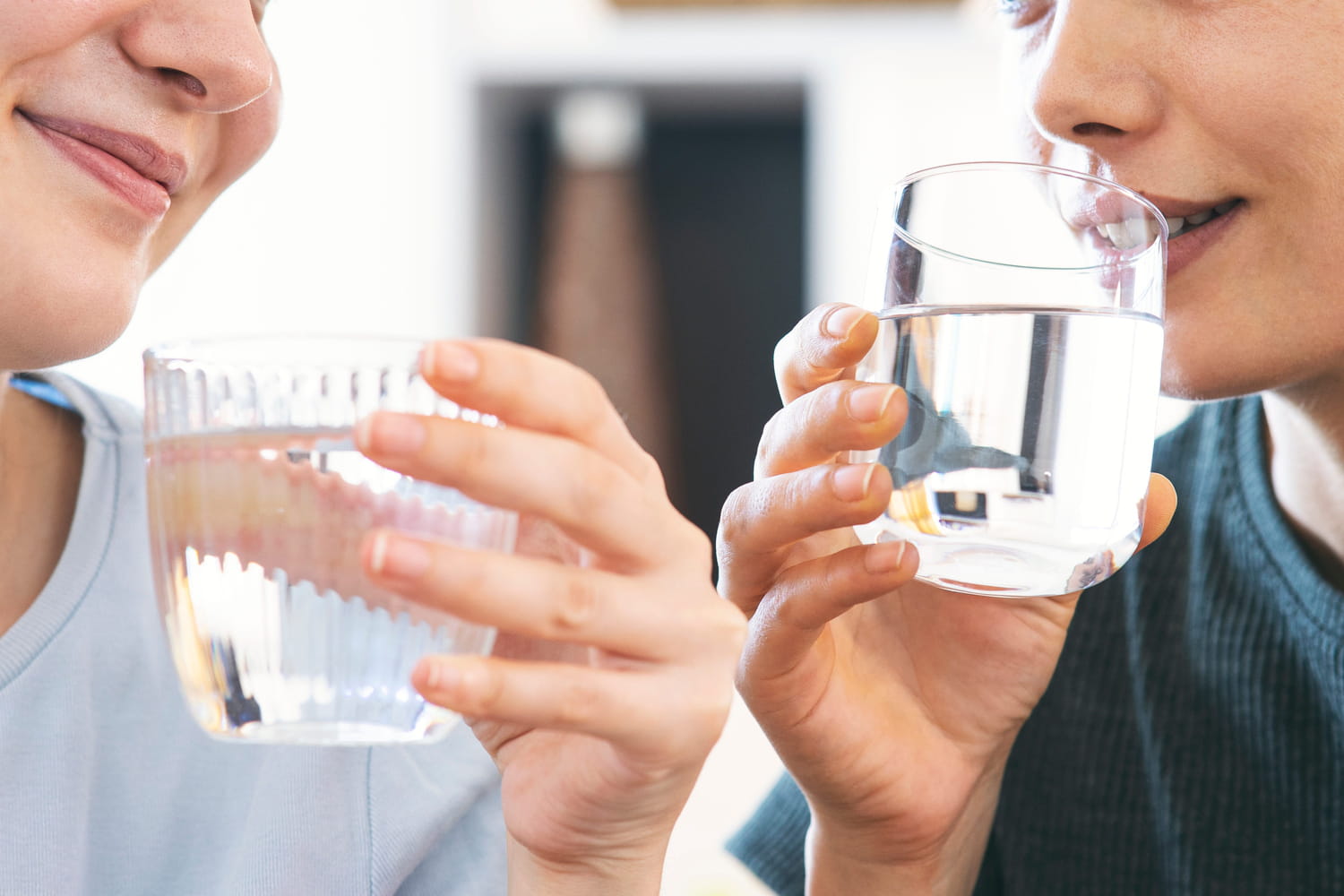
This is not trivial. Explanations with Dr Nadia Abid, surgeon-urologist.
In the middle of a heatwave, do you notice that, even if you drink water, you are no longer going to pee? Far from being trivial, this physiological phenomenon is linked to the way your body manages heat and it is not without consequences for health. Dr Nadia Abid, surgeon-urologist, deciphers this mechanism for the Journal des Femmes.
If we urinate less during periods of high heat, it is because the body draws on its water reserves to cool down and maintain its internal temperature at 37°. It then favors perspiration rather than the elimination of water via urine. “The water we consume will be used to cool our tissues. When it is very hot, we will evacuate more of our water through the skin, instead of evacuating it through urine. So we’re going to urinate less.” summarizes our interlocutor. Hence the importance of compensating: “During periods of high heat, you need to drink more”warns the urologist. And it’s possible, even outside: an interactive map reveals the drinking water points around us.
But you still have to think about it. “The problem when you don’t drink a lot and urinate little is that the urine will be very concentrated. So the waste that is normally passed out in the urine will accumulate.” In women, this opens the door to a well-known inconvenience: urinary infection. “In them, the anus and the urethra are very close. Germs go up into the bladder in an almost normal way and are eliminated each time we urinate.” If we do not produce enough urine, these germs accumulate in the bladder instead of being evacuated, and a urinary infection appears. Women therefore have to drink even more than usual when it is very hot.
“You have to urinate every 3 to 4 hours”
Men are not spared but are exposed to a greater risk of developing kidney stones. Certain wastes are in fact filtered by the kidneys, such as calcium, phthalates or phosphate. “If we don’t drink enough, in concentration, they will be too big”explains Dr. Abid. Result: this waste accumulates, crystallizes and forms small crystals. “Then the crystals will accumulate and form stones.”
How do you know, then, if you are drinking enough? Here again, it is better to rely on your urine than on the quantity of water ingested, because the needs vary according to each person, the heat and the effort provided. Dr Abid gives a first reference: “You have to urinate approximately every 3 to 4 hours sobe well hydrated every 3-4 hours.” Another indicator, and not the least, the visual: “The main thing to watch out for is the color of the urine. It must be very clear.” If they are too yellow or orange, “they are hyper concentrated” : it’s time to pour yourself a large glass of water and drink it without delay.