





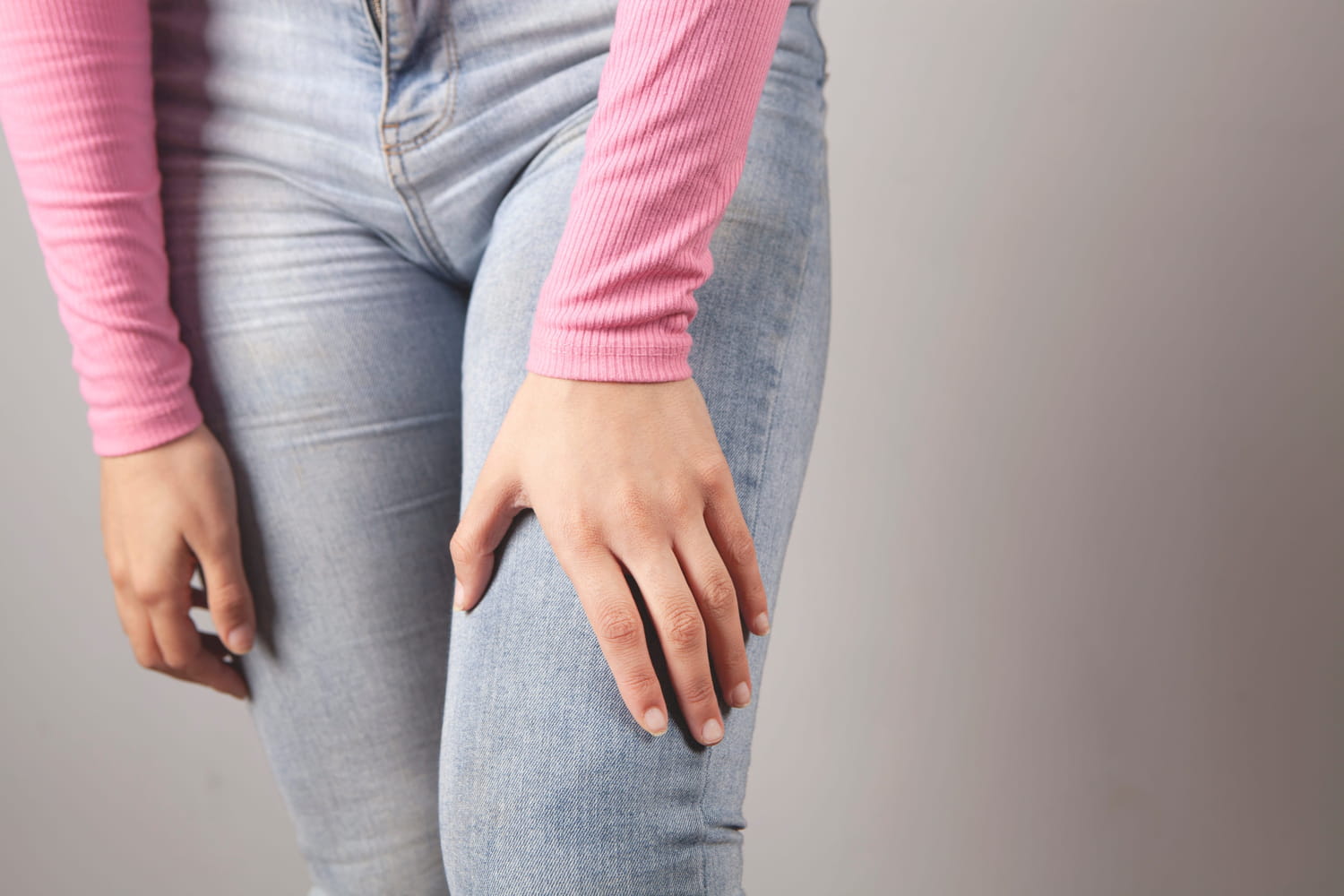
Thigh pain in the front, back or side: this common symptom can have very different causes. Signs to recognize, possible causes, when to consult and how to provide effective relief with the advice of Dr Sophie Bur, sports doctor.
Thigh pain often appears after physical exertion, but not only. Depending on its location (front, back, inner thigh), its intensity and the circumstances of its appearance, it can reveal very different causes, ranging from a simple muscular problem to nerve, vascular or bone damage. Identifying the origin of the pain allows you to quickly adapt the treatment. THE Dr Sophie Bur, sports doctor, enlightens us.
4 possible origins
We generally distinguish four main origins: muscular, vascular, nervous or bone.
► Pain of muscular origin is the most common. It occurs after too intense or unusual effort. It can correspond, depending on its severity, to a muscle stiffness, contracture, elongation, strain or tear.
► Pain of vascular origin is not linked to sport. “It is linked to venous insufficiency or phlebitis. In case of venous insufficiency, the pain is more diffuse, more permanent and intensifies in the evening, after prolonged standing, when it is hot or during pregnancy”describes Sophie Bur. It is often accompanied by a feeling of heavy legs and sometimes swelling.
► Pain of nerve origin may suggest sciatica or cruralgia, linked to nerve compression in the spine. “The nerve is compressed in the back with pain in the lower limbs. In cases of sciatica, the patient has pain in the back of the thigh (this can go down to the foot) and in cases of cruralgia, the pain is more localized in the front of the thigh”specifies Sophie Bur. The pain often takes the form of burning, tingling or electric shocks.
► Pain of bone origin can follow trauma, such as a fracture of the femur. “This can also be a sign of osteoarthritis in the hip: in this case, the pain is rather located in the groin fold, with radiation to the front of the thigh”describes Sophie Bur.
What does muscle pain in the front of the thigh mean?
Pain localized in the front of the thigh corresponds to an injury to the quadriceps muscle.
What does muscle pain in the back of the thigh mean?
Pain located at the back of the thigh corresponds to a hamstring injury.
What does inner thigh muscle pain mean?
Pain located on the inside of the thigh corresponds to an adductor injury.
Who to consult in case of thigh pain?
“First of all, it is important to see his general practitioner who can direct the patient to a rheumatologistA sports doctor or a Physical Medicine and Rehabilitation doctor (MPR) if they suspect pain of muscular or neurological origin or towards a angiologist if the pain appears to be of vascular origin“, specifies our expert.
What tests should you do in case of thigh pain?
► A simple ultrasound if the pain is muscular
► One Doppler ultrasound if the pain is vascular
► A back imaging (CT, MRI) if the pain is nervous.
► A x-ray if the pain is related to a bone fracture
What treatment to relieve thigh pain?
► For pain of muscular origin: “it is advisable to put on heat on the sore area in case of stiffness or contracture, and rather cold in case of elongation, strain or tear“, advises Dr Sophie Bur. To relieve pain, you can take painkillers. In the event of a muscle tear with heavy bleeding, the hematoma can be punctured to relieve the patient’s tension and pain. In the event of significant injury, the rehabilitation at a physiotherapist is essential to recover damaged muscle tissue and reduce the risk of recurrence. The return to sport must be done gradually.
► For pain of vascular origin: several treatments are possible such as lymphatic drainagewearing compression stockings, taking venotonic medications.
► For pain of nervous origin: “firstly, we will do rehabilitation with a physiotherapist to strengthen the back muscles, the abdominals and stretch the legs. It is also possible to take medications, such as anti-inflammatories or corticosteroids. If this is not enough to relieve the pain, corticosteroid infiltrations may be indicated.
► For pain related to hip osteoarthritis: First-line treatment is based on taking analgesic and anti-inflammatory medications as well as rehabilitation to maintain hip range of motion and strengthen the muscles. Then, if necessary, infiltrations into the hip to relieve pain.
Thanks to Dr Sophie Bur, sports doctor and doctor of Physical Medicine and Rehabilitation, Pôle de MPR IURC Strasbourg.