






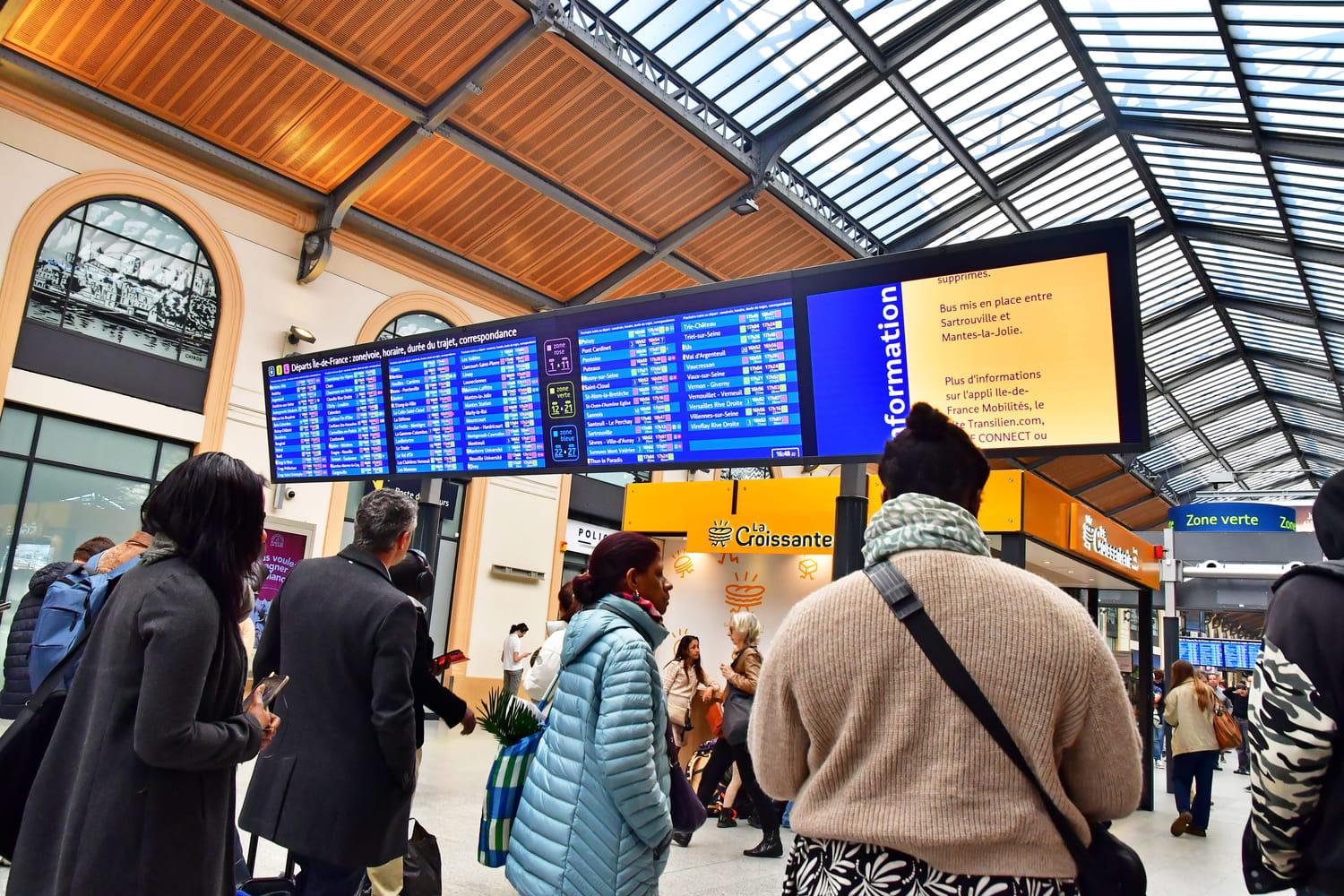
It is common knowledge: the SNCF is not the champion of punctuality. But in reality, not all regions are equal when it comes to train delays.
This is probably one of the only subjects on which everyone can agree: the SNCF is (too) often late. Indeed, everywhere in France, the railway company is not known for its punctuality. Any traveler can tell you, you never know what time you will arrive when taking the train in France. Signaling problems, obstacles on the tracks, bad weather, works, suspicious packages or of course strikes… Whether at departure, during the journey, or on arrival, there are multiple causes of delay and passengers suffer the consequences. However, not all regions are equal when it comes to the problem.
On average, on all regional trains which operate within French territory, the SNCF displays a punctuality rate of around 91%, according to figures from last year. A score higher than one would have imagined, but which nevertheless differs from one zone to another. To have a better chance of arriving on time, it is better to travel to Brittany, champion of the ranking: almost 95% of trains there are punctual. Next come Burgundy-Franche-Comté and the Grand Est with almost 94% each, then Île-de-France with 93%. But then, what is the worst region to take the train?
We notice that Occitanie stands out: it is in this region that the SNCF shows the most delays, with punctuality of less than 87% over the year. It is followed by Nouvelle Aquitaine with 90%, then by the Provence-Alpes-Côte d’Azur and Auvergne-Rhône-Alpes regions, and finally Hauts-de-France, which is barely above 90%. For their part, the Centre-Val de Loire, Pays de la Loire and Normandy regions are in the middle of the ranking, approximately at the national average of 91%.
As for the train lines, one of them is breaking all delay records. It is the Paris – Briançon route, the Intercités line which therefore joins the capital to the Hautes-Alpes department, which displays the worst punctuality: only 63% of trains arrive on time. Conversely, it is the Clermont-Ferrand – Béziers route, also in Intercités, which ranks at the top of the good students with an honorable score of 96%.
Note that the SNCF has a rather flexible definition of delay, which includes a small margin depending on the total duration of the journey: 5 minutes are tolerated for journeys of less than 1 hour 30 minutes, then 10 minutes for less than 3 hours, and 15 minutes beyond 3 hours. In other words, delays of less than 15 minutes are not counted in the official figures, which would therefore be much higher.