




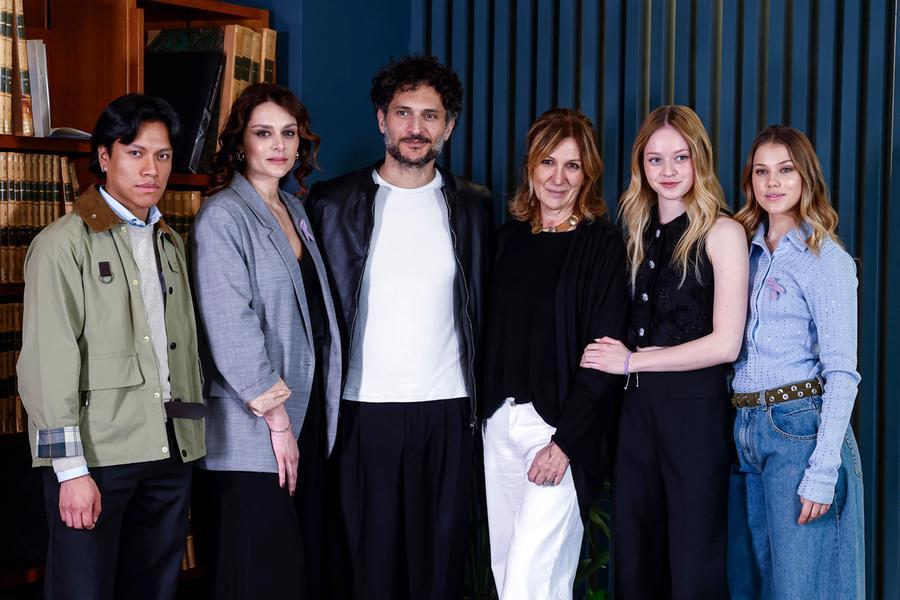
It arrives, in prime time on Rai 1, Something lilacthe film directed by Isabella Leoni that shines the spotlight on a disorder that is still little recognized: bulimia. A disease that often remains hidden, far from sight, but which can have dramatic consequences, especially among adolescents.
Produced by Rai Fiction, the film was born from ten years of activism by screenwriter Maruska Albertazzifrom hundreds of collected stories and the events of five young people who died due to eating disorders, to whom the work is dedicated.
The story: Nicole and that pain you can’t see
At the center of the story is fifteen-year-old Nicole. He lives with his mother Veronica, severe and distant, while his father Cristiano – affectionate but often absent – remains an intermittent presence after separation.
The arrival of Luce, a new charismatic and unconventional classmate, changes everything. It is she who drags her into a world of excesses and transgressionsbehind which lies a deeper reality: bulimia. Nicole slowly slips into the same vortexalmost without realizing it.
An invisible disease that creeps into everyday lifeuntil a tragic event that forces the family to deal with what had remained hidden. Marco remains next to herstable presence in a wavering equilibrium.
The cast and faces of the story
Nicole is played Federica Palaflanked by Alessandro Tersigni in the role of father Cristiano and by Raffaella Rea in that of his mother Veronica. Margherita Buoncristiani it is Light, a central and ambiguous figure, while Miguel Bonini plays Marco.
They complete the cast Federico Coccia, Costantino Comito, Rebecca Orlandi, Valentina Valsania and the same Maruska Albertazzi.
A topic still little understood
What Something lilac brings to the screen, however, it is not just a story. It is a concrete reality, often invisible, which affects more and more families.
According to data released by the Istituto Superiore di Sanità, eating disorders represent the second cause of death in Italy among girls and young women between 12 and 25 years oldimmediately after road accidents. Numbers that tell of a widespread and still too little recognized suffering, especially when (as in the case of bulimia) it leaves no obvious marks on the body.
To better understand what lies behind this disorder, we interviewed the psychiatrist Leonardo Mendolicchioexpert in eating disorders.
Doctor, how serious is the situation of eating disorders in Italy today?
«The real big issue is that we don’t have updated data to think about: the most reliable ones date back to 2009 and speak of around 3 and a half million Italians. But a lot of time has passed, in the meantime the world has changed. If I had to give an estimate today, I would talk about around 5 million people who suffer from eating disorders, and 60% concern adolescents. We are talking about complex, difficult and unfortunately also fatal pathologies. During Covid there were around 5 thousand deaths a year; today we are around 3,500. They are enormous numbers: to think that more than 3,000 people die from eating disorders in Italy is a figure that cries out for vengeance.”
What is the difference between bulimia and anorexia?
«Eating disorders are different: anorexia, bulimia, binge eating disorder, ARFID, vigoroxia. Bulimia is characterized by uncontrollable hunger pangs, so-called binges, followed by a very strong sense of guilt. This sense of guilt leads to the implementation of compensation mechanisms. The best known is self-induced vomiting, but it is not the only one: there is physical hyperactivity, fasting after a binge, the use of laxatives or diuretics. It is therefore an alternation between large quantities of food ingested and attempts to “compensate”, with an enormous sense of guilt in the middle. Anorexia, on the other hand, leads to the refusal of food, to the intense fear of gaining weight and seeing the body change. It must also be said that eating disorders are not static: it is very common to go from anorexia to bulimia. It is not a disease that arises in one way and remains the same, it changes over time.”
What is the basis of a disorder like bulimia?
«They are multifactorial diseases. Cultural, social and psychological components come into play. There are often traumas: abuse, bereavement, bullying, abuse, violence. All experiences that can compromise the relationship of trust with the outside world and generate a strong sense of helplessness. This produces a vacuum that is not discharged directly onto the food, but which leads to binge eating. And then the sense of guilt comes into play, also linked to the pressure towards a certain ideal of thinness. This is where the need to compensate arises.”
How much influence do aesthetic models and social networks have today?
«Social pressure on the body is not new: it has always existed. The body, especially that of women, has historically been the object of aesthetic expectations, through art and culture. Today, however, this pressure has amplified. It also involves younger and younger ages and, increasingly, also men. Social media is the “armed arm” of this pressure: while before it was more difficult to get in touch with certain models, today a scroll on your mobile phone is enough. It’s all immediate, continuous, pervasive.”
Are bulimia sufferers aware of the problem?
«Yes, unlike anorexia. The anorexic person often struggles to recognize their condition, while those who suffer from bulimia experience real slavery and are aware of it. However, there are two situations: those who decide to stay within this mechanism – binging and compensating – even for years, and those who instead ask for help. I still see women aged 50-60 years old who tell me: “Doctor, I have been eating and vomiting for 30 years”. This makes us understand how widespread and silent this pathology is, and how much it can accompany a person for decades.”
Is bulimia more difficult to detect than anorexia?
«Yes, and that’s the big problem. Bulimia is a sort of “phantom pathology”: it can go on for years without anyone noticing. Unlike anorexia, there are not always obvious signs on the body. This is why it remains hidden and is often intercepted late.”
Are there any signs a parent can pick up on?
«The relationship with food becomes problematic. There can be a frantic search: the bulimic subject can end up emptying the pantries, eating anything, even frozen food. It’s not that difficult to notice, but you need to be careful. And above all, a culture of sensitivity is needed: parents, siblings, partners should train themselves to understand each other’s suffering. If we recovered this empathic ability, even an invisible disease like bulimia could be recognized sooner.”
What should we avoid saying or doing when trying to help a bulimic person?
«The biggest mistake is the judgmental approach. Those suffering from eating disorders already live with a ruthless internal “court”. If you approach it judiciously, you strengthen that inner voice. The right approach is made of tenderness and presence: telling the other “we have seen that you are ill, we are here beside you to understand and help you””.
Can it be healed?
«Absolutely yes. And fortunately we see more and more people who manage to overcome eating disorders, even bulimia.”