





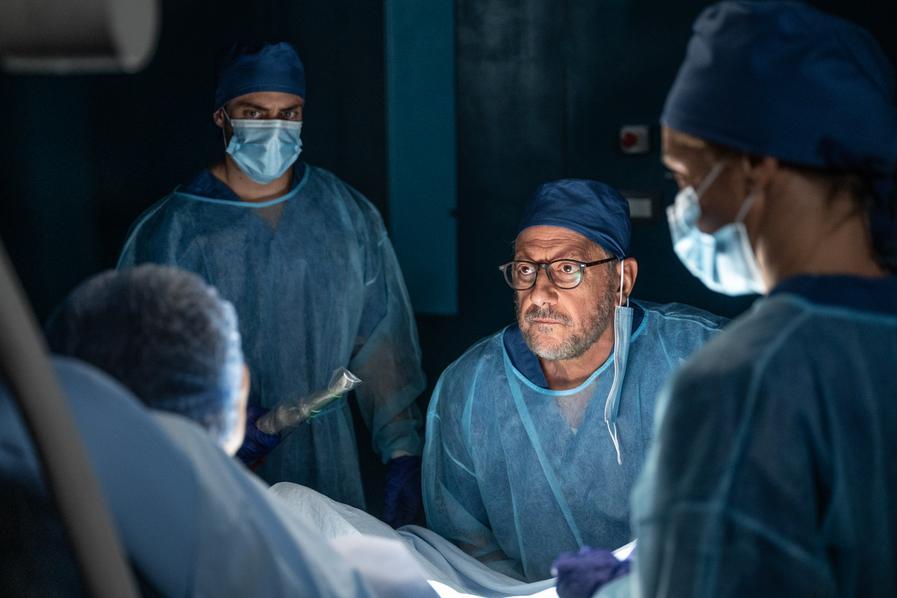
There is a sort of strange melancholy that pervades the characters of In the Uterusthe new HBO series, by Maria Sole Tognazzi, written by Margaret Mazzantini and set in a fertility clinic in Barcelona. From the director of the clinic Ruggero Gentile, a very good man Sergio Castellittoflanked by his wife, his closest collaborator Angelo, who recently completed the transition from woman to man, up to the protagonists of the different cases that arise in each episode, all are in search of a happiness that always seems to escape. Maybe because it’s not where they’re looking for it.
In the eight episodes of the series we explore the different situations that can lead a couple to try to have a test tube child, but also the many other cases in which technology invades the body and sometimes transforms it into a commodity – like that of the young woman who sells her eggs to pay for a scholarship -, or proposes herself as a solution to what would seem impossible, and this is the case of the girl who is becoming a man but first wants to freeze her eggs, because “you never know”.
In the Uterus does not hide the difficulties, especially psychological, that characterize assisted reproduction paths. When you decide to have a child – the series seems to suggest – many issues in life come to a headand even what seemed to be going smoothly instead breaks down: this is what happens to the couple of women who, faced with the forced decision on which of them will be the mother, enters into crisis, or the protagonists of the initial episode, who question their relationship when the much desired child struggles to arrive.
The story of Ruggero and Teresa (Maria Pia Calzone), owners of the Creatividad clinic, which has serious economic problems, forms the background to the events of each episode. He is an idealist in his own waywith his work he tries to satisfy the desires of patients and chases a dream that has accompanied him since he was a child, while she is more pragmatic, determined to find a financier to give the clinic a future. However, the two have no children: “I have always been convinced that children can ruin everything, both when they arrive and when they don’t arrive”, screams Teresa in the intense scene in which her husband seems to question all their choices.

In the Uterus portrays a fragile humanity. The characters are entangled in toxic relationships, entangled in internal conflicts that they try in vain to resolve by trying to bring a child into the world. These are “frozen” relationships, like the embryos in the clinic’s freezers, which struggle to evolve in a linear way, where everything is subjected to meticulous analysis, and which are lost as the story progresses, in a series that from a narrative point of view proceeds at a slow and uninvolving pace.
In the eight episodes, none of the protagonists’ choices are problematized, In the Uterus abstains from any ethical evaluation, even on extreme procedures, such as the sale of eggs, which is understandably prohibited in Italy. Every practice, however, seems possible and “normal”, dependent on the desire for happiness of others. But then this happiness does not arrive, and the questions that his research had generated remain suspended.
There is room for a question about faith, with the story of a woman determined to implant all the eggs that develop, because she is a believer and refuses to select them (“I see them, how can I tell them ‘you yes, you no'”, she says to her husband). Warned of the risks of her case, she does not give up on the project and in a dialogue with Ruggero explains that she trusts in the mystery.
And the nostalgia that characterizes the protagonists of In the Uterus it is perhaps precisely because of that mystery, for the abandonment to a life that surprises you, and which emerges here and there between the folds of the series. We see it in Ruggero’s story where, due to fortuitous circumstances, a purely biological bond with a now forgotten daughter claims all its power.