






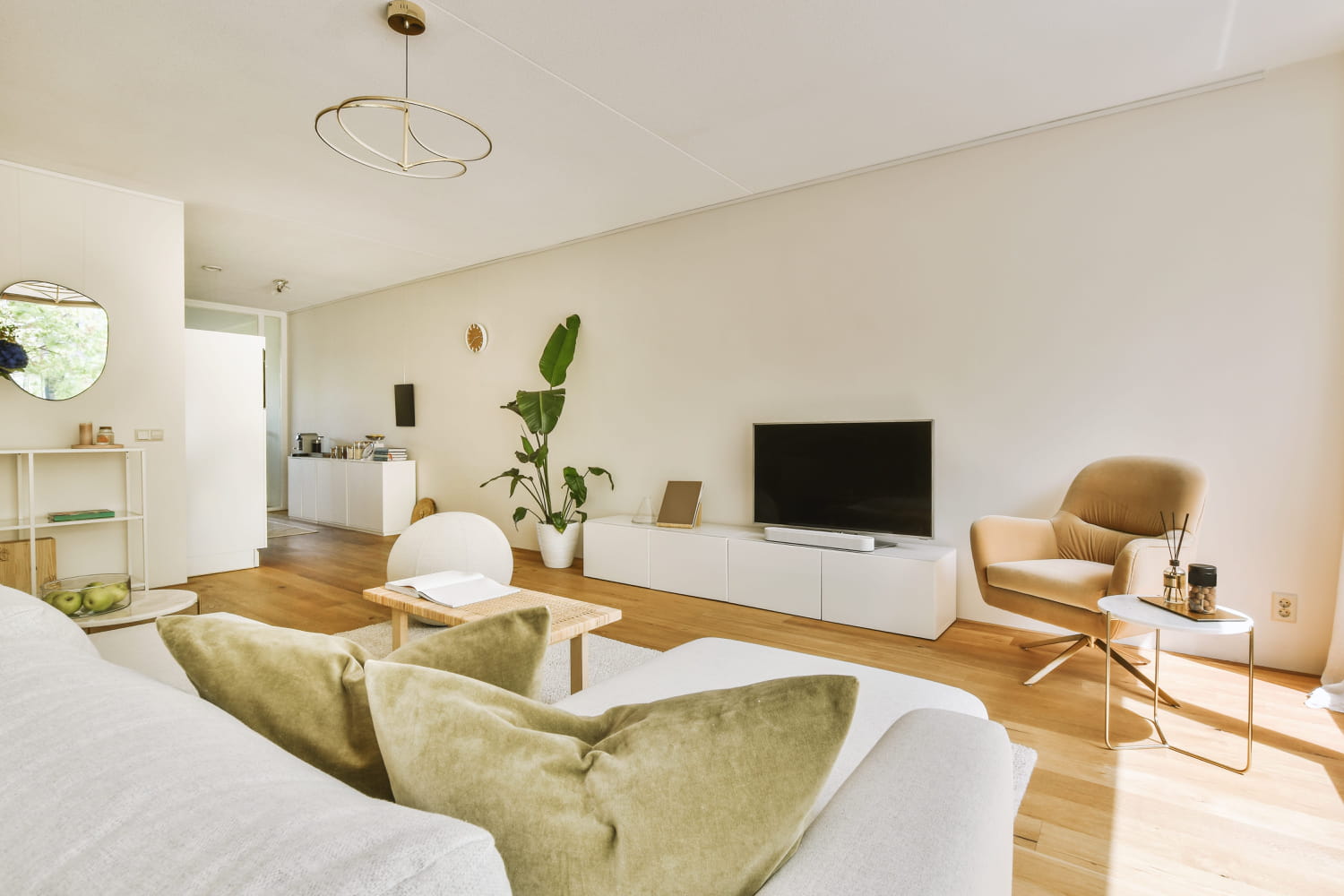
Extremely popular, this color is however not the one you should choose in a living room. It can really ruin your decoration.
A couch you can sink into. A lamp that gives beautiful light. A coffee table that lives, a rug that warms. It all matters. But the walls? This is where it all begins. Their color changes the mood, the energy, the feeling of comfort. And if it is well chosen, it can transform the living room into a cocoon. On the other hand, it can also, sometimes, ruin everything. According to the pros, there is indeed a color that should be avoided at all costs.
Meredith Still, designer, emphasizes one point: “Color has a huge impact on the energy of a living room. It’s one of the main ways to create an emotional mood in the space.” Translation: painting your walls is not just a matter of taste or fashion, it is above all a question of sensations. And some colors get in the way of that. Tracy Morris, also a designer, goes in the same direction. She says the wrong shade can kill the mood of a room. You must therefore choose it carefully, taking into account the light, the furniture, but also what you want to feel in the room.
So what are the common mistakes? The two specialists point out several pitfalls. First, the colors are too bright. Fire engine red, fuchsia pink or neon green are often tempting on a color chart. But on four walls, it’s a different story. Tracy Morris explains that these saturated hues create visual tension. “They can be suffocating. In a living room, we seek calm. These colors prevent relaxation.” The same problem arises with very dark shades, such as midnight blue or cocoa brown. “They can be magnificent on a section of wall, or in a well-lit room. But if there is a lack of natural light, the effect becomes oppressive. You have the impression that the walls are closing in.”
Another criticized color: gray. Long adored for its sober side, it is today losing points. “He has been everywhere, in every interior. But he is tricky,” explains Meredith Still. “When the light changes, the gray turns dull, it drains the room of its warmth.” For her, it’s not just a question of aesthetics, it’s a question of comfort. Even when combining it with wood or natural materials, gray can pose a problem. It tires the eyes. It makes the atmosphere a little flat, like an overly retouched image.
But the worst of all is none other than cold white. The one that tends towards blue or gray. “It erases everything we try to build,” slices Meredith Still. It doesn’t reflect light, it crushes it. It gives a clinical, impersonal feel, a bit like a waiting room. Even beautiful furniture looks dull against it.
Fortunately, not all neutral colors are worth throwing out. On the contrary, the two decorators defend soft tones, beiges, warm whites. “These shades adapt to the light, the seasons, the decor. They create a cocoon”, explains one of them. To remember!