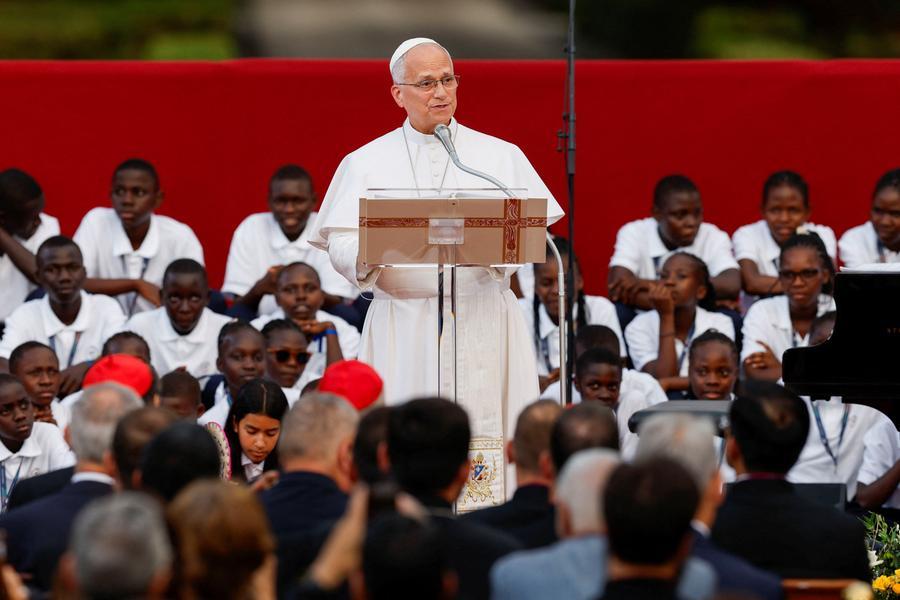






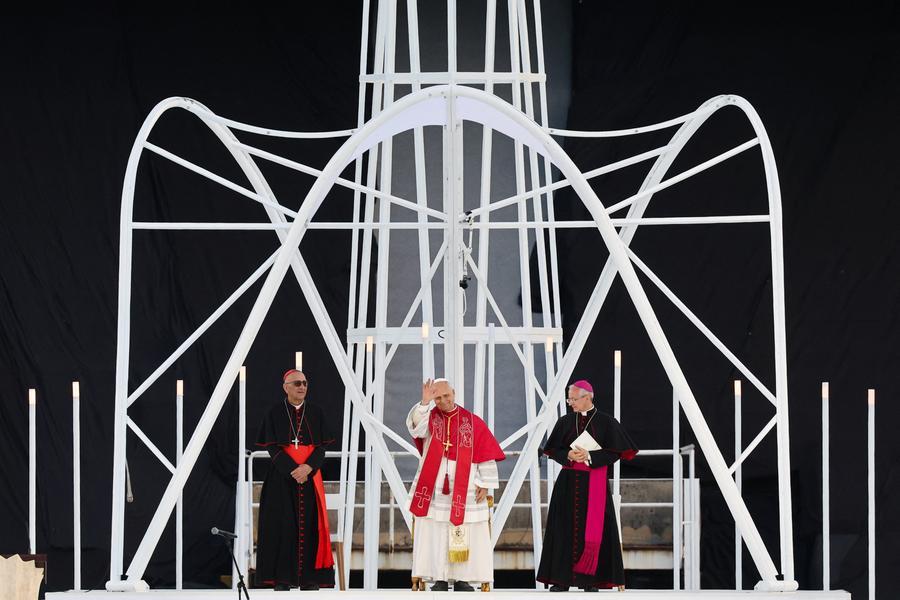
It is a night of celebration, prayer and reflection. Pope Leo arrives at Olympic Stadium which takes its name from Lluís Companys, the president of the Catalan government during the civil war who was shot by Francisco Franco in 1940 and the 40 thousand who await him explode with joy. First he had met Salvador Illa, the president of the Generality of Barcelona and the approximately 200 participants in the Med26 Mediterranean Meeting, which takes place until the 13th in the city and encouraged them to reach, “in a geographical and spiritual sense, those ports where men and women await the good news”.
In the stadium Leone is welcomed with i castellersthe human towers expression of Catalan culture and UNESCO intangible heritage.

Between songs and dances, the Cardinal of Barcelona, Juan José Omella Omella welcomes him to what he calls the “capital of the Mediterranean” which is now “his home”. Joy, however, does not forget the crosses of the world and personal ones. The Pope, just before entering the stadium, blesses 33 ambulances headed to Ukraine and, after having greeted the stands, the vigil begins by engaging in a dialogue with the young people. With those who have recently received baptism and are wondering about their restlessness and about a company whose sole objective is to produce, be successful and take care of its image. With whoever he has attempted suicide feeling an immense and silent pain inside himself and asks how to trust in God «when it seems that nothing, not even for ourselves, is worth it». With whom you ask where was God when, in his childhood, his father had tried to kill his mother and this one had been saved by a boy who, instead, had lost his life. With who he would like to forgive that fatherbut he can’t do it. The Pope does not give easy answers. He tells the kids not to be afraid of restlessness, a “gift from God”, which opens us to broader horizons. «We are tailor-made for the infinite and for this reason every finite horizon, every step, every conquest, while satisfying us, at the same time pushes us forward and invites us to continue searching.to search by moving forward, but, above all, to search by “going internally”, that is, by going deep.” This healthy restlessness must be cultivated because it is it that puts us on the trail of God. «The idolatry of profit and performance, the frenzy of always having to produce and be winners, as well as the cult of one’s own image», explains, «they are nothing more than anaesthetics to put our conscience to sleep and adapt it to a certain idea of society. When people learn to stop, to give value to important things, to appreciate time in a new way and to reflect on their lives allowing themselves to be enlightened by the Gospel, they also develop critical thinking towards a social system that does not place the person at the center and causes situations of injustice and existential poverty at different levels. This is why restlessness is scary, as is the discovery of interiority, spirituality and even more so the Gospel.”
But restlessness must not lead to loneliness or depression. The traces of God must be sought together, with catechists, with teachers, with the community. The Pope encourages those who talk about having hit rock bottom, but having had a second chance but were unable to finish it. “You got up and resumed your journey, and this is a wonderful miracle that we see in many characters of the Gospel: in contact with Jesus, even those who feel lost find confidence in life, heal from illness and can get up to live again.” And he highlights how «Mental health is increasingly threatened in the context of societies that consider themselves advanced. It is a sign that there is something profoundly wrong with a certain idea of growth that subjects people to pressures, expectations and tensions that compromise fundamental balances. This is why we need a healthcare system that includes this among its priorities invisible and generalized malaise, which also affects young people”.
«Pain tests faith and the meaning we attribute to life. This applies to everyone, not just to those who, at a given moment, have to face the test of illness.” He also speaks of Jesus and his night of darkness and anguish “when the hour of his death approached”. And of the darkness that came over the whole earth as he was dying. Because that of Jesus is not a personal suffering: «the Son of God is taking on in his own flesh all the anguish, loneliness and suffering of humanity. In those dark hours, dying on the cross, Jesus shares our pain and reveals to us the face of a compassionate God, who bears the weight of our sorrows, who suffers with us, cries our tears and remains at our side with his presence full of love and mercy”. In moments when we may think that God has abandoned us, “He remains crucified with us in the moment of pain and extreme loneliness” and “collects not only our tears, but the cry of our suffering that others do not hear”. It is in hours of pain that as much as possible “we must open ourselves to someone who helps us express a simple prayer, who accompanies us discreetly without the rush to explain that pain to uswho takes us by the hand and takes us out of that cry.” And he warns believers and the whole Church: «We must not spiritualize pain, superficially tracing it back to “God’s will” or to some mysterious project of his, because this risks minimizing that suffering, silencing it, hurting people. God does not want suffering, he brings it with us and invites us to trust in Him with perseverance.”
He talks about violence and the question about the presence of God. Rather, he explains, we should ask ourselves “about man and humanity, about how we are sometimes prisoners of evil to the point of becoming violent with otherson how we fail to cultivate love and respect others in their dignity and freedom.” Underline how the «many crime news, even today, reflect a poisoned climate in family relationships, characterized by abuse and oppression, and in particular by violence against women, which unfortunately often also leads to feminicides». And he calls everyone to reflect on how to deal with this «dramatic reality both personally and as a society, because it is up to us to face it in all its dimensions. We cannot attribute to God what has been entrusted to our responsibility; we cannot imagine that God from above automatically responds to our needs or miraculously prevents evil from happening.” Again, he insists, “if violence exists, if selfishness triumphs, if even love between family members turns into hatred, we must ask ourselves some questions about ourselves, about the dynamics of our society, about the culture of individualism, about the temptation to violence, and not about God”.
Finally, forgiveness, which must be considered as a «powerful remedy against evil that heals our internal wounds, as part of a process, of a journey. The Gospel itself, if we read it as a book of indications, commandments and duties, risks causing us great discouragement and frustration, because while Jesus invites us to forgive we realize that we are not capable of it. However, this is not the case. We must above all invoke forgiveness from the Lord; continue to ask – perhaps for the rest of our lives – that the Lord expands the space of love within us precisely where we have been woundedwhich helps us to reconcile with ourselves and with that part of our history marked by suffering, which slowly transforms resentment into mercy and compassion. It is a long journey, it is a process that requires a lot of patience, it is work that we must do on ourselves, both personally and through other paths of accompaniment and inner reconciliation.” Without thinking that this means returning to the previous situation or living a full relationship with those who hurt us, «especially when the event was also characterized by violence. We can maintain a good disposition of heart towards the person, reject any form of hatred or revenge, strive to recompose the relationship as much as possible and, perhaps, pray for him or her: this helps us to enter more and more into the dynamic of forgiveness and to reconcile with God and with others”.
__________________