





The feast of the Sacred Heart of Jesus is one of the most heartfelt celebrations of popular devotion. Through the symbol of the pierced Heart of Christ, the Church contemplates God’s merciful love for humanity and invites the faithful to respond with prayer, adoration and charity. A devotion that has its roots in the first centuries of Christianity, but which found an extraordinary diffusion thanks to the revelations received from Saint Margaret Mary Alacoque in the 17th century. Even today, as he recalled Pope Francis in the encyclical Dilexit Nos (2024), the Sacred Heart represents «a synthesis of the Gospel» and the very center of the Christian faith.
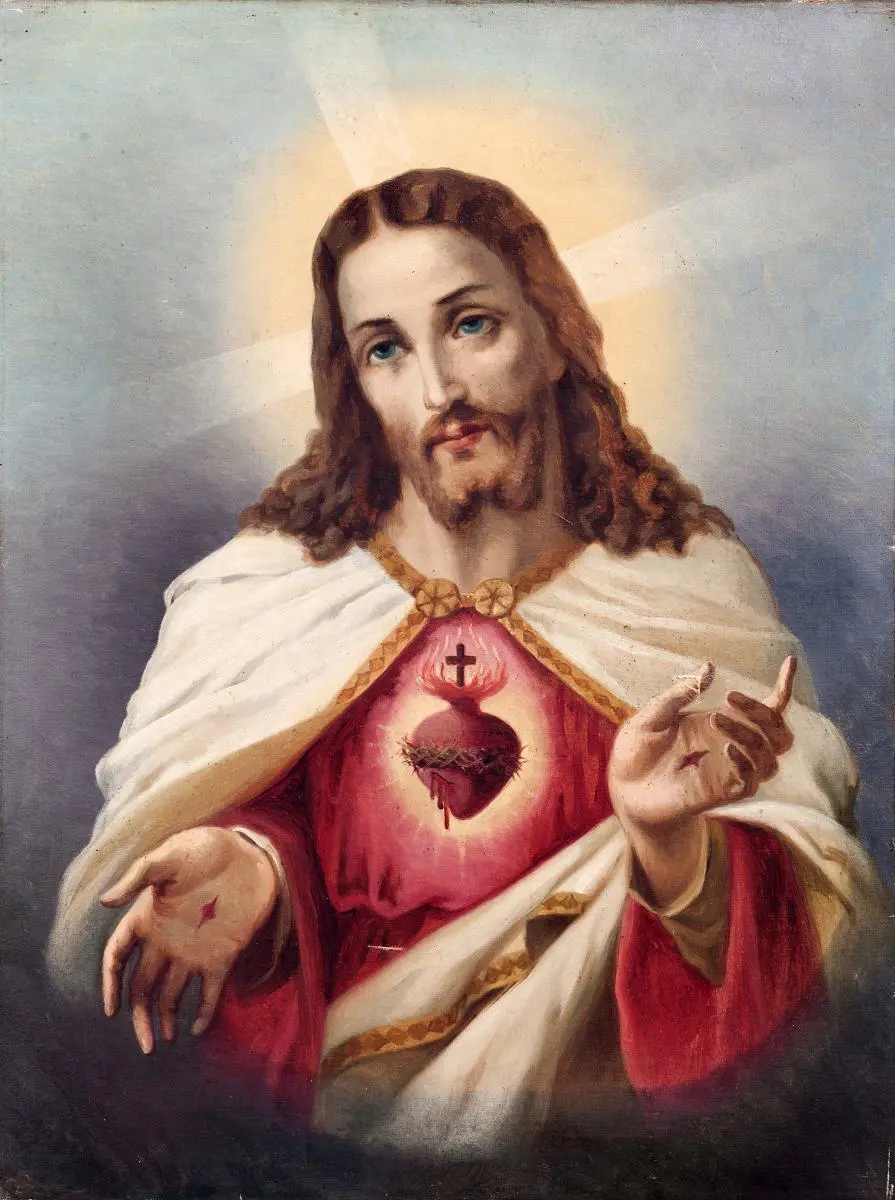
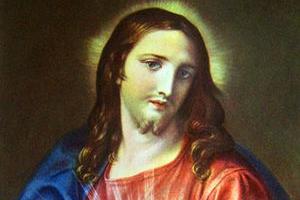
The Sacred Heart of Jesus, 19th century Portuguese icon
What is the meaning of this holiday?
With the cult of the Sacred Heart of Jesus, the Catholic Church intends to honor the Heart of Jesus Christ, one of the organs symbolizing his humanity, which due to the intimate union with the Divinity, has the right to the adoration and love of the Savior for men, of which His Heart is the symbol. The last encyclical of the pontificate is also dedicated to the Heart of Jesus Pope Francis, Dilexit Nospublished in 2024, in which the Pontiff underlines that dealing with this topic is not “mere religious romanticism” (DN 46), a resuscitation of a past sensitivity, but means truly drawing on that unifying center of the entire believer’s existence and, at the same time, of the entire person of Jesus Christ: thus «the Sacred Heart is a synthesis of the Gospel».
When does devotion arise?
Already practiced in Christian antiquity and in the Middle Ages, the cult spread in the 17th century thanks to Saint John Eudes (1601-1680) and above all Saint Margaret Mary Alacoque (1647-1690). The Feast of the Sacred Heart was celebrated for the first time in France, probably in 1685.
Who was the messenger of the Heart of Jesus?
Saint Margaret Mary Alacoque, a French nun, entered the Visitandine convent of Paray-le-Monial (Saone-et-Loire) on 20 June 1671, lived her experience as a religious woman with great simplicity and mysticism and died on 17 October 1690 at just 43 years of age. Even before entering the convent, she was endowed with mystical gifts which were accentuated with her new condition as a religious; he had numerous mystical manifestations but in 1673 the great visions that made his name famous began; they were four major revelations, plus numerous others of lesser importance.
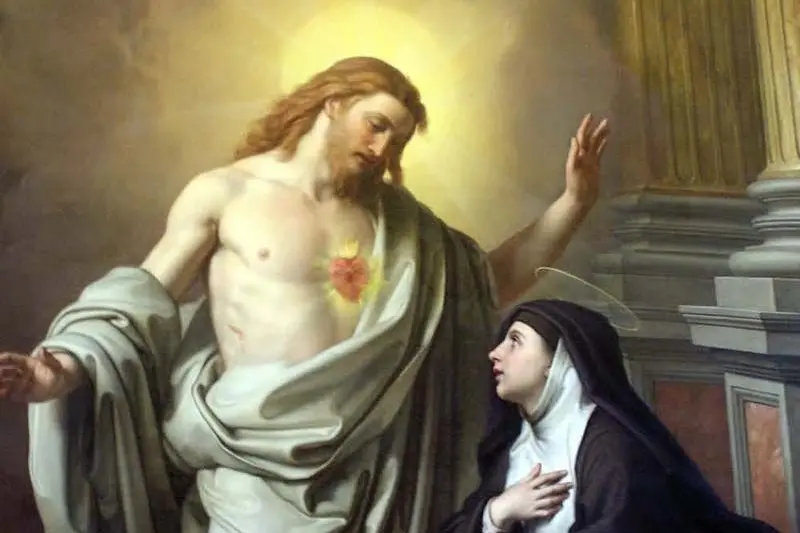
How many and what were the mystical visions of Saint Margaret?
The first vision occurred on 27 December 1673, the feast of Saint John the Evangelist, Jesus appeared to her and Margaret felt “entirely invested with the divine presence”; he invited her to take the place that Saint John had occupied during the Last Supper and said to her: “My divine Heart is so passionate with love for men, that as it can no longer contain within itself the flames of its ardent charity, it must spread them. I have chosen you to fulfill this great plan, so that everything may be done by me.”
A second vision appeared to her at the beginning of 1674, perhaps on a Friday; the Divine Heart manifested itself on a throne of flames, more radiant than the sun and transparent as crystal, surrounded by a crown of thorns symbolizing the wounds inflicted by our sins and surmounted by a crossbecause from the first moment it was formed, it was already full of every bitterness. Also in 1674 the third vision appeared to her, this time too on a Friday after the feast of Corpus Domini; Jesus presented himself to the Saint all blazing with glory, with his five wounds, shining like suns and from that sacred humanity flames came out from every sidebut above all from her wonderful chest which resembled a furnace and having opened, she discovered the lovable and loving Heart, the true source of those flames. Then Jesus, complaining of men’s ingratitude and carelessness regarding his efforts to do them good, asked her to make up for this. Jesus urged her to receive Communion on the first Friday of every month and to prostrate herself on her face from eleven to midnight, on the night between Thursday and Friday. The two main devotions were thus indicated, Communion on the first Friday of each month and the holy hour of adoration.
In what revelation was the feast established?
The fourth mystical vision took place on 16 June 1675 during the octave of Corpus Christi. Our Lord told her that he felt hurt by the irreverence of the faithful and the sacrileges of the wicked, adding: “What is even more sensitive to me is that it is the hearts consecrated to me that do this”. Jesus also asked that the Friday after the octave of Corpus Domini be dedicated to a particular feast to honor his Heart and with communions to make amends for the offenses he had received. Furthermore, he indicated Margherita’s spiritual father, Il., as the executor of the diffusion of this devotion Jesuit Saint Claude de la Colombiere (1641-1682), superior of the nearby Jesuit House of Paray-le-Monial. Margaret Mary Alacoque, proclaimed saint on May 13, 1920 by Pope Benedict XV, obeyed the divine appeal made through visions and she became the apostle of a devotion that was to lead the faithful to the adoration of the divine Heart. The first two ceremonies in honor of the Sacred Heart, in the presence of the mystic saint, took place in the Novitiate of Paray on 20 July 1685 and then on 21 June 1686, in which the entire Visitandine community participated.
Has the cult of the Sacred Heart been hindered? And by whom?
Yes, especially in the 18th century. In 1765 the Sacred Congregation of Rites stated that the heart of flesh was a symbol of love; then the Jansenists understood this as an act of idolatry, believing that a cult only of the heart was possible, not real but metaphorical. Pope Pius VI (1775-1799) in the bull Auctorem fideiconfirmed the expression of the Congregation by noting that the heart is adored «inseparably united with the Person of the Word».
February 6, 1765 Pope Clement XIII (1758-1769) granted the feast of the Sacred Heart of Jesus to Poland and the Roman Archconfraternity of the Sacred Heart; in the Pope’s thought this new feast had to spread in the Church the main steps of the message of Saint Margaret, who had been the privileged instrument for the diffusion of a cult, which had always existed in the Church in different forms, but nevertheless giving it a new orientation. With her she would no longer be alone a loving contemplation and adoration of that “Heart that loved so much”, but also a reparation for the offenses and ingratitudes received, through the improvement of our existences. The saint said that “love makes souls conform”, that is, the Lord wants to inspire souls with a generous love which, responding to his, assimilates them internally to the divine model.
Which Pope officially established the feast of the Sacred Heart?
Devotion to the Sacred Heart triumphed in the 19th century and the convent of Paray-le-Monial became a destination for continuous pilgrimages; in 1856 with Pope Pius IX the feast of the Sacred Heart became universal for the entire Catholic Church. On the wave of devotion that now involved the entire Catholic world, chapels, oratories, churches, basilicas and sanctuaries dedicated to the Sacred Heart of Jesus arose everywhere; we remember one of all the “Sacred Heart” Sanctuary in Montmartre in Paris, begun in 1876 and finished building after 40 years; all the social and military categories of France contributed to the massive expense.
What are the most common devotional practices?
That of Eucharistic adoration every first Friday of the month and the “Litany of the Sacred Heart”. The month dedicated to the cult of the Sacred Heart is June.
What is the act of consecration to the Sacred Heart?
In order for the cult of the Heart of Jesus to go out and penetrate the social life of peoples, he began, at the exhortation of Pope Pius IX in 1876, a whole movement of “Acts of consecration to the Heart of Jesus”, starting from the family to that of entire nations through Episcopal Conferences, but also by enlightened and devout rulers; including the president of Ecuador, Gabriel Garcia Moreno (1821-1875). There was such fervor that throughout the nineteenth century and the first decades of the twentieth century, it was dedicated to the cult of the Sacred Heart, which consequently arose numerous religious congregations, both male and female. Among the main ones, we remember the Congregation of the Priests of the Sacred Heart founded in 1874 by Blessed Leo Dehon (Dehoniani); the Children of the Sacred Heart of Jesus o African Missions of Verona, congregation founded in 1867 by Saint Daniele Comboni (Combonians); the Ladies of the Sacred Heart founded in 1800 by Saint Magdalene Sofia Barat; the Handmaids of the Sacred Heart of Jesus founded in 1865 by Blessed Caterina Volpicelli, several female institutes bear the same name.
How did the cult of the Immaculate Heart of Mary arise?
The promoter was Saint John Eudes (1601-1680) who already around 1643 began to celebrate it with the religious of his congregation. In 1668 the feasts and liturgical texts were approved by the cardinal legate for all of France, while Rome refused several times to confirm the feast. It was only after the introduction of the feast of the Sacred Heart of Jesus in 1765 that the faculty to celebrate that of the Heart of Mary was granted here and there, so much so that even the Roman Missal of 1814 still includes it among the feasts “pro aliquibus locis”. Pope Pius XII extended the celebration to the entire Church in 1944, as a perennial reminder of the Consecration of the world to the Immaculate Heart of Mary, made by him in 1942. The cult of the Immaculate Heart of Mary received a strong impulse after the apparitions of Fatima in 1917, when Our Lady made an express request to consecrate Russia to her Immaculate Heart, a heavenly request still unanswered.