





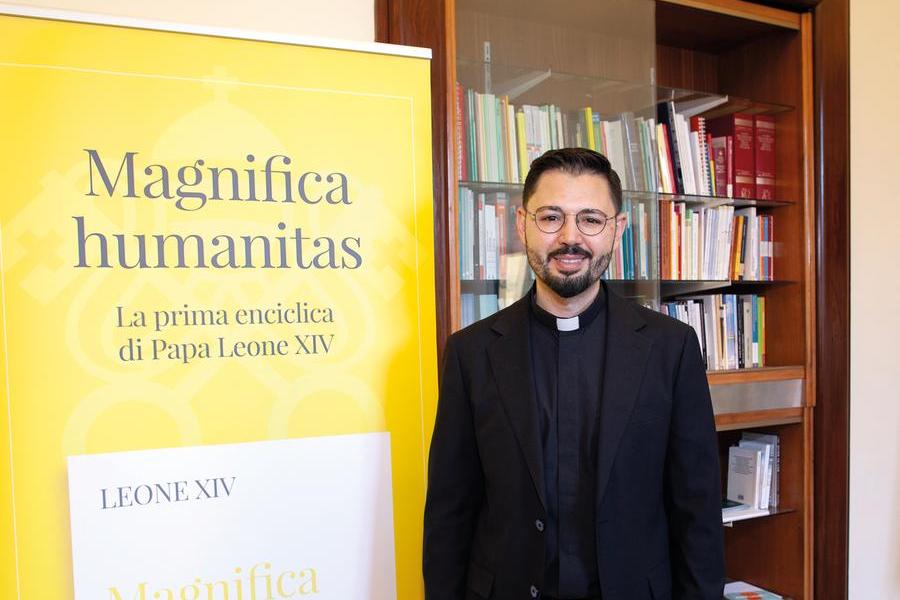

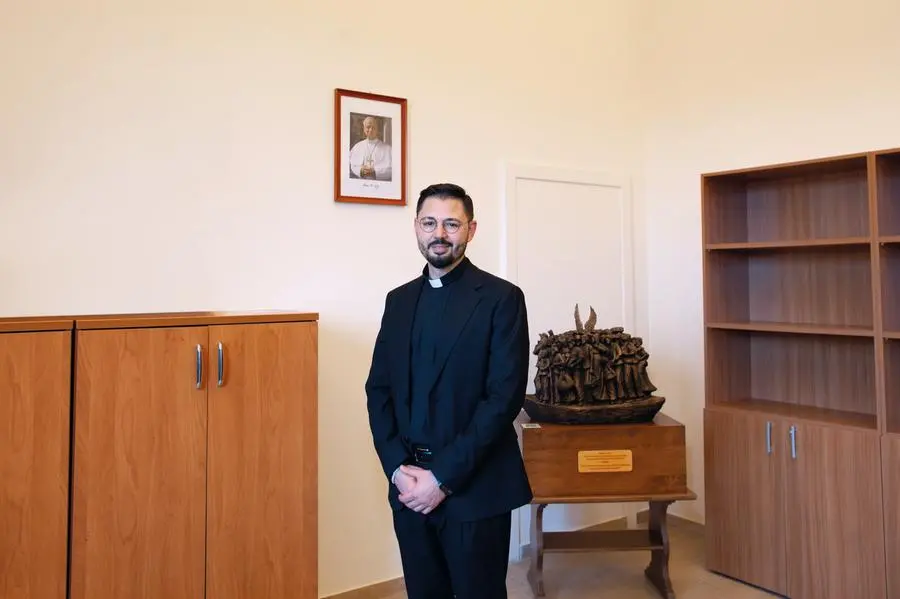
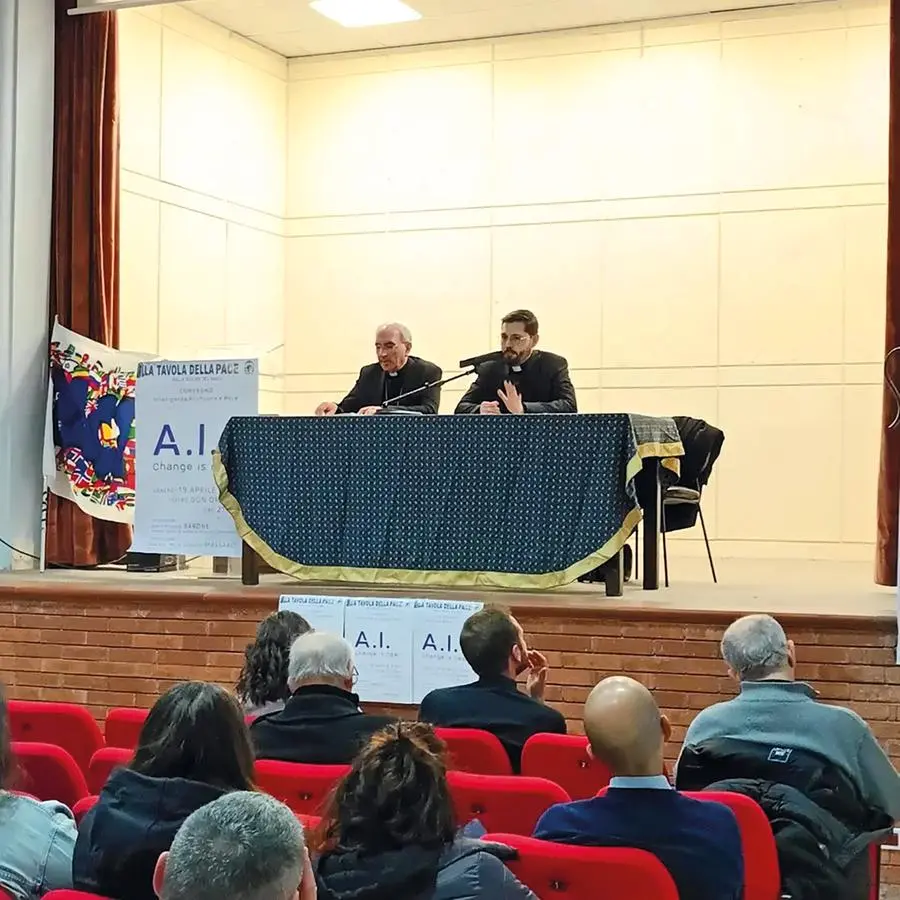
Everything comes from listening, said Pope Leo regarding the genesis of his first encyclical, Magnificent Humanitas. Monsignor Christian Barone also chose to study neuroscience because he was “listening” to a need: finding the right words to communicate with his brother Francesco. «He studied biology, I studied anthropology. We didn’t understand each other on certain issues, I used a philosophical approach, he used a scientific one. After my doctorate in theological anthropology I studied neuroscience. And then dogmatic theology.” Today he teaches fundamental theology in Gregorian and is theologian at the Dicastery for integral human development, where he deals with the impact of artificial intelligence (AI) on the job market: 44 years old, Sicilian from Pozzallo («the town of Giorgio la Pira»), Monsignor Barone is the right person to try to understand the heart of Magnificent Humanitas.
What does this encyclical represent in the social Magisterium of the Church?
«A great appeal for responsibility and a call to dialogue. The image of the construction site is a powerful metaphor to indicate the need to bring together resources and skills to orient AI towards a way of safeguarding humanity.”
What is AI?
«It is the ability to carry out very complex calculation operations in order to sort large quantities of data, with a speed and precision that human intelligence cannot match».
In ordinary use, mathematics is not “perceived”: it communicates with the AI, which responds in kind…
«The most widespread AI models are linguistic ones, such as ChatGpt, Claude, which always work on a statistical calculation basis, but through words. They manage to produce texts that have an increasingly greater coherence. They help us simplify some daily operations, such as drafting a text or being able to better understand its meaning. They also have major limitations. We talk about “opacity”, to say how they are often unable to justify the results they arrive at, not even to their own builders. In the process from initial to final information, from input to output, there remains a processing space that we cannot understand.”
How is it possible that those who created them cannot understand them?
«Unlike the calculators we were used to, these do not proceed in a linear manner, they have a so-called rhizomatic, i.e. bushy, trend, they open up to a range of possibilities. They work by probabilistic calculation on a statistical basis, we don’t know exactly what type of operations they do. And there are experts in interpreting AI in its internal work. A bit like a psychologist trying to understand these artificial minds.”
The Pope says not to think of it as a human intelligence, do not consider it neutral. And disarm her.
«We are inclined to anthropomorphize machines. Language can deceive us because it makes us think of the machine as someone who understands us, with whom we enter into a relationship. The very definition of AI is a bit ambiguous, because human intelligence has qualities that the machine will never possess. Our cognition is inseparable from the way in which the body relates to others in the environment. There is no intelligence abstract from the body, and this already marks an abyss between us and machines. Furthermore, artificial or intelligent machines amplify an aspect of human intelligence, which is rationality. But our intelligence has many other qualities and above all it has a synthetic capacity, which the machine does not have. Ours is often a non-verbal communication, made up of gestures, understandings, glances. There is a body language that the machine doesn’t possess.”
And neutrality?
«The encyclical explains to us that AI is an infiltrative technology, which increasingly becomes part of us and our way of understanding things and the world. And it is clear that those who design AI bring their vision of the world to it. The tool works with a large amount of data which in itself is not neutral, it carries prejudices and pre-understandings regarding race, gender and cultures. Furthermore, an AI that has been trained on predominantly Western data could produce forms of cultural colonization in other contexts, in Africa or Asia. There is the risk of yet another attempt to culturally colonize the world in a form which however is now unpredictable.”
Can we say that this is a political encyclical?
«Speaking of human dignity inevitably calls into question the rights of the human person and a whole series of issues that are political. The intention of the encyclical, however, is to return to the foundations and principles of social doctrine, which have a theological foundation. As is written in chapter 2, we start from an understanding of the human person in the light of Revelation, and then speak to everyone. There are truths of reason that are valid for everyone, because the truth of humanity is at stake.”
From an ecclesial point of view this encyclical gathers and makes people move forward Gaudium et Spes?
«It takes the method of Gaudium et Spes and grasps AI as a sign of our times, which asks to be understood, questioned and illuminated in the light of the Gospel. It is on the same line, which is to listen to the joys, pains, hopes, the cry of humanity today. Pope Leo said it: he was moved by a listening that includes listening to the silence of those who are voiceless, of those who are cut off from the tables where great decisions are made, but then suffer them firsthand.”
What are the risks?
«Those linked to a growing delegation of human responsibility to the machine. It’s a problem, because partisan interests are hidden behind the machine. For this reason, the Holy Father always recalls the need for accountability: it must be clear to whom to attribute responsibility and the use of the machine must remain under human control. It is particularly evident when dealing with the topic of war. Entrusting the decision on the life and death of people to the machine is a great risk for humanity, because the machine will always tend to optimize the success of an objective, even at the expense of the civilian population. Another great risk is that of increasing the injustices that are already present in our society. There are a number of situations in which artificial systems will probably increasingly replace human decision-making, I am thinking of access to work or medical care. If a convicted felon comes to me to get a job, we look each other in the eye, I trust, I give him the opportunity to get involved. The machine will evaluate the risk and decide that that person should not have the job. In human relationships we have the possibility of introducing a value, such as trust, of making the other experience forgiveness and redemption.”
It’s the question of limits, of errors…
«Error, for us sin, can be a place of salvation, because precisely in human frailty it can reveal a possibility of rebirth. The limit is a place of truth in which we discover ourselves in our condition as creatures dependent on God and therefore in need of support and grace. The machine cannot do this.”
What are the potentials of AI?
«For example, in the field of medical diagnostics, AI is a very powerful tool. The machine draws on a quantity of data, medical literature that a single person cannot possess as personal knowledge. On the other hand, it must remain an instrument, because then the doctor must have the final say based on his human competence. They are useful tools, but they must support human work and not replace it.”
The Pope invites everyone to work on the construction site of our time. How?
«The metaphor of the two cities, Babel and Jerusalem, is very interesting. It is not enough to build, it is not enough to do it together, there is a need for openness to God. That is the difference, the transcendence, it is building without excluding God from our way of operating. The encyclical has the great merit of calling everyone to be responsible towards AI, not to feel like passive spectators. Taking up the teachings of Francis, he speaks of artisans of peace. And this enhances the diversity of belonging and experience, even within the Church. Everyone can do their part. It is an appeal addressed to civil society, to intermediate bodies, which organize themselves and take a participatory position towards the challenges of the present. The Pope asks us to be protagonists of history.”
What can the individual do?
«Keep an eye on new technologies, don’t adopt them passively. And this calls into question personal conscience. Don’t get used to new digital tools, but try to somehow understand the impact they can have on us, especially because their work is often silent and we don’t even realize it. He asks us to learn to fast from AI, also to have time to enhance our critical capacity through exercises of other kinds, such as reading, comparison, debate. With respect to commitment, I believe that everyone can do something to the extent that they participate in political life, it is the great value of participation, which is recalled in the encyclical. We are all involved in an ordinary pattern of education in which we have a responsibility towards others.”
After the encyclical, how will the Church continue to work on these issues?
“An interdicasterial commission has been established, which means that the Holy See has an interest in pursuing these issues.”