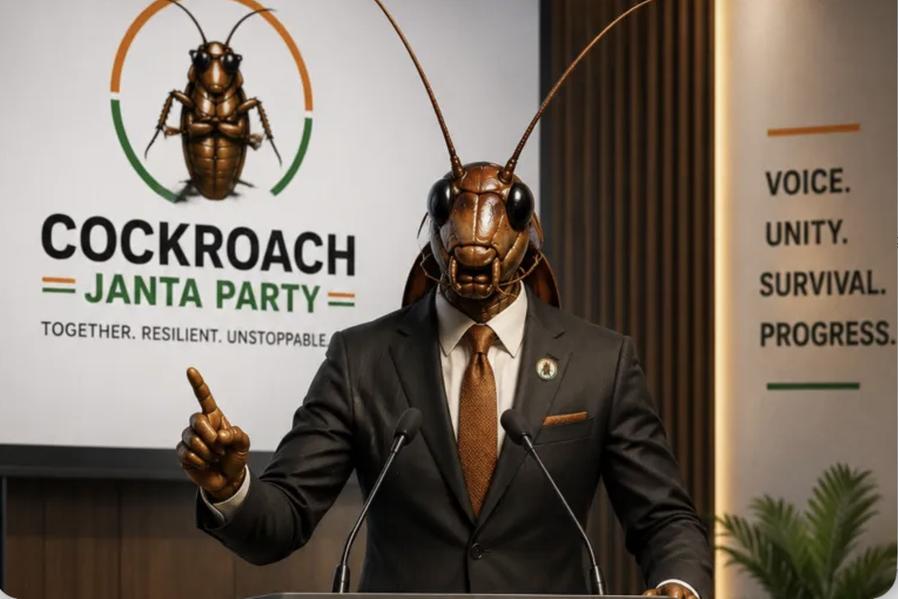
The Indian political system is having to deal with one of the most unpredictable and viral social phenomena of recent years: the Cockroach Janta Party (CJP), literally the “Cockroach People’s Party”.
Born as an online parody, this movement led by Gen Z (those born between 1997 and 2012) has crossed digital borders to become a thorn in the side of the prime minister’s government Narendra Modileading thousands of young people to demonstrate permanently in the squares of New Delhi.
It all began in mid-May this year. During a public court hearing, the Chief Justice of India, Surya Kant, 64, utters a contemptuous metaphor towards unemployed youth and digital activists, comparing them to “cockroaches” and “parasites of society” who spend the day on the internet complaining instead of working. “There are young people like cockroaches, who neither get jobs nor have space in the world of work. Some of them go into media, some into social media, some become right to information activists or other activists, and start attacking everyone,” he said. Kant later clarified his statements, stating that his comment referred to some people obtaining fraudulent degrees and was not aimed at young Indians, who he called “the pillars of a developed India.”
However, his words sparked widespread outrage, especially among Generation Z internet users, who face unemployment, inflation and bitter religious divisions after 12 years of Prime Minister Narendra Modi’s Hindu nationalist rule.
The network’s response was not long in coming. Instead of suffering humiliation, young political communications strategist Abhijeet Dipke decides to reverse the insult. Dipke, 30, a student at Boston University, worked with the Aam Aadmi Party (AAP) before moving to the United States, a political organization born more than a decade ago out of an anti-corruption movement in India and known for its strong presence on social media.
On May 16, Dipke founded the Cockroach Janta Party online, an ironic play on words that mimics the very powerful government party, the Bharatiya Janata Party (BJP, Indian People’s Party). The launch manifesto presents itself provocatively as the “Voice of the lazy and unemployed”, inviting all those who are capable of “complaining on a professional level” to sign up.In the space of a few days, the CJP’s Instagram page exceeds 22 million followers, transforming from a light-hearted joke into a megaphone of generational dissent.
Despite the satirical approach of the movement, which defines itself as “Secular, Socialist, Democratic and Lazy”, its demands touch very sensitive chords in Indian society. With almost 40% of young Indian graduates unemployed and the chronic plague of leaks (the leaks and buying and selling of exam papers) which invalidate public competitions and university entrance tests, the anger is real.
The movement has thus structured a serious manifesto, which is based on various non-negotiable demands: the resignation of the Minister of Education, Dharmendra Pradhan, and protections against rigged tests that destroy candidates’ futures; the ban on Supreme Court justices receiving political appointments immediately after retirement; the fight against private information monopolies close to the government; measures against political transformation and guarantees on female representation quotas.
The strength of the CJP was the ability to translate clicks into physical presence. Since June 2026, young “cockroaches” have begun to occupy Jantar Mantar, the famous protest area in New Delhi, resisting for weeks under the monsoon rains inside improvised tent cities. Similar demonstrations touched cities such as Pune, Bengaluru and Lucknow.
The protest registered a sensational acceleration when Sonam Wangchuka well-known and respected 59-year-old climate activist, has decided to take to the streets in support of young people, declaring himself an “honorary activist” and embarking on a harsh hunger strike to demand that the government dialogue with the movement. Tensions escalated on Saturday 18 July after police forcibly hospitalized Sonam Wangchuk, who was on the 21st day of a hunger strike in support of the CJP.
On Monday 20 July the police and demonstrators clashed in the streets of Delhi, there were moments of tension and several opposition members joined the young people’s protest.
Two CJP spokespersons met briefly with federal Health Minister JP Nadda in the early hours of the day. One of them, Saurav Das, recently published a post on “The minister has assured us that he will discuss this at the appropriate levels. However, so far no commitment has been made. The peaceful protesters will not rest until the demand is met!” he wrote.
As the BBC reports, many protesters were still present at Jantar Mantar, although the police continued to urge people to leave. It is not yet clear whether the CJP will stop the protest or continue the sit-in. Activist Sonam Wangchuk said she will continue her fast.
Despite not being (at least for now) a party registered to compete in elections, the Cockroach Janta Party has demonstrated that in the largest democracy in the world, the resilience of digital “cockroaches” can be incredibly tough and irony remains one of the sharpest weapons to hold those in power to account.