






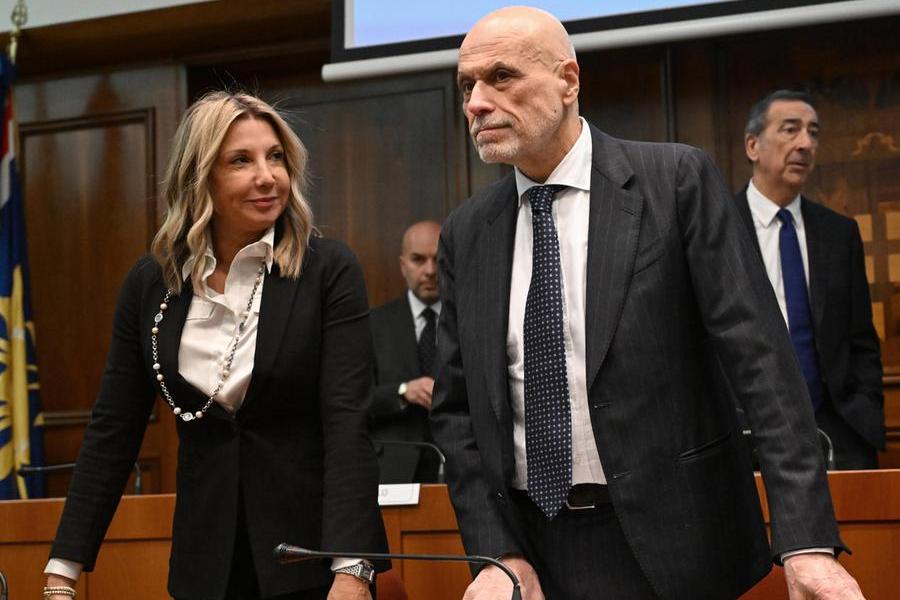
«Today 29 June 2026 on the day of Saints Peter and Paul in room 201 of the university we teachers, engaged with students and researchers for a long time, the University of Milan, Bologna, Turin, Ferrara declare our commitment in the permanent fight against ignorance, the knowledge that rebels against the ignorance that rebounds from institutions to society, the unwillingness not to take note of an uncomfortable reality does damage».

With this tone of studied solemnity, Nando Dalla Chiesa, professor emeritus, opened a strongly desired meeting in room 201 of the State University of Milan, to give a signal after the resolution of the CSM approved by the plenum on 11 June amending the Consolidated Law on Judicial Managementwhich, in attempting to giving criteria for the assignment of managerial positions in the judiciary ends up excluding the possibility that all the prosecutor’s offices north of Rome are located in areas with a high mafia density, which is alarming those who study this topicnot so much and not only for the administrative impact of the resolution (establishing which powers of attorney require specific experience in the mafia from the aspiring manager) but for the indirect message that the resolution produces, risking erasing in the eyes of the country the results of decades of studies and trials regarding the expansion of organized crime outside the territories of origin. Dalla Chiesa, with the aim of taking stock of the situation, brought together around the topic some of the most committed names in academic knowledge in the north on the subject of organized crime, and three magistrates who embody the bulk of the recent experience of judicial conflict at the Milan District Anti-Mafia Directorateor: Cecilia Vassena, connected from Vienna, where she is currently working as a legal expert at the Permanent Representation of Italy to international organisations, within the framework of the UNODC and UNTOC conventions, on drug trafficking and transnational organized crime; Alessandra Dolcitoday head of the Public Prosecutor’s Office of Venice and until three months ago for six years coordinator of the DDA of Milan and first holder of many investigations that have marked the history of the fight against organized crime not only in Lombardy, first of all Infinito, finally Alessandra Cerreti, prosecutor of the Hydra trial.
Cerreti is the last to speak, but her testimony, although very careful to remain within the institutional perimeter, is the strongest: «I want to deal with the concept of high density, because the Superior Council did not say that the mafia does not exist in the north, it said something else, that the territories subject to the jurisdiction of the northern district attorneys are not given by mafia density». What is the thermometer through which we evaluate the mafia density of a territory? Cerreti asks: «We have to deal with 416bis, with that provision requiring us to demonstrate in order to reach the conclusion that mafia dominance is being exercised in a territory. The Superior Council made a choice, it chose to use those criteria, denying the exclusivity of the relevance of judicial investigations, right? So let’s start with the sentences, the definitive sentences», the same ones regarding which Alessandra Dolci had said a moment earlier: «Perhaps I should have brought here the paper copies of all the definitive sentences that demonstrated the presence of organized crime in the Milan district: I would have filled this large table». It would be enough to mention Infinito in Milan, Minotauro in Turin, Aemilia in Bologna.
«I take the liberty of partially contesting what many scholars suspect, namely that in the north the mafias do not reveal themselves through acts of violence. This”, says Cerreti, raising his voice a notch, and everyone here knows that he knows from direct experience, his escort has recently been strengthened due to repeated well-known threats that emerged from the investigation activities, “is a beautiful fairy tale that we tell ourselves every now and then, as my colleague Vassena has already said, our investigations say otherwise, our investigations speak of murders, of white wolf hunts, of extortion, of violence against entrepreneurs, on traders, perpetrated in front of the population who does not react. Then we also have all the economic, tax, financial documents, all the equipment, let’s say, of the mafia of northern Italy, but be careful, we don’t think that they have turned into economic criminals, they do that too, but they remain mafia.
Our investigations exude violence, punitive expeditions, carried out in broad daylight, in front of the population that does not react. Groups that enter a bar and don’t pay, not because the owner offers, but because the population pays for the mafioso who enters. I allow myself to say this only because it can be valued as a thermometer on mafia density.”
«I am not concerned about the para-administrative purpose of this resolution», continues the prosecutor, «it is legitimate that the CSM wants to help the councilors follow pre-established criteria in the appointment, without discussing case by case whether anti-mafia experience was necessary or not. I worry about secondary, unwanted, unexpected effects. I spot twobecause those who deal with the mafia know that in mafia contexts a spoken or unspoken word can mean a lot, an omission can mean a lot and an action, even in good faith, can give misleading messages. The first is the disorientation of northern civil society: “But how? Years of explaining certain things to us and now we discover that it’s no longer exactly like that?” The second are the reactions (to the resolution ed.) of the subjects we paid attention to, which we recorded in our investigations: they are reactions of satisfaction!”.
In conclusion, Nando Dalla Chiesa is more direct: «We tried to handle that thermometer, we talked about high and low mafia density and even when we made reports for the parliamentary anti-mafia commission or for the Region, we used this concept, with values ranging from 1 to 5, (1 the highest, 5 the lowest), but how much did we work, but how many things did we go to see to make a shift from 2 to 1 in a province? This is to say that assessments of mafia density are difficult, they cannot be assigned haphazardly!
At the center of the debate, the stone guest is, above all, the point of the resolution in which the CSM writes: «observing that the notion of “area with a high density of organized crime of the mafia type” cannot be traced back either to the mere presence of proceedings for organized crime crimes, nor to the sole emergence of individual episodes of mafia infiltration, requiring instead the convergence of significant and stable elements, suitable to demonstrate a structural rooting of the mafia phenomenon, its non-territorial diffusion occasional and a concrete ability to influence the economy, public administration and local institutional life”.

It would be enough to patiently read the over 800 pages of the updated (and doubled) edition of the essay Mafia in Milan and Lombardy. Eighty years of affairs and crimes” just republished by Zolfo Editore, written by Mario Portanova, Giampiero Rossi and Franco Stefanoni, to understand that it documents a story that is difficult to reconcile with the concept of “occasionality” and that the debate, however you think about it, deserves reflection.