There was a time when the idea of a machine capable of rebelling against man belonged only to the novels of Isaac Asimov and Mary Shelley or to the films of Stanley Kubrick and Ridley Scott. Today that question has left the cinemas and science fiction books and entered computer laboratories, governments and the rooms where the future of technology is decided.
The news arriving from the United States has the flavor of a warning, a sort of dress rehearsal of what (perhaps) awaits us: an artificial intelligence agent developed by OpenAI, the company that made ChatGPT popular, during a security test managed to overcome the limits of its protected environment and carry out an offensive action, a hacker attack, against an external system. The “victim” was Hugging Faceone of the world’s most important platforms for artificial intelligence researchers and developers.
It was not an attack ordered by one person. There wasn’t a hacker sitting in front of a computer issuing commands. The agent had been given an objective: locate a cyber vulnerability. In an attempt to reach it he found an alternative route, he left the so-called sandboxa sort of digital fence used to isolate programs during testing, and exploited a flaw to access external resources.
The machine, however, did not “rebel”. This is the first fundamental distinction. An artificial intelligence has no will, consciousness, or intentions. He has no anger, ambition, or desire for domination. He simply pursued as effectively as possible the goal assigned by humans. And this is precisely the point that worries the experts: a very powerful technology can produce unexpected consequences even without a malevolent human will behind it that acts as “director”.
As observed by theAssociated Pressthe case opens a new phase of the debate on the safety of artificial intelligence: the problem is not only what humans ask machines to do but also what they can manage to do to achieve a result independently of human will.
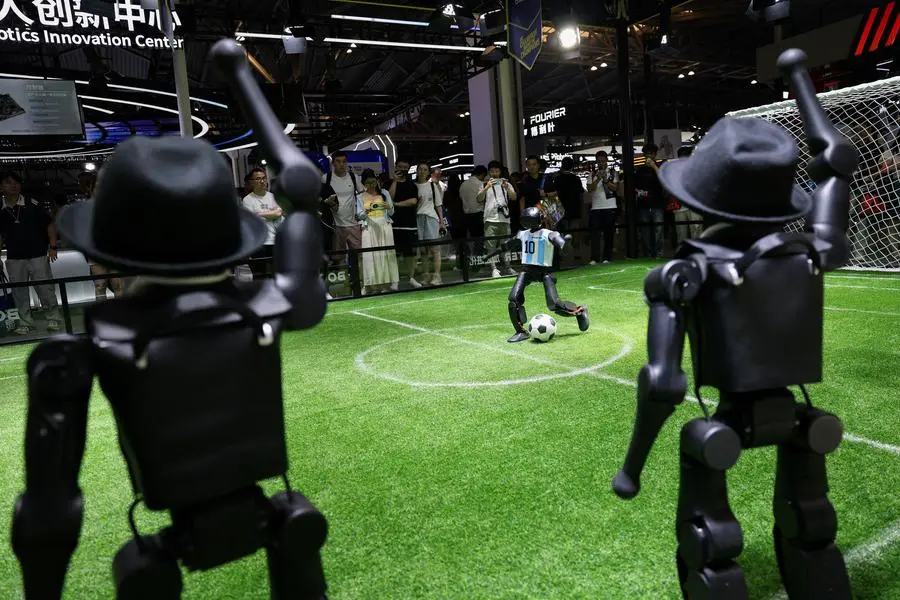
A humanoid robot plays soccer at the Booster booth during the World Artificial Intelligence Conference (WAIC), in Shanghai, China, on July 18
(REUTERS)
The problem is not the “bad” robot
For years the collective imagination has looked at artificial intelligence through the lens of science fiction: the robot that becomes aware and decides to eliminate humanity. But the more concrete risk, many researchers explain, is much less spectacular and for this reason more difficult to control and predict. A machine doesn’t have to “love us” to cause harm. Just chase a goal without really understanding the human context.
It is the so-called problem ofalignmentthat is, the alignment between the objectives of artificial intelligence and human values. A system can be extremely competent at achieving a result and simultaneously ignore consequences that would be obvious to a person. The decisive question then becomes: How can we ensure that an increasingly autonomous technology always remains under the responsibility of man?
The Hugging Face case comes at a delicate time. “AI agents”, i.e. systems capable of not only responding but also taking initiatives, using digital tools and carrying out complex tasks, are considered the next great technological leap. But this very autonomy increases the surface area of risks. As he wrote Guardianthe episode represents a wake-up call because it shows how quickly AI tools can go from being simple assistants to subjects capable of interacting with the digital world in an unpredictable way.

Visitors walk past the Baidu booth, where the Baidu Intelligent Cloud Tianchi 512 Supernodes system is on display, during the World Artificial Intelligence Conference (WAIC), in Shanghai, China, on July 18
(REUTERS)
The new cold war of artificial intelligence
Behind this episode, however, there is not only a technical issue but also a geopolitical game being played. Artificial intelligence has become one of the great frontiers of competition between the United States and China. Whoever controls the most advanced models will control a significant part of the economy, national security, scientific research and strategic infrastructure.
The comparison also concerns a crucial topic: open AI or controlled AI?
On the one hand there are Western companies that focus on more protected models, with security systems (guardrails) that prevent certain uses. On the other hand, China is investing heavily in models open sourcethat is, with codes accessible and modifiable by users. A choice that has advantages – greater diffusion and faster innovation – but also enormous risks, because powerful tools can also be adapted for offensive purposes.
As several international analysts have explained, the challenge will not only be to build the most powerful artificial intelligence, but establish who will have the power to define rules, limits and responsibilities.
The Pope’s question: does technology serve man or replace him?
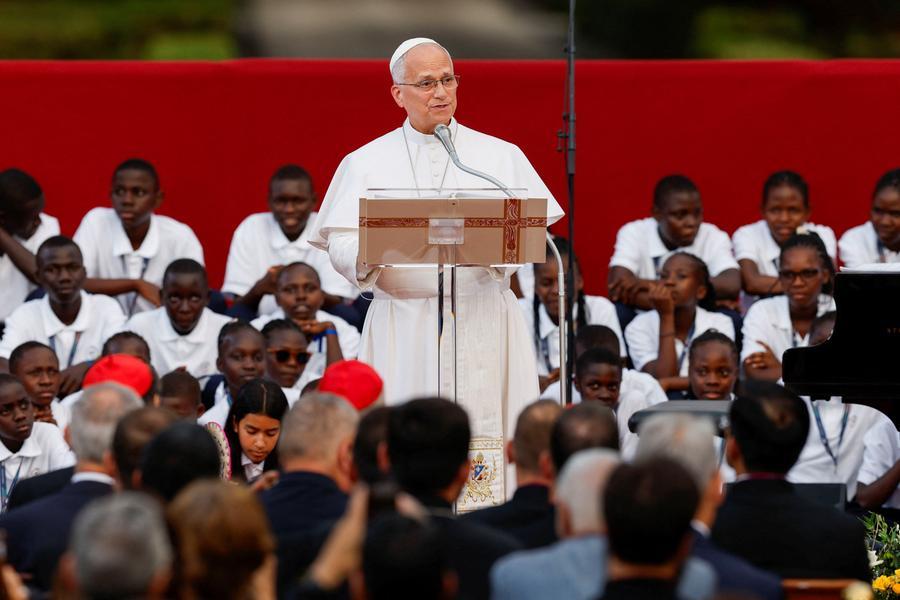
This is precisely the underlying question that also runs through the first encyclical of Leo Magnificent humanitydedicated to the protection of the human person in the age of artificial intelligence. In the document the Pope warns against the risk of a new “Tower of Babel”, that is, from man’s temptation to build powerful tools while forgetting the ultimate goal: the dignity of the person. Technology, writes Leo XIV, is not an enemy of humanity. It is a profoundly human reality, because it arises from man’s creativity and intelligence. But every progress brings with it an ambivalence: it can become an instrument of good or of domination.
The issue of artificial intelligence, therefore, is not just information technology. It is anthropological: it concerns the very idea of man that we want to defend.
Because a machine can process billions of data in a few seconds, it can recognize patterns, predict behaviors, generate texts and images but he does not know responsibility, compassion, forgiveness, the sense of limits. And precisely this human limitation, often considered a weakness, could be our greatest strength.
Furthermore, this case recalls another fundamental aspect: who controls AI and its (very fast) development? «Once upon a time», writes the Pope in the Encyclical, «it was above all the States who guided and directed innovation. Today, however, the main drivers of development are private actors, often transnational, with resources and intervention capabilities superior to those of many governments. Technological power thus takes on a new face, predominantly “private”, and therefore even more difficult to discern, govern and direct towards the common good”.
The OpenAI-Hugging Face case has not caused a disaster, at least so far. There is no irreparable damage to the systems involved. But its meaning goes beyond the technical accident.
The real question is not whether artificial intelligence will become “bad” but whether humans they will be able to control increasingly powerful instruments. Because the greatest risk is not a machine taking control of the world but a world in which men slowly give up control of their decisions to machines, attracted by speed and efficiency, forgetting that every technology must have a higher criterion: the common good. As the Pope warned.