





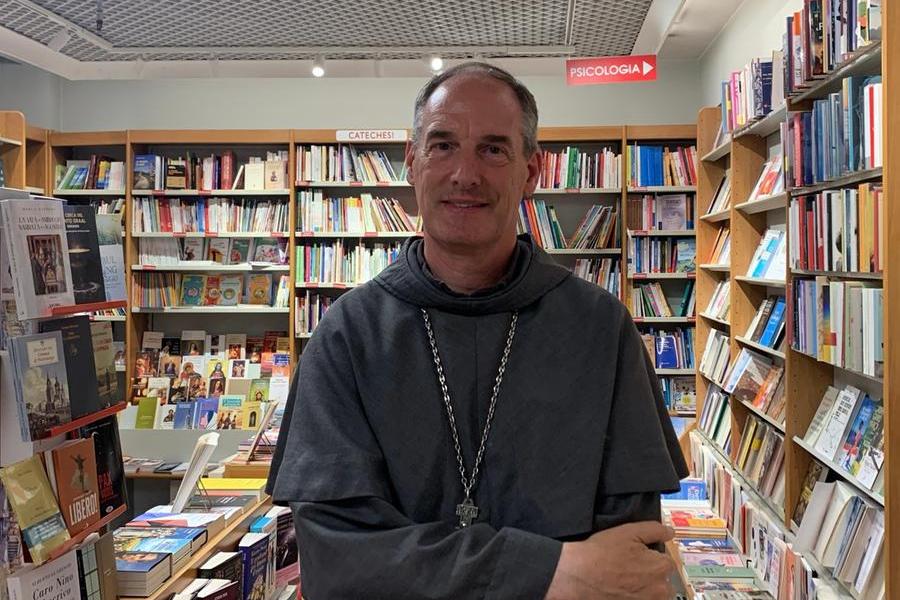
«We have become harsh, violent, ready to judge everything and everyone. Max Weber, at the beginning of the twentieth century said the West is now disenchanted in the sense that it is no longer capable of singing. So, in the face of all this evil, it is no longer enough to denounce what doesn’t work, but it is necessary to propose therapies, alternative responses, paths.” There is a need, as the title of the latest book by the cardinal of Ajaccio, Francois Bustillo, says, of the “need to repair”. First published in France, where it had a huge success with the public, and just translated into Italian for San Paolo, the text starts from the observation of how much social media has become a sort of “court”.
Cardinal, why did we end up using the web this way?
«Social media have a beautiful mission which is to build spaces and relationships. In certain circles, however, especially in the West, everyone has begun to use them to express their opinion. We speak out on everything and everyone. In this way I believe we have created a mentality of judges rather than philosophers. Instead of looking for answers, of reflecting, we judge and condemn without having the elements and arguments to do so. We thus become a harsh, intransigent and violent society. I denounce this in my book.”
Why are we so violent?
«Because we are a society that suffers. Our society needs to find an ethical and moral GPS. We have lost some principles, and some values have remained somewhat on the periphery of our personal and social life. For this reason, I say this for France but not only, we need to recover and repair a society that has been damaged. When repairs are made it means that there is still hope.”
On social media there is a sort of “revenge of the illiterate”. The less expertise you have on an issue, the more you make judgments. Is that so?
«With social media everyone feels they have the right to speak without thinking. In discussions there are more emotions than reason and depth. We never ask ourselves whether our opinions on an area we don’t know are useful or not. If it is really necessary to comment on everything.”
Is this where violence comes from?
«Processes that have always existed are accelerated. Let’s think of Adam who goes from thanking the Lord for Eve to blaming her for the apple. Or in Holy Week we move from the Hosanna of Palm Sunday to the crucifixion. In social media there is this tragic movement of moving from admiration to accusation. Emotions suddenly change and, if there isn’t a solid intellectual and spiritual structure inside, we follow the movements.”
How do we get out of this trap and what contribution can the Church make?
«I am convinced that if there are no ethical and spiritual principles one can easily fall into this way of doing things. The Church can help to escape from this somewhat barbaric aspect and advance towards an evangelized and civilized society. Just read the Gospel where we find exceptional principles for the whole of society: do not judge, do not condemn, love, forgive. This is not poetry, but they are fundamental principles for common life. Today the fraternity is experiencing an erosion, it remains a bit like a relic from a few centuries ago, so it is important to rediscover it and work to heal the fratricide of the origins, otherwise we remain primates.”
You wrote the book before the encyclical Magnifica Humatisa. However, there are themes that we also find in the words of Pope Leo.
«Yes, communication, brotherhood, forgiveness. This society that would like to do without God. In France, after May 1968, there was praise for a freedom without God and without masters. Today, 60 years later, are we better? Does a society without God work better? So without manipulating or imposing and without arrogance, we must propose our values and our principles.”
THEn France there is a return to this need for God. We also saw it in Leone’s recent trip to Spain. Do you agree?
«There are very strong signs. We have many adult baptisms. We French bishops have not prepared a strategy, a tactic, a policy to recover these people. It is they themselves who knock on the door and come. This is something new for us and it is a responsibility to live the Gospel.”
In this society of noise and speed you talk about silence and detachment as a form of resistance. In what sense?
«We live in a society where there is a lot of haste and emotional reaction to everything and everyone. The monastic tradition teaches us, however, not to be in a hurry to make judgments that may not be very objective. Let’s take some time. Even if society asks us for instant, frenetic reactions, we must learn to admire, to pause. I was in Barcelona for the inauguration of the Tower of Jesus Christ at the Sagrada Familia. Here, there beauty spoke to us. Today we live in an era where there is a deficit of gratuitousness, of freedom, of beauty, of culture. There is the world of politics, the world of economics, having, knowing, possessing that speak to us, but the human being is not cared for. Perhaps the Church has a nice word to say to our society on this.”
Even the Church is tempted by speed, by producing one document after another, by rushing.
«The Church must also heal. We are on the way. We must think of Easter night, where we have the alpha and the omega. The beginning and the end. There is a linear concept of time, not a cyclical one. This means that we have a time to live and the Church must offer society a different rhythm, a different time, a different life. We must not rush in celebrations, in prayer. Nobody runs after us. We must resist the society that pushes us to rush otherwise we lose our joy and our health. And it’s not enough to say it, we also need to be more human against this temptation to robotize ourselves, to have a mechanical and non-organic conception of life. We respect time.”
Before you said that forgiveness is not poetry. What is it then?
«Forgiveness is a construction site for the human being. It’s not enough to say I forgive you. They are words, maybe there is the intention, but to forgive you must be totally at peace. Forgiveness also requires time to absolve the evil, the pain and then find peace again. So forgiveness, in my opinion, is a beautiful thing that the Church can offer to society, because sometimes we are without mercy. When at the beginning of the mass we say: “Lord have mercy”, we are not saying something banal. Everyone comes from their professional, personal, family life and asks for forgiveness, asks for purification. This dimension of purification, of forgiveness, allows us to free ourselves. This is why in the book I talk about forgiveness as a liberation. It doesn’t mean saying that everything is fine, that no harm has been done. Instead, it means freeing oneself from a bond that is negative, which destroys me, and also destroys the relationship with the other.”