




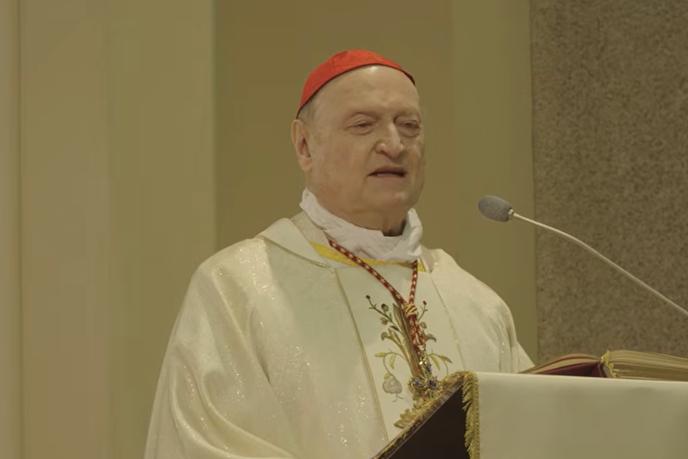
We publish the full text of the homily given by the cardinal Gianfranco Ravasi held last May 12th at the Seminary of Venegono for his 60 years of priesthood on the occasion of the “Flower Festival” during which the future priests of the Ambrosian diocese were presented.
I must first of all express my gratitude to the Archbishop for this invitation, and to the Rector of the seminary for allowing me to participate in this which is a sort of patronal event for the Milanese clergy. And it is for this reason that it is with emotion that I want to reflect with you within this particular space, with emotion also for all the accumulation of memories, but also for the presences that are here.
An evocative image from the Letter to the Hebrews comes to mind at this moment, when we talk about nephos martyronwhich means “a cloud of witnesses”: a bit like the luminous cloud of the desert, whose drops were crossed by the radiation of the sun’s light. And here there are many figures, many people – you priests who also celebrate different years of priestly ordination – who nevertheless have a trace of that light in their interiority.
In particular, I would like to mention in this nephos martyronin this cloud of witnesses, first of all all the bishops who are present here and all of you. And explaining a little freely, I would like to remember first of all my companions. I didn’t study theology with them – as you perhaps know: I did the four-year course of theology in Rome, yet they always kept me almost tied to them, spontaneously, familiarly, despite the distance. And then I would like, at this moment – allow me to add within this nephosof this cloud – to evoke in a particular way those who are celebrating their fiftieth year of priesthood. They were also remembered by Don Enrico: they are my first teaching class. I tried to instill in them first of all the tremendum of the word, and then also possibly the charmsum. I must say that I have in mind all their faces, their names – I saw them again with pleasure today – and I also remember how much they knew then how much they knew how to testify of passion, of love, even of effort in understanding the Word.
The symbol of the Temple
After this introduction, I would now like to move on to a reflection, I said with emotion, but also with familiarity, given this marginal evocation that I made. And I would like to take a symbol: or rather, in reality, initially a sign that becomes a triple symbol.
I would like to start first from the sign. The concrete, spatial sign is the Temple. It is not for nothing that this Temple is remembered: you all remember – they are probably still there ideally – all our voices. Me, in high school at least, when I was here, the voices of the liturgies, the voices of the songs, the voices of the prayers that rose here, gathered like incense within this space. The Temple is fundamental in the Bible, it is the heart: “The stones of Zion are dear to your servants,” says the psalmist. And therefore the Temple is almost the center towards which all the rest of the horizon converges, in concentric circles.
Well, this symbol is used in the three suggestive readings that we have heard. It is used in an analogical way, in a symbolic way, for three different temples, if you like, even profane, even secular.
You heard about the first Temple in the book of the Apocalypse. When it is being described, note carefully, not a temple, even if it says: “Behold the tent of God among men, he will dwell with us, beside us.” We talk about a city, the ideal city of Jerusalem, but in filigree, almost fading, the city of current men appears, with all that darkness entails.
Think for a moment what it means, in our times, the city of Gaza: this enormous pile of rubble, of still buried corpses, of children, of women, of innocents. The city of history, Babylon, as the Apocalypse would say, is still waiting for that supreme city.
However, you have heard that this is also the function of the presbyter, of the priest: it is not to remain in the oasis protected by his Temple, among the curls of incense and the songs, but it is to go out into the city square, to cross the portal. There was an Orthodox theologian who almost always lived in Paris and died in 1970, Pavel Evdokimov, who said: «Who knows why all the great cathedrals have the wonderful main portal, in bronze, but blocked, barred? And instead it should be open, wide open onto the square.” Therefore precisely those incenses, those words, the wind of the Spirit of God also enter that square where crimes are committed, where there are blasphemies, but there are also good works, of course, there is laughter and there are also tears.
«Entering the city»
And that’s why I think that the work of the presbyter, of the priest, is to enter the interior of the city as its templewhere he must carry out those acts that are remembered in the text of the Apocalypse. Furthermore, a beautiful act is a quote from Isaiah, taken from the Apocalypse: God passes by and sees this whole sequence of wounded people in front of him. Think about the violence in our day, about the knife. He sees the tears of the victims and erases, wipes this suffering, these tears from their faces. There will still continue to be those four terrible inhabitants who even at this moment cross the streets, the squares of the metropolis, but also of the villages: death, mourning, lament, anxiety. Those are always there. But you have to enter, not so much to do politics there, but to enter society, the polis, daily life, daily breathing, which is often anxious.
Allow me a personal memory at this moment, which I also consider a bit of a moment of confidence. In Rome, I really love walking through the streets, even to think, actually. And once I was stopped at a traffic light when, by chance, looking behind me at the wall of the building that was there, I found a writing, not those sensational writings, no: it was in black marker, and it was written like this: «In this city no one knows me. Except God.” He was probably homeless, a miserable person, one of those who in the evening, when dusk falls, at Termini station, but also where I live, around St. Peter’s Basilica, you see these people. And sometimes it’s true: there are many good people who go to cleanse, to help, to see even the faults they have. But above all there is God.
We have the second Temple in Paul’s First Letter to the Christians of Corinth. He says it explicitly: three times he repeats that you are the Temple of God. “If anyone destroys the Temple of God…”, “…holy is the Temple of God”, is repeated continuously. Naosthe sacred Temple: it is you.
But here there is another dimension, taken up again in the sixth chapter of the First Letter to the Corinthians, a very pastoral letter by Paul, which shows how he is not theoretical and abstract, but how his feet also get dusty in the crises, in the tensions of a tormented community like that of Corinth. Well, it’s the idea that we, the body. In the Bible, you know, we don’t have a body: we are a body. Even at this moment: I couldn’t talk to you, nor you listen to me, if there wasn’t this instrument which is fundamental, because it also expresses the soul, the interiority. Well, the body is a Temple, says Paul, and in the letter, in the sixth chapter, he will say: you cannot, as was mentioned before, destroy the Temple of God; you cannot defile it; you cannot simply reduce it to hosting the idol, the dead object, “the prostitute”, so in chapter six.
Here then is a meditation on us too. I would say: the transcendence that is within us. There was a philosopher who said in his very complicated treatise, but in the preface: «I wanted to describe the contours of an island. What I eventually discovered were the frontiers of the ocean.” You see: we are indeed finite, the skin, but on this skin beats the wave of the eternal, of the infinite, of God. And it is for this reason that it is important that our body, our life, has this divine stigma: that has its invocation to God, prayer, mystical union, almost, with God.
And we are at the last Temple. The last Temple is inside the Gospel, which is also very suggestive, typical of Luke. It is the episode of Zacchaeus. Here too, the word home returns three times on several occasions. Now, we know that in the Old Testament the Temple was also called Beth, simply home, Betel: house of God. And this is why we have another dimension here: the dimension of houses, the dimension of everyday life.
Think about it: when you walk in your cities, in your villages, and watch in the evening the lamps come on, the windows light up, many times the bluish color of the television appears in the picture, towards which they are almost with their hands raised in a sign of surrender. Well, what is consumed in there? And how necessary it is, many times, that you enter, that you somehow manage to give, when it is possible, of course, to give trust. Let’s think about the problem of the family today: what is the problem of parents? Think of the parent who gets up in the morning and has to do the same day again, and perhaps his child is addicted to drugs. You understand how tormented the story is.
And then, in this regard, I would like to focus on this particular Temple: the house of Zacchaeus, where the conversion takes place. Have you heard why? Because the Lord passes by, and therefore becomes the Temple. And the hypocrites, you see, there are always, those who will criticize something you do, whether you enter this house or not: this is normal. Here too they say: “He entered the house of a sinner.”
Well, I want to end with a still personal memory, to demonstrate how this meeting is a meeting that touched me too, which starts a little from my experience in Rome where we do not have such warm relationships as those found in a diocese, in a community like the priestly one in Milan.
A personal testimony
I would then like to conclude with another testimony of mine, and then at the end I leave the floor to this person.
When I became a priest and was ordained in Milan, I then immediately moved to Rome to study. On Saturdays and Sundays I went to a peripheral parish in Torpignattara, a very desolate neighborhood then, now it is no longer the extreme suburbs, but still a neighborhood of this kind. Well, in that neighborhood I went to bring communion to the sick, but above all on the first Friday of the month also to the elderly and so on. Then there were no extraordinary ministers of the Eucharist, so we priests had to go.
And I always went – I went the whole time I was there, every month – to an elderly person, who had told me clearly: «I have no one left in the world. I am here”.
During my presence, before or after communion, he made me coffee, made all those gestures that are typical of the affection of an almost family member. However, one Friday in June came when I had to say to him: “Look, it’s the last time we’ll see each other, because I’m going back to Milan, I’m going back to teaching.” And he told me a phrase that I have quoted several times, which I still remember and leave to you: “You can’t imagine how dramatic it is to no longer wait for anyone.” Behold, make sure you go to those who are in solitude and are waiting for a voice, a hand, a word.