





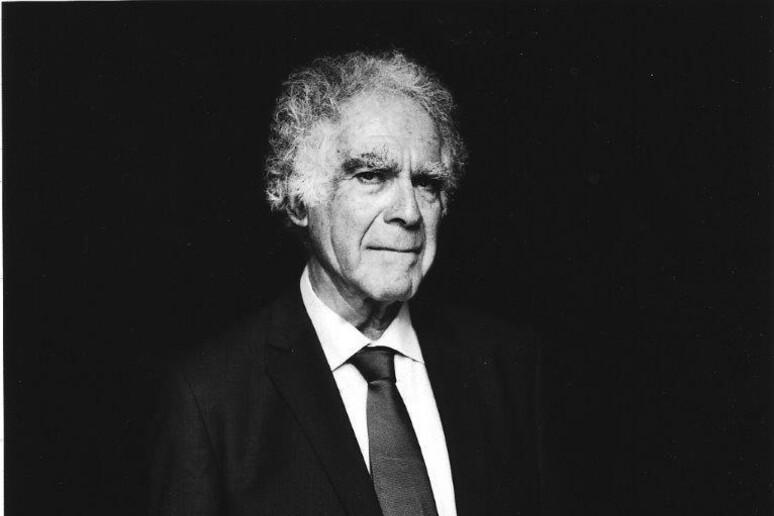
Carlo Ginzburgthe great Italian historian who closed his eyes in Bologna this morning at the age of 87, was one of those rare figures capable of teaching human disciplines how to breathe. Not just to colleagues inside the universities, Harvard, Yale, Princeton, the Normale of Pisa where it all beganbut to anyone who has wanted to learn how to look at history when you are not in a hurry to reach conclusions, when you learn to walk among the shadows of documents with the patience of someone who knows that right there, in the margins, in the silences, in the unexpected voices, lies the deepest truth.
Era born in Turin in 1939 from a family that had the non-conformism of reason and conscience in its blood: son of Leone Ginzburg, anti-fascist intellectual who had paid for his moral integrity with his life, and of Natalia Ginzburg, a writer who knew how to describe the daily lives of ordinary people with heartbreaking clarity. Heavy legacy, that of seeking the truth where others do not dare to look. A legacy that Carlo never betrayed.
He was twenty-six years old when, in the library of the Scuola Normale of Pisa, he made a decision that would change the course of European historiography. Three resolute resolutions: learn the historian’s craft, study the witchcraft trials, but not the persecution itself, rather the victims. This is the founding gesture of his work: the choice to listen not to those who condemn, but to those who are condemned. To read between the lines of the inquisitors the voice of peasants who did not want to be burned for heresy, of healers who practiced fertility rites, of people whose knowledge had been crushed by the machine of theological certainty.
In 1966 he published the first book, “The benandanti“. A title that already contained the secret: that Friulian word indicated men and women who said they fought at night for the fertility of the fields, who the inquisitors wanted to transform into Sabbath sorcerers. Ginzburg understood that those were not lies. They were survivals of an ancient land cult, distorted by the judges through a theological lens. He had invented a method: to read the trials of the Inquisition not as sources on witchcraft, but as involuntary testimonies of buried cultural worlds.
Ten years later came “The Cheese and the Worms”, a masterpiece that told the story the life of Menocchio, a sixteenth-century Friulian miller tried for having heretical ideas about how the world was born. The cheese that forms from milk when worms become angels. Ginzburg understood that this was not delirium: it was popular, synthetic, metaphorical knowledge that attempted to give meaning to the mystery. And in doing so, he tried to listen through the violence of the words recorded by the inquisitors to the true cadence of a mind that reasoned differently, but reasoned.
This was Ginzburg’s gift: the capacity for patience, for waiting for the dead to speak. Not from referee external, but as a historian who knows he is part of the history he studies, that is, who understands that every attempt to understand the past is also a conversation between his own era and a distant one. He had written: “We know that reality is opaque; but there are moments in which, for one reason or another, a glimpse briefly illuminates it.” He was looking for these glimpses. In the Seventies he founded, with Giovanni Levi, the Einaudi “Microstorie” series: an entire school of thought that would guide European historical research for decades. Microhistory was not a renunciation of greatness, as some superficially thought. It was the opposite: starting from the small, from the singular, from the marginal, the very structures of power, the contradictions of societies, the functioning of repression were illuminated. It was a radically democratic method.
In 1991 he published “The judge and the historian”, where he compared his job, understanding the past, with the judge’s job, ascertaining the present. Not to confuse the genres, but to show how both have to deal with the problem of distance, of perspective, of the temptation to crush the facts into a single explanation. He did it reasoning on an Italian case, the trial for the assassination of Commissioner Calabresi, where the documents contradicted the suspicions, where the truth escaped those who wanted to capture it too quickly.
In recent years, while others slowed down, Ginzburg continued to write, to think, to intervene on current issues with that same ability to look from the margins. He understood that the microhistory method was not just a research technique. It was a way of being in the world. An ability to actively listen to those who are different, to those who don’t speak your conceptual language, to those who want to say something that you hadn’t foreseen. He explained it like this, in a 2023 interview: “We must reformulate our hypotheses based on physiognomic traits, expressions, voice intonations, to try to understand what they are really telling us“.
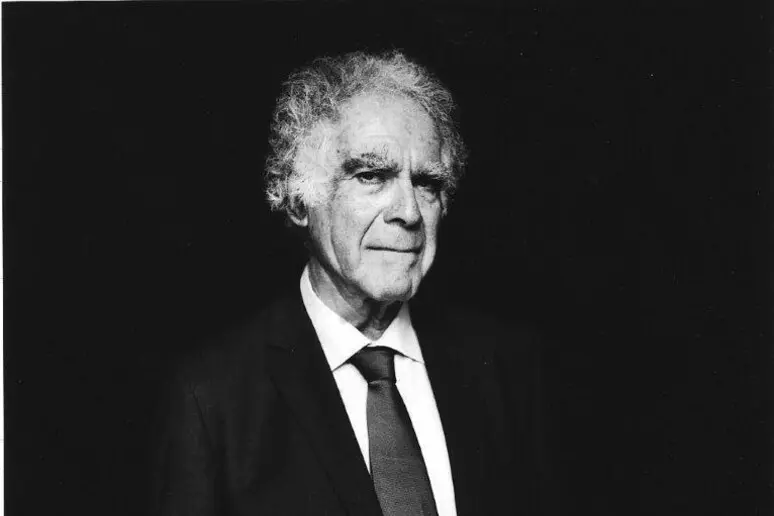
It was this teaching, practical, humble, radically human, that made him unique. Not a teacher who explains, but a colleague who shows how to listen. An intellectual who, with the simplicity of the greats, understood that history is conversation, research is dialogue, knowledge is an act of love towards others.
In an era that forgets quickly, that consumes stories and throws them away, that is in a hurry to reach conclusions, Carlo Ginzburg leaves us his most important teaching: learn to wait, learn to look in the margins, learn to feel the breath of those who don’t listen to your time. This is what he taught historians. This is what he teaches us all.