





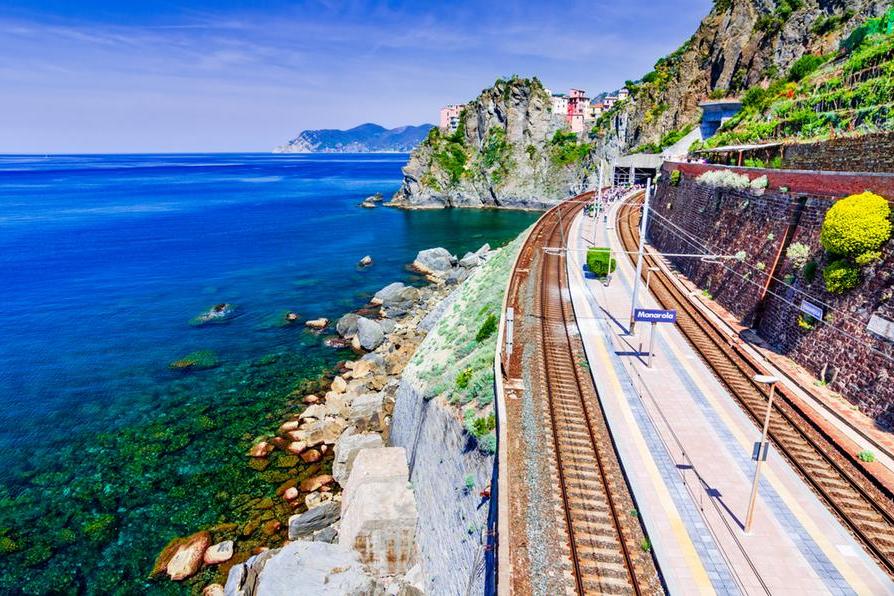
«In flashes, in segments, in lightning-fast and dazzling fragments». The Nobel Prize-winning poet Eugenio Montale, who spent his childhood in Monterossohad thus fixed and described the five seaside villages, overlooking the Ligurian Sea, and so even today they can be seen from the window of the Cinque Terre Express: not a continuous landscape, but a sequence of apparitions between one tunnel and another. In fact, the railway runs for long stretches in a tunnel, dug into the rock between the sea and the mountains. Then, suddenly, a gash opens up: a stretch of coast, terraced vineyards, pastel-colored houses clinging to the stone.
From the traveler’s point of view, in addition to the tunnels, the glimpses are very quick and short. The five fascinating stations, with a slightly retro flavour, are the most exposed to the light, colors and blue of the sky and sea. And it is precisely this broken rhythm that defines the journey: the wait, then the revelation. Every exit from the gallery is like the sudden opening of a painting.
From La Spezia station (some routes reach the neighboring Levanto) the train enters the heart of the Cinque Terre following a precise sequence: Riomaggiore, Manarola, Corniglia, Vernazza, Monterosso to the sea. Five names that have become a unique image of Italy by the sea, also recognized as a UNESCO World Heritage Site. The line extends for approximately 20 kilometers along the coast. A short stretch but full of emotions. Travel times between one stop and another are just a few minutes. A fast pace that makes the villages very close and at the same time separated by a steep and vertical geography.
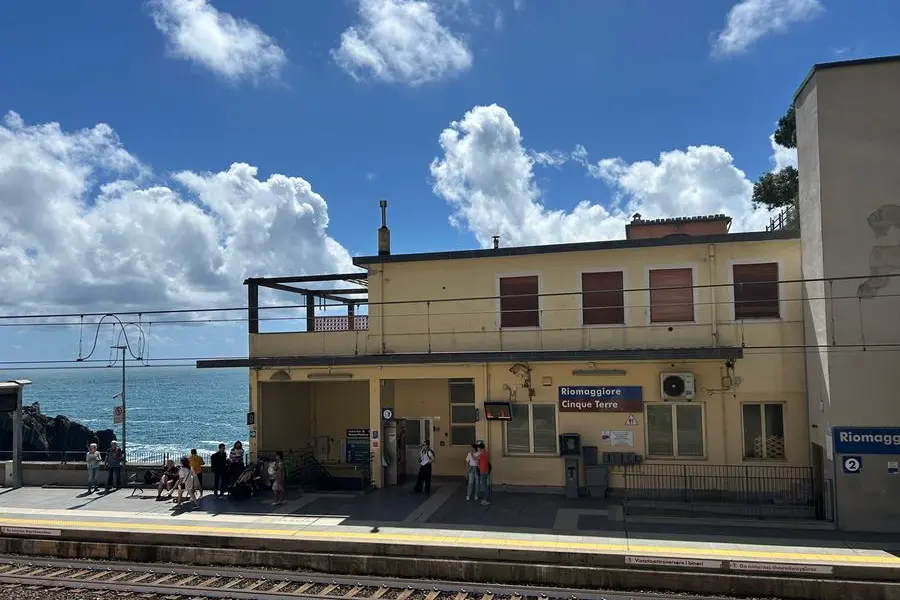
The station of Riomaggiore (La Spezia) overlooking the sea.
There is a detail that becomes useful travel advice: those who decide to leave from La Spezia and go towards Monterosso find themselves with the left window on the sea side, so they have the opportunity to enjoy the views better. Choosing the direction means choosing the gaze with which to live this experience.
On the train the landscape mixes with the people. We hear a continuous shouting, a tangle of overlapping languages: English, French, German, Spanish. It is the most obvious sign of the incredible fame of this short strip of land abroad. A railway compressed between the sea and the mountains, where every slowdown is immediately reflected in the chain of connections. It is a very busy line, especially from spring onwards. The difficulty, in Liguria, is the conformation: you proceed more slowly because it is very tortuous. But the real focus for staff is flow management. In certain periods of heavy traffic it is necessary to maintain punctuality, always respecting safety.
The great popularity has changed the rhythm of the villages and made necessary an increasingly delicate balance between hospitality and protection. However, the Cinque Terre were born long before contemporary tourism. The railway line between Sestri Levante and La Spezia was activated on 22 July 1874 and completed the connection between Genoa and Pisa. It was a complex work: the coast imposed a tortuous route, squeezed between the sea and the mountains. For this, 51 tunnels were necessary, covering over 28 kilometers out of 44 in total, and 23 bridges. An engineering feat that removed these villages from isolation. Today that same railway is still the best way to cross them.
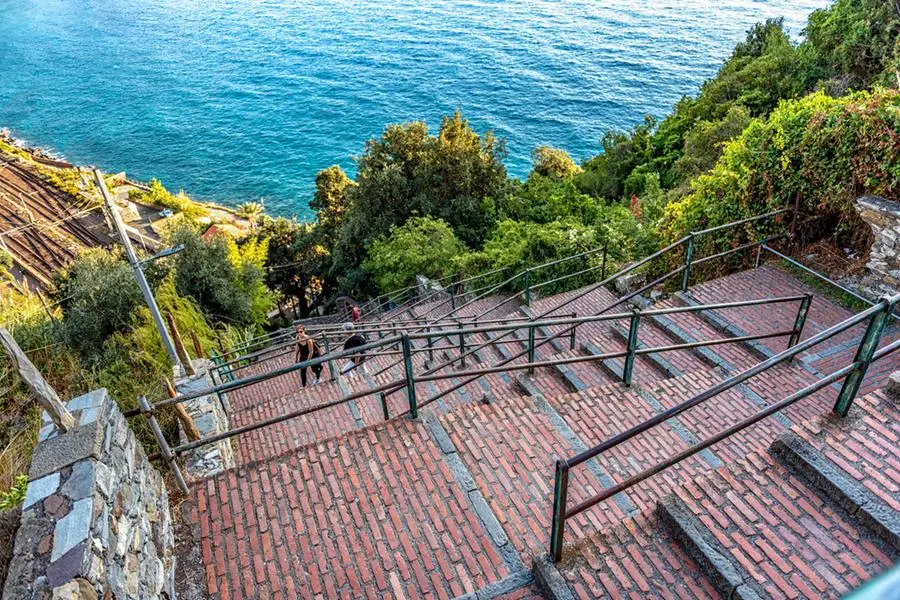
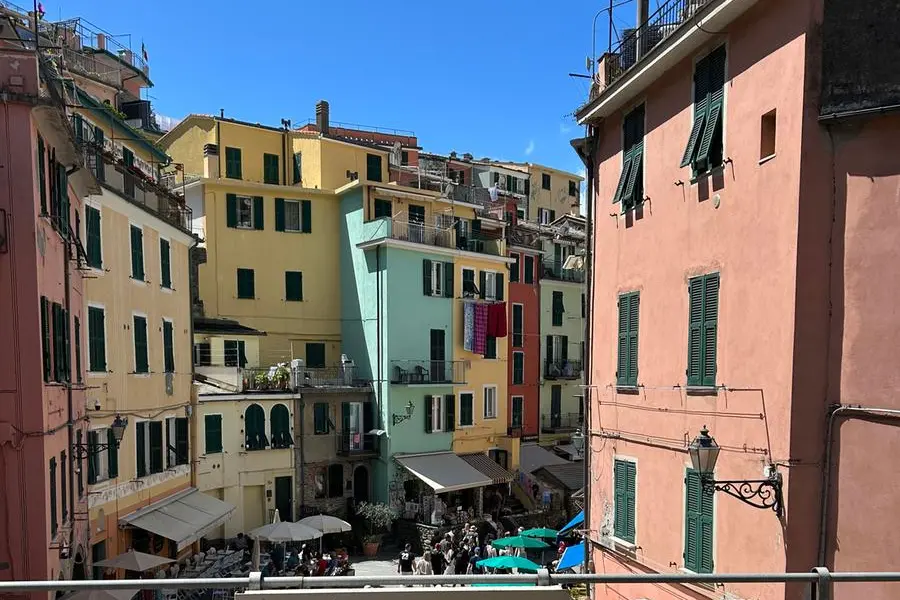
The stations are the real windows of the journey. From La Spezia you first encounter Riomaggiore, where the train journey can also stop momentarily to continue on foot along one of the most famous stretches to do, the Via dell’amore (for which a pass and reservation are required), about 1 km carved into the rock which connects Riomaggiore to Manarola and is managed by Cinque Terre National Park, the body that accompanies the fragile balance between nature and human presence, between protection and access, between paths and railways, all in a vertical territory, built over time, where every movement is always also a descent or an ascent. Once in Manarola, here is perhaps the most photographed view of the coast. Manarola and Vernazza have a particular, more scenic look: they almost seem like a mix between a painting and a film shot. Corniglia follows, the only village not directly on the sea, suspended on a promontory and reachable by a long staircase (the Landarina) or by a bus waiting outside the station. Then Vernazza, with its small natural port nestled between the houses. Finally Monterosso, where the coast opens up, the landscape relaxes and the rocks give way to the beaches.
Between one stop and another, on the way back along the same route, the train resumes its rhythm: tunnel, light, sea, tunnel. And every time the landscape seems new.