




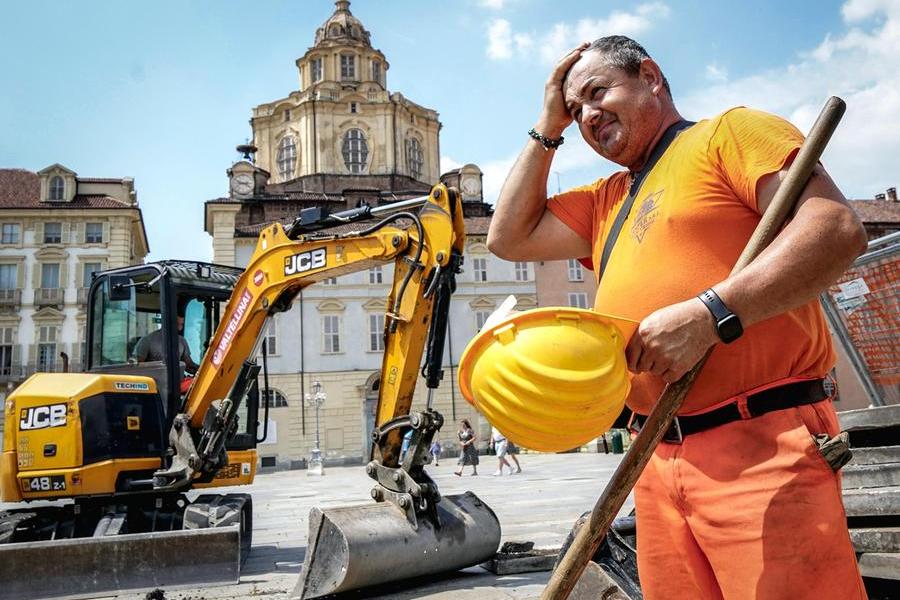
Now that summer has become a season to defend ourselves from, it is useful to reflect on who should protect us. Because the heat wave that has suffocated Europe (meteorologists say that the waves of the “general summer” will soon return to torment us) is a political matter, unless we consider politics not as a service to the common good but a simple matter of power. The WHO says that the heat has so far caused 1,300 deaths, but if we go by the estimates ofEconomist we arrive at 12 thousand, all probably low figures. The main victims are children, heart patients and above all the elderly, fragile people who should be taken care of by the civic community.
We have to get used to “fists in the air”
Yet these days politics – at least at a high level – are pretending nothing has happened, as if it were an unforeseeable fatality, starting with the leaders of Brussels and Strasbourg, who are more committed to cracking down on immigration. We worry about sending back those who arrive and much less about the reasons that push them to leave, such as desertification and drought that destroy crops.
Despite climate change, we persist in not seriously considering the reduction of carbon dioxide and other greenhouse gases, using fewer coal plants, less oil and gas, producing more energy from low-emission sources, improving the energy efficiency of buildings, industry and transport, stopping deforestation and strengthening renewable energy. All long-term measures that do not produce consensus in the next elections. So why implement them? The heat doesn’t vote.
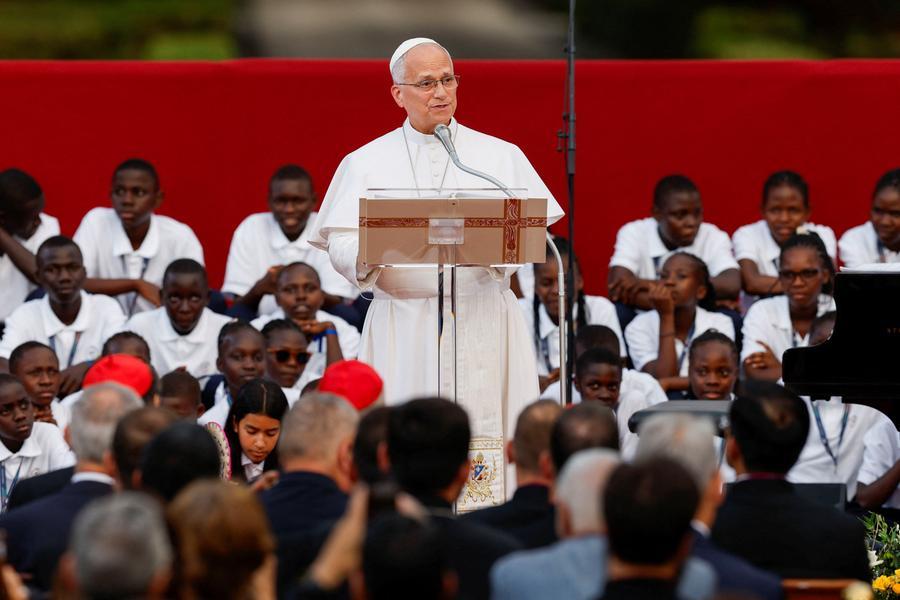
The warming of the Earth also affects the territories of the Third and Fourth World, with the destruction of crops and the desperation of campesinos, minifundistas and small landowners, who have no choice but to emigrate to Fortress Europe. Yet the care of creation is a necessary imperative precisely for the salvation of humanity, as prescribed by “integral ecology”, or at the service of man, enunciated in Pope Francis’ Laudato Sì and in the speeches of his successor Leo XIV.
But these are long-term policies (and politics – starting with Brussels – often has shortness of breath). There are more stringent measures that should be taken such as the launch of a plan against heat waves. What is happening in France, where in less than 10 days there have been tens of thousands of deaths and 74 victims of drowning, as well as three children who died in cars, is emblematic. Schools closed, hospitals overcrowded, empty shelves in supermarkets, air conditioners and fans sold like hot cakes. From prevention we have moved on to emergency in a country which is in a state of “health shock” and which according to all the mass media “has not been up to the task and politics is dramatically absent”, as he wrote Le Mondewhich reports the findings of a parliamentary commission of inquiry. Faced with all this, President Macron preferred to pretend nothing had happened, classifying this sort of drip as an “unforeseeable event”. Yet Paris had a health emergency plan after 2003, when the “canicule” caused 15 thousand deaths, of which 72 percent were over the age of 70. But from a climate point of view, 2003 is equivalent to a distant era, since our ecosystems were designed “for a climate that no longer exists”, as the climate scientist Valérie Masson-Delmotte declared.
In Italy we proceed in no particular order, and therefore disorganized and ineffective, where we can: swimming pools open to over 65s, mega nebulizers fired into the crowd by civil protection, free entrance to museums, health facilities, emergency rooms, open libraries, climate shelters, parks and gardens open all day, distribution of bottles of water. In short, we make do as we can. Management of the emergency is entrusted to local administrators, while at government level not a leaf is moved, nothing is pretended, not even a laconic declaration of solidarity.
We must also consider that the heat does not only claim victims, but also measures inequalities. Not everyone can afford air conditioning, or a month’s “holiday” at the seaside or in the mountains, where the temperature is milder. We often talk about the phenomenon of cooling poors.
These days the oral exams for the final exam are taking place: those who have not been able to study or revise in the cool are certainly more disadvantaged at the start than those who have been able to do so in an air-conditioned environment. There is a climate injustice that governments should make up for instead of shouting about inevitability. And instead we wait for the air to cool down and a nice summer storm to arrive to wash away every memory of this dripping. It’s not the weather that’s unpredictable. It’s our stubbornness in not wanting to learn anything.