





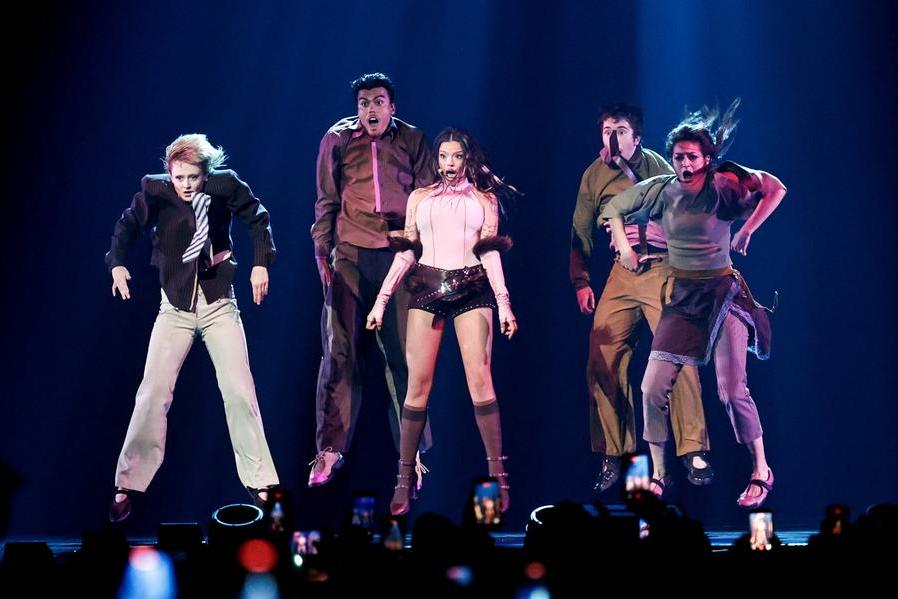
The Eurovision Song Contest 2026 ends with the hit Bangaranga, anthem to personal freedom, by Dara, the Bulgarian singer. Surprisingly and against previous predictions, Bulgaria took first place on the podium for the first time (it had obtained a second place in 2017 as its best result). Born in Varna in 1998, Dara (Darina Nikolaeva Jotova) is a highly regarded artist on her country’s pop scene, fusing different genres in her music. The singer conquered the event after a performance inside a mobile room, with a scenography that continuously rotated and changed perspective, conveying a sensation of chaos and destabilization. The title of his song, the word “Bangaranga”, comes from Jamaican and means “revolt”. As the artist herself explained on the evening of the final, before the verdict, this term «symbolises the discovery of the inner strength that each of us possesses. Act with love, not with fear.”
Italy had to settle for fifth place. But not bad for Sal Da Vinci, who with his Forever Yes is achieving unprecedented international success: with over 60 million streams on digital platforms it is becoming one of the Italian musical phenomena of the moment in Europe. Having taken the stage as the twenty-second singer, the Neapolitan artist, the oldest at the event at 57 years old, was visibly emotional. To support the Italian singer and strengthen the institutions’ support for music, the Minister of Tourism Gianmarco Mazzi had also arrived in Vienna.
Second place for Israel with Noam Bettan, born in 1998, an Israeli artist son of French emigrant parents, who sang about toxic and tormenting love in the song Michelle mixing Hebrew, English and French in the text. A qualification which also took place this year in a climate of political protests: for the third consecutive year the singing event was marked by requests to exclude Israel from the competition. Five countries expressed their dissent by boycotting the event and choosing not to show up. On the afternoon of the final, a Pro-Pal procession took place in the streets of Vienna with around 3 thousand participants.
The protests were also felt during the demonstration, with some boos being heard when Noam Bettan took to the stage for his performance and with an even stronger and more evident protest when the result of the televoting was announced which brought the Israeli to second place on the podium. On the other hand, Bettan also hasn’t given up on sending a political message, despite the event’s regulations expressly prohibiting it: at the end of his performance he shouted “Am Yisrael Chai!”, or “The people of Israel live”.
But, as we know, Eurovision is also, indisputably, political. And also the Ukrainian singer, Viktorija Leléka, on the stage of the final renewed her country’s slogan “Slava Ukraini”, glory to Ukraine.