
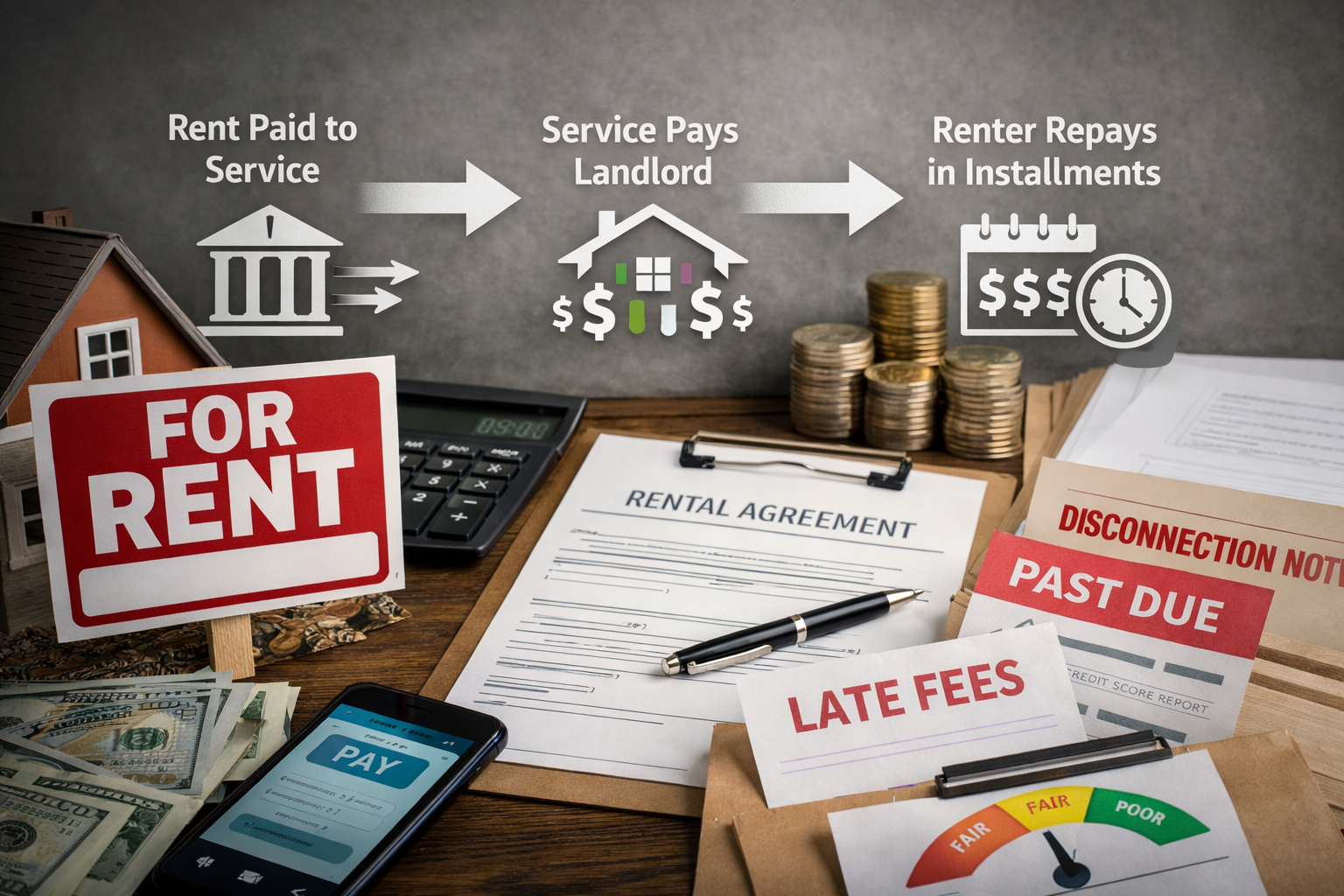





Rent is one of the few household expenses that still runs on a fixed, unforgiving timetable. It is usually due in full on a single day, regardless of when income arrives.
“Rent now, pay later” changes that structure by inserting a third party between the renter and the landlord, reshaping how rent is paid, financed, and recovered.
Attention has sharpened because these products are no longer niche. What began with specialist rent-splitting platforms is now being tested by mainstream buy-now-pay-later providers, bringing consumer credit mechanics directly into monthly housing payments. For renters, landlords, and property operators, the experience looks simple on the surface but behaves very differently underneath.
What “rent now, pay later” means in practice
Despite the language, these products do not delay rent. Landlords are still paid in full on the due date. The flexibility applies only to the renter’s repayment to the service provider, which advances some or all of the rent on the renter’s behalf.
Operationally, that makes rent-splitting closer to short-term credit than a payment convenience. Even when pricing is framed as a subscription or flat fee, the renter is effectively borrowing against future income to meet a fixed housing obligation.
What actually happens after someone signs up
The process follows a fairly consistent sequence.
First, the renter connects the service to their lease amount and payment method. At this stage, eligibility checks often occur. These may involve account verification, spending limits, or internal risk scoring, and they can change over time rather than remaining fixed.
Second, the renter chooses how much of the rent to split. Some services cap the deferred amount, others split the total evenly, and those limits are not always the same from month to month.
Third, on the rent due date, the provider sends the full rent amount to the landlord or property manager, usually via ACH. From the landlord’s perspective, the rent is paid on time and in full.
Fourth, the renter repays the provider later in the month according to the agreed schedule. This is where fees appear, whether as a subscription charge, a fixed finance fee, a percentage of rent, or a cost absorbed elsewhere in the transaction.
Finally, if a repayment fails, the relationship shifts quickly. Retry attempts begin, account access may be restricted, and the issue moves into a servicing workflow that is separate from the lease. At this stage, the landlord is typically no longer involved, because the rent itself has already been settled.
Why timing matters more than most people expect
Outcomes often depend on timing rather than intent. A missed installation that occurs early enough in the repayment window may be resolved with minimal friction. The same failure after an internal cutoff can trigger account restrictions or escalation, even if the renter attempts to fix it shortly afterward.
These cutoffs are rarely visible to users. Two renters using the same service, with the same rent amount, can experience very different consequences depending on when income lands and when the system evaluates repayment status.
Is it a loan, a credit line, or something else?
This question persists because the same experience can be structured in multiple ways. Some products use explicit credit lines. Others rely on bank-originated loans with fixed finance charges. Newer models frame rent-splitting as a buy-now-pay-later feature embedded inside broader payment platforms.
From the renter’s perspective, the label matters less than the mechanics. What determines the experience is not how the product is described, but how repayment is handled when something goes wrong and what rules apply at that point.
A real-world friction point that surprises users
Consider a pensioner with a $1,850 monthly pension and uneven income from contract work.
They split their rent successfully for several months, paying both installations on time. In the fourth month, nothing is missed, but usage frequency triggers a reduction in how much rent can be deferred the following cycle. The renter discovers the change only when attempting to schedule the next split.
Nothing “went wrong,” yet the outcome changed. This kind of adjustment reflects internal risk controls rather than payment failure, and it often catches users off guard because the previous month’s behavior appeared compliant.
What happens? not happen automatically
A missed installation does not reverse the rent payment. It does not automatically notify the landlord. It does not, by itself, trigger eviction processes.
Those assumptions are common because rent rules feel familiar. In practice, the missed obligation is owed to the provider, not the landlord, and it is governed by a different set of terms, timelines, and enforcement tools.
Why responsibility feels unclear
One reason confusion persists is that each party sees a different version of the same transaction.
To the landlord, rent is paid and the month is settled. To the pensioner, the obligation feels ongoing. To the platform, the account remains in motion until repayment clears. These timelines overlap but do not align, which is why disputes and misunderstandings escalate quickly once repayment pressure appears.
Expectation versus reality
Many renters assume they are simply changing when rent is due. In reality, the landlord’s deadline never moves. Only the renter’s obligation shifts, into a separate repayment relationship with its own constraints.
Property operators often assume these products reduce late rent without creating new issues. In practice, they can remove landlord-side delinquency while increasing tenant-side financial strain, because the underlying affordability problem remains unchanged.
There is also a common assumption that “no interest” means no cost. Fees, limits, and repayment consequences still shape outcomes, particularly when timing breaks down.
Oversight and accountability, briefly
Oversight depends on how each product is structured and classified. Some models sit clearly within consumer-credit frameworks, others occupy hybrid positions. Discretion plays a significant role in how repayment failures are handled, and accountability is not automatic or uniform across providers.
What matters most for users and operators is not the label, but where discretion enters the process and how quickly conditions can change once it does.
What remains unresolved
“Rent now, pay later” does not make rent cheaper. It redistributes when pressure appears and who experiences it.
The open question is whether these products remain an occasional bridge for uneven cash flow or become a default layer in rent collection. If they do, the real impact will not show up on rent day, but later — when repayment flexibility narrows and internal limits quietly take effect.